Full disclosure: I don’t like Rick Perry for our next president. I have my reasons that aren’t worth going into here. However, when I was watching the GOP debate and pro-Perry people started bringing up Rick Perry’s job numbers as a cudgel against other candidates, I looked into the BLS data on Texas jobs. Having familiarized myself with the data, I started noticing claims on the Texas jobs data that started popping up that directly contradicted what I was seeing in the data. So I wanted to clear up a couple of these common misconceptions.
Note: If you are going to comment and you want to introduce some new objection to the Texas job numbers, you MUST provide original data. I spent about 4 hours digging through raw data to write this post. I don’t want you to point to some pundit or blog post and take it on their authority, because I’ve already researched several idiot pundits who are talking directly out of their asses when it comes to the data. I want you to point to the raw data that I can examine for myself. This means links. I refuse to waste any more of my time on speculative bullshit or “Well, I’ll wager that the Texas jobs don’t really count because…” If you’re willing to wager, take that money and put it towards finding the actual data. In short, put up or shut up.
I’m not cranky, I swear.
Anyway, let’s deal with the complaints in no particular order:
“Texas has an unemployment rate of 8.2%. That’s hardly exceptional.”
See… that’s what I thought when I started looking at the data. I knew that Utah had a lower unemployment rate than Texas and I kept hearing that Texas was go great at jobs, blah, blah, blah, so I looked up the unemployment rate.
Nothing special.
So I was going to drive my point home that Texas was nothing special by looking at their raw employment numbers and reporting on those. That’s when I saw this:
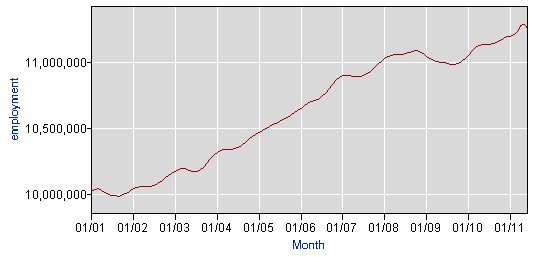
This may not look like anything special, but I’ve been looking closely at employment data for a couple years now and I’ve become very accustomed to seeing data that looks like this.
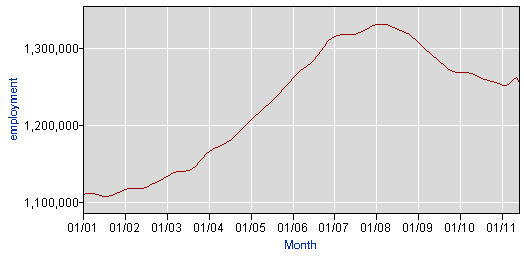
In a “normal” employment data set, we can easily look at it and say “Yep, that’s where the recession happened. Sucks to be us.” But not with Texas. With Texas, we say “Damn. Looks like they’ve recovered already.”
(To get to this data, go to this link http://data.bls.gov/cgi-bin/dsrv?la then select the state or states you want, the select “Statewide”, then select the states again, then select the metrics you want to see.)
But if Texas has so many jobs, why do they have such a high unemployment rate? Let’s take a closer look at that data.
As a percentage of the number of pre-recession jobs, here is a chart of the growth of a selection of states. (For clarity, in this chart I selected a number of the largest states and tried to focus on states that have relatively good economic reputations. I did not chart all 50 states b/c it would have taken me too long.)
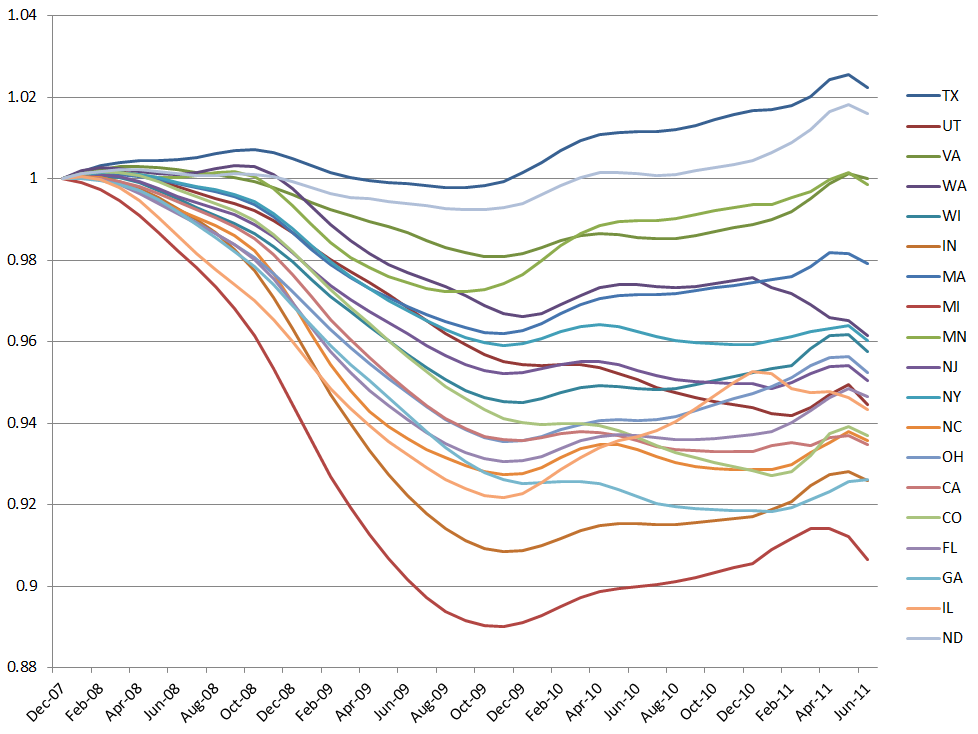
We can see that Texas has grown the fastest, having increased jobs by 2.2% since the recession started. I want to take a moment and point out that second place is held by North Dakota. I added North Dakota to my list of states to show something very important. North Dakota currently has the lowest unemployment rate of any state at 3.2%. And yet Texas is adding jobs at a faster rate than North Dakota. How can this be?
The reason is that people are flocking to Texas in massive numbers. Starting at the beginning of the recession (December 2007), let’s look at how this set of states have grown in their labor force.
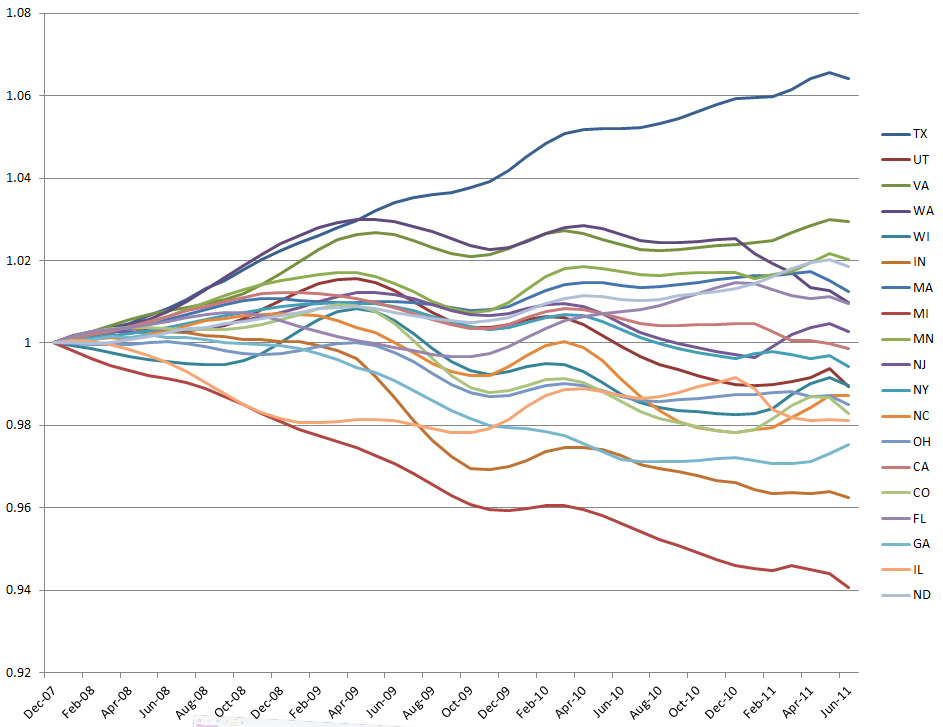
As you can see, Texas isn’t just the fastest growing… it’s growing over twice as fast as the second fastest state and three times as fast as the third. Given that Texas is (to borrow a technical term) f***ing huge, this growth is incredible.
People are flocking to Texas in massive numbers. This is speculative, but it *seems* that people are moving to Texas looking for jobs rather than moving to Texas for a job they already have lined up. This would explain why Texas is adding jobs faster than any other state but still has a relatively high unemployment rate.
“Sure, Texas has lots of jobs, but they’re mostly low-paying/minimum wage jobs”
Let’s look at the data. Here’s a link: Occupational Employment and Wage Estimates
Texas median hourly wage is $15.14… almost exactly in the middle of the pack (28th out of 51 regions). Given that they’ve seen exceptional job growth (and these other states have not) this does not seem exceptionally low.
But the implication here is that the new jobs in Texas, the jobs that Texas seems to stand alone in creating at such a remarkable pace, are low paying jobs and don’t really count.
If this were true, all these new low-paying jobs should be dragging down the wages data, right? But if we look at the wages data since the beginning of the recession (click to enlarge, states are listed alphabetically)
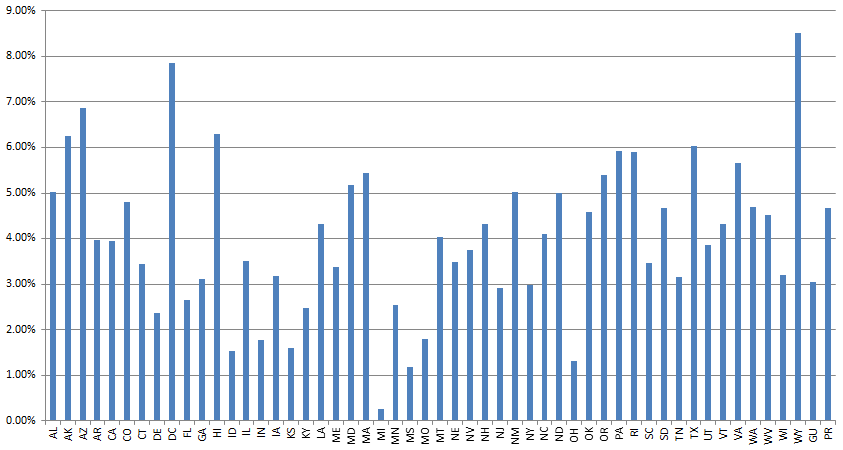
And it turns out that the opposite is true. Since the recession started hourly wages in Texas have increased at a 6th fastest pace in the nation.
As a side note, the only blue state that has faster growing wages is Hawaii. Just thought I’d get that jab in since so many people have been making snarky “Yeah, I could get a job in Texas is I wanted to flip burgers!” comments at me on Twitter.
“Texas is oil country and the recent energy boom is responsible for the incredible jobs increase.”
In identifying “energy jobs” I cast as wide a net as possible. If you want to replicate my findings, go to this link: http://www.bls.gov/sae/data.htm, click on “One-Screen Data Search”, then select “Texas”, then select “Statewide”, then in Supersectors select “Mining and Logging”, “Non-Durable Goods” and “Transportation and Utilities” and then in Industries select “Mining and Logging”, “Natural Gas Distribution”, “Electric Power Generation” and “Petroleum and Coal Products Manufacturing”.
Tedious, I know, but transparency is important and this is how you get the data.
When we finally get the data, we discover that energy isn’t really the biggest part of the Texas economy. Increases in jobs in the energy sector (or closely related to it) account for about 25% of the job increases in the last year. Since the energy sector only makes up 3% of all employment, there is some truth to this claim.
However, take the energy sector completely out of the equation and Texas is still growing faster than any other state. This indicates to us that the energy sector is not a single sector saving Texas from the same economic fate as the rest of the states. It’s not hurting, but Texas would still be growing like a weed without it.
“Texas has 100,000 unsustainable public sector jobs that inflate the growth numbers.”
I’m not sure where this one comes from, but the numbers are these (and can be found by selecting government employment from the data wizard at this link http://www.bls.gov/sae/data.htm):
Counting from the beginning of the recession (December 2007) the Texas public sector has grown 3.8%, or a little under 70,000 employees. This is faster than normal employment, but it’s not off the charts.
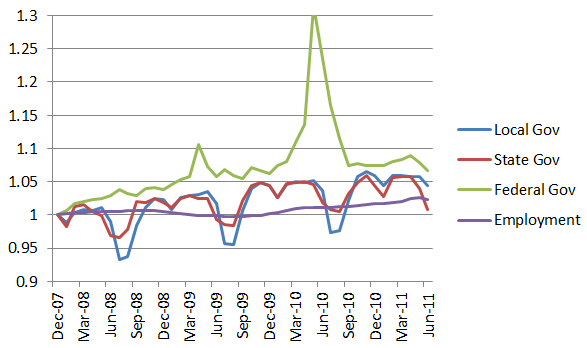
Given that the Texas economy has grown so much and private sector jobs have grown so much, that doesn’t strike me as an unsustainable growth in the public sector.
But, just in case you’re really worried about it, you can lay your fears to rest because in the last year the Texas public sector has shrunk by 26,000 jobs. In the last 12 months, Texas lost 31,300 federal employees, trimmed 3,800 state jobs, and increased local government jobs by 8,400 jobs.
(To be fair, this was partially driven by the role Texas employees played in the census, which inflated federal job numbers this time last year. Since the census numbers stabilized, federal employment has been at about break-even.)
As you can see, we’re nowhere near the “100,000 unsustainable jobs” number.
My Personal Favorite Chart
I’ll leave you with my personal favorite chart. I mentioned at the beginning that Texas is seeing high unemployment in a large part because they’re growing so damn fast. The problem with this from a charts and graphs perspective is that it leaves worse states off the hook, making them look better than they actually are. Looking at unemployment alone, we would conclude that Wisconsin has a better economy than Texas. But Wisconsin is still 120K short of it’s pre-recession numbers. The only reason they look better than Texas is because 32,000 people fled the state.
During that time, 739,000 people fled into Texas. Anyone who takes that data and pretends that this is somehow bad news for Texas is simply not being honest. At the worst, I’d call it a good problem to have.
So, to give something of a better feeling for the economic situation across states, this chart takes the population of the states I selected above and judges the current job situation against the population as it stood at the beginning of the recession.
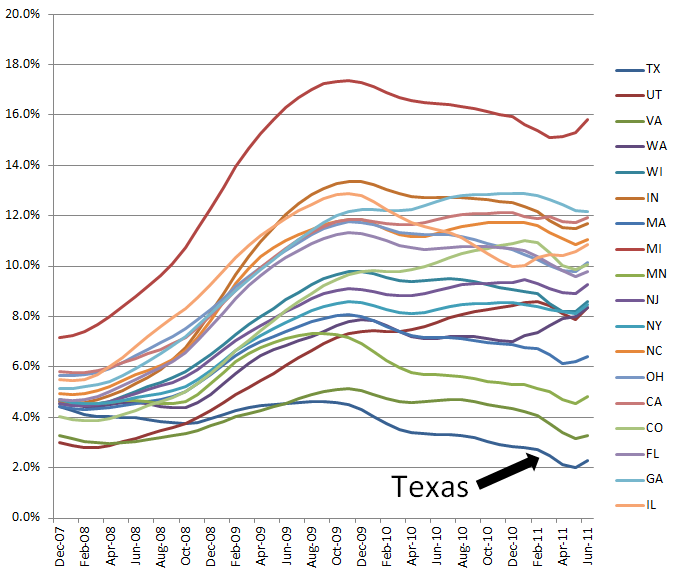
Using that metric, Texas would have a very low unemployment rate of 2.3%. But the fact that unemployment in the United States is fluid means that the unemployed flock to a place where there are jobs, which inflates its unemployment rate (at least in the short term). It’s not a bad thing for Texas… it just looks bad when dealing with the isolated “unemployment %” statistic.
UPDATE: @francisgagnon on Twitter felt that this chart was dishonest because it charts Texas as having 2.3% unemployment and (in his words so I don’t get him wrong): “It assumes immigrants create no jobs. But more people = more consumers = more jobs.”
He is absolutely right about this. I tried to be clear above that this chart doesn’t account for the fluid nature of an economy with immigration and departures of hundreds of thousands of people, but I don’t want to leave anyone with the wrong impression. So here it is: This chart doesn’t account for the fluid nature of an economy with immigrations and departures of hundreds of thousands of people. The point of this chart is not to say “Texas should have 2.3% unemployment if only things were fair.” Instead, it is an attempt to chart job growth in such a way that controls for people leaving one job market to enter another. To say “Wisconsin has a better job market than Texas because its unemployment rate is 0.6% lower” is a wholly untrue statement even though it cites accurate numbers. What this chart is meant to do is not posit a counter-factual, but to give a visual representation of the employment reality that is obscured by the way we calculate unemployment numbers.
END UPDATE
And… that’s it.
You may have noticed that I don’t mention Rick Perry very much here. That is because Rick Perry is, in my opinion, ancillary to this entire discussion. He was governor while these these numbers happened, so good for him. Maybe that means these jobs they are his “fault”. Maybe the job situation is the result of his policies. Or maybe Texas is simply the least bad option in a search for a favorable economic climate.
That is not an argument I’m having at this exact moment. My point is to show that most of the “excuses” you will hear about Texas’ job statistics are based in nothing more than a hope that Rick Perry had nothing to do with them and not on a sound understanding of the data.
My advice to anti-Perry advocates is this: Give up talking about Texas jobs. Texas is an incredible outlier among the states when it comes to jobs. Not only are they creating them, they’re creating ones with higher wages.
One can argue that Perry had very little to do with the job situation in Texas, but such a person should be probably prepare themselves for the consequences of that line of reasoning. If Rick Perry had nothing to do with creating jobs in Texas, than why does Obama have something to do with creating jobs anywhere? And why would someone advocate any sort of “job creating” policies if policies don’t seem to matter when it comes to the decade long governor of Texas? In short, it seems to me that this line of reasoning, in addition to sounding desperate and partisan, hogties its adherents into a position where they are simultaneously saying that government doesn’t create jobs while arguing for a set of policies where government will create jobs.
Or, to an uncharitable eye, it seem they are saying “Policies create jobs when they are policies I like. They don’t create jobs when they are policies I dislike.”
People will continue to argue about the data. But hopefully this will be helpful in sorting out reality from wishful and desperate thinking. I mentioned on Twitter that the Texas jobs situation was nothing short of miraculous. This is why I said that and why I’m standing by that statement.
It can be said that Governor Perry has a very small role in the unemployment rates, etc. of Texas because, frankly, the governor of Texas has very little power, and it has been so for the past century or so. After Governor Davis abused power in the 1800’s, the Texan people gave most of the power (according to the Texas Constitution) to the Lieutenant Governor – the Governor is just a figurehead. You said, “One can argue that Perry had very little to do with the job situation in Texas, but such a person should be probably prepare themselves for the consequences of that line of reasoning. If Rick Perry had nothing to do with creating jobs in Texas, than why does Obama have something to do with creating jobs anywhere?” – Obama has more power as the head of the US than Rick Perry does as the head of TX (specifically, Obama carries more policy-making power over his constituents – the US – than Rick Perry does over his constituents – the state of Texas).
@Alex 1.6 million illegal immigrants would probably skew your states’ ranking too.
Another factor in the Texas situation which i have seen some analysts mention is its high minority population. Given that minorities usually have a higher rate of unemployment than whites, it is remarkable that that factor does not push down the numbers.
I do believe having a core business concentration like energy which is doing well influences then entire economy. When crude prices were $8 in the ’80s, things weren’t so good here even though the tax and regulation environment were about the same.
Perry has been a good governor, though not an exceptional one. I have my doubts whether he is presidential timber, as they say. But to his undying credit, he successfully resisted enormous pressures this past legislative session, from all the major newspapers and government employees groups, to raise taxes to cover a budget shortfall. Instead it was accomplished with budget cuts and I believe we will prosper because of it.
Thought I would throw this out there as well. This guy has done a good job dissecting some of the stories/myths currently going around the mediasphere at the moment.
http://peskytruth.wordpress.com/2011/07/19/rick-perrys-negatives/
Pretty impressive analysis. Given the economic state of this country, it behooves us to analyze what Texas is doing to create jobs that is not being done in the other states. To those who say that the “Obama stimulus” created these jobs, the obvious question would be why did Texas create jobs where other states did not. I don’t know all of the answers, but I know several businessmen who have moved their companies from California (where I live) to Texas. The reason? Lower taxes.
Sanalbar, if they could be on the border of Mexico, they could…just wait…they’ll find their way to a state near you. and…..GOD BLESS TEXAS
Oklahoma 5.3%
New Mexico 6.8%
Louisiana 6.8%
1,000,000 gov’t killed by Congress since 2009.
After checking this out again….I was wondering how you make it through a whole article on post-recession job growth and don’t even use the word “stimulus”?
After noting that Texas largely missed out on the housing bubble bursting, doesn’t it make sense that the resulting stimulus, which went to everyone, had a more powerful effect on an economy that wasn’t already reeling?
wait a sec here- the BLS data on median wages here is only for the job, not the actual distribution of jobs. The actual median wage EARNED is $11.20, below the national average (http://www.bls.gov/ro6/fax/minwage_tx.htm#_ftnref3). More importantly, the earned wage has been going down – not the trend in the rest of the country
wait a sec here- the BLS data on median wages here is only for the job itself, not the actual distribution of jobs. The actual median wage EARNED is $11.20, below the national average (http://www.bls.gov/ro6/fax/minwage_tx.htm#_ftnref3). More importantly, the earned wage has been going down – not the trend in the rest of the country
Problem number Three:
As discussed in my second post – the real Texas population growth story is driven by the growth of the Hispanic population with a 42% increase over the last decade (compared to only a 4% increase for the non-Hispanic White population over the whole decade). Now, Texas has the longest border of any state with Mexico – 1241 of the 1933 miles of land border – so you might expect the growth of the Hispanic population to be a bit larger there than in other states. But was it? No! Actually, the Hispanic population grew rapidly almost everywhere during the last decade and Texas ranks 42nd out of the 50 states in the percentage increase (see http://pewhispanic.org/files/reports/140.pdf).
Again, attributing the population growth to different economic policies in the different states is speculative at best.
Nice analysis overall but I think you’re vastly underestimating the impact of engergy on job growth in TX. For starters, you would also want to at least include the industries – 1. oil and gas extraction and 2. Support activities for mining. I took a quick look at annual data with your categories plus those categories and the job growth ’10 / ’09 was about 43%. (I assume you were dividing by growth in non farm payroll.)
It doesn’t make a lot of sense to include manufacturing of petroleum products because higher commodity prices in the face of a weak domestic economy would hurt employment at the margin and capacity is essentially fixed.
I would say that whatever the raw BLS data tells you underestimates the impact of energy for a couple of other reasons. 1. The upstream part of the business has experienced tremendous productivity improvements through technology over the last 10 – 15 years – improved seismic imaging, horizontal drilling, frac’ing, etc. I don’t think the categories either of us selected sufficiently capture the R&D, and possibly the equipment manufacturing associated with upstream capital expenditures. 2. Employment in the upstream part of the business is not derivative of any other sector outside of energy. People don’t go to Texas to drill for oil and gas for the BBQ. BBQ restaurants, hotels, services, investment bankers, lawyers, etc. follow the core employment drivers.
There’s really no good way to measure the investment capital in the state due high commodity prices but I’d bet my house that it accounts for more jobs than one can reasonably estimate with BLS data.
I don’t say this as a knock on Perry because I think any Republican candidate can reasonably say that we need an energy policy more accommodating to job creation and relieving the pressures high gas prices put on consumers.
sorry folks if you think about it ….Texas has added close to …well I suspect a good deal more than 3,000,000 people over the last decade ….how do I reach that conclusion …easy ….Texas is adding 4 congressional seats and I believe each congressional seat represents 700,000 people
My opinion is that jobs is the foremost topic on the minds of the voter this time around. Texas is a rare gem as far as employment is goes because of the energy boom. One hundred new jobs in energy will create jobs in some other sector. Just look at North Dakota. Dumb luck. Right place at the right time. Cowboys will say “they would rather have a thimble of luck than a bucket full of skill”. As long as Texas energy jobs and energy companies grow in Texas they will continue to thrive. But, as soon as energy supply sours they’ll be like so many other less fortunate states are now. It won’t be Perry’s fault.
Question is…can Rick Perry bring us out of this recession? Is low corporate taxes, less regulation and free trade the answer? What’s good for you may not bee good for me.
The real question is what Perry can accomplish in D.C. He will be stepping into a situation vastly different than the one he stepped into in Texas – peak commodity prices, business friendly policy, being in a state where people were already beginning to relocate from cold weather states, and being the closest viable state to the disaster that has been California / Arizona.
Inheriting a business friendly regime in Texas is a much different job than reforming entitlement spending, getting tax and trade policy through congress, etc. I honestly don’t know enough about him to say but I haven’t heard any of his supporters make the case for it in simply saying jobs grew under his tenure as governor.
Would you mind an update integrating this data? It indicates that Texas is tied with Misssissippi for highest percentage of min wage workers, and that the median wage is $11.20, as pointed out above.
http://www.bls.gov/ro6/fax/minwage_tx.htm
I was waiting for the other shoe to drop and everything to come crashing down around Gov. Perry.
The best analysis I’ve seen anywhere. Thank you.
As for sending him to Washington….., how has the last 2 years been working for ya?
JT,
Hope you’re not responding to my post because I’m not an Obama fan. If you were, have a look at my first post about 5 or 6 up from yours.
Remember, Texas government has been spending way more than it takes in – running a deficit!!! – thereby stimulating the economy, perhaps creating jobs.
Nice work, looks like it took some time. Being a military guy, i am a strong believer in the commander is responsible for everything the unit does or fails to do. I think the concept of the US (in its founding) is that if the government stays out of the way the people will drive prosperity. Taken at any given snapshot in time you can point out flaws with capitalism, but if you look at it in the long run the prosperity is astounding. So if all Perry did was continue successful policies or not institute harmful ones, that is what i want my president and government to do. I am willing to succeed or fail on my own wits and talent. As an American I bow to no man, and pledge fealty to none, but my country, my community, and my family.
AFMom hit it out of the park.. She also has very good information that this person cannot refute. I’m sure a lot of people are hurting and would take one of those “minimum wage” jobs. And she’s correct, if you happen to get blessed and make $250,001, here would come this tyrannical government and say ‘time to pay the piper’ (AKA Government).
Puh-leeze! Perry has made it possible for Texas to be better off than most of the country. Criticize him for that shall YOU? Yes you shall.
Just saw on CNN Anderson Cooper citing a .5 % drop in private sector employment, with sizable increases in public sector employment for Texas. Have you seen this, and what would be your reaction?
The only thing missing from this excellent analysis is the fact that while wages might be solidly in the middle of the pack, Texas has no state income tax – making takehome pay on the order of 10% higher. Just another reason why Texas rocks.
Your origional data can be made to look pretty interesting in your perspective. An obvious reason you are so confused… When you ANALYZE that data with elementary math, the work force of the nation declines slightly (due to people quitting job searches, causing a deflation of the true unemployment level). At the same time, the Texas work force increases considerably (no doubt, due to people going to Texas because of the lucrative job market). Simple supply and demand would state that the national employment rate would go up and Texas would go down. This is not the case in the sources that you provided. Texas’ economy DOES work better than most and you would be a fool for thinking otherwise. Check again pal. Don’t be so quick in judging and being an ignorant retard. Does it even matter to you anyways?
I’d like to see refuted that Texas does not really have a job miracle, it has a population growth miracle. If this is just due to increase in population, it is not really a miracle at all.
Not to mention the government putting thousands of Texans out of jobs for several weeks in the period analyzed. I think Texas did pretty well for themselves…
People hate to hear it, but Texas is just awesome in every way.
All I can say after looking over the graphs……poor Michigan….how do they survive? Is Nugent feeding everyone?
…the intellectual capital of the energy industry yes it is, but the nasty rhetoric, threats, taxes and tax plans, and general punitive designs of the left are driving some leading outfits to Switzerland.
http://www.reuters.com/article/2009/03/12/us-swiss-tax-location-idUSTRE52B08T20090312
(and that’s an old article –some real biggies have since joined the exodus)
Matthias,
I’d encourage you to take a look at per-capita numbers as well, and then you’ll see that the numbers aren’t as rosy as they seem. You do mention population growth on multiple occasions in your piece, but I think it’s important to note that per-capita growth in GDP etc is what’s important when measuring well-being.
http://truecostblog.com/2011/07/09/california-vs-texas/
I compared CA and TX on per-capita GDP growth since the late 90’s and found (to my surprise) that CA wins handily. So the story isn’t quite so simple. Even when you measure over a shorter period, say eliminate the 90’s boom – CA still has higher per-capita GDP growth than TX. I only compared these two states, though I’d like to do a ranking time permitting.
Additionally, government job growth was a huge part of the picture in TX during the recession, and served as quite a traditional Keynesian buffer:
http://jaredbernsteinblog.com/texas-and-the-gov%E2%80%99t-better-friends-than-you%E2%80%99d-think/
Texas is indeed creating jobs, that’s a fact. But its population is also growing rapidly, both due to high internal population growth and migration. Unless you measure on a per-capita basis, you won’t see the whole story. And when you do, you’ll see that TX is doing fine, but it’s not exactly top of the rankings.
P.S. Why do I harp so much on per-capita GDP and per-capita GDP growth? Well, would you rather live in China or Luxembourg? Absolute size doesn’t help with well-being. And if Perry is claiming that he increased prosperity, it is absolutely important to look at the numbers in this way.
I am a bit confused. You start off by saying that you don’t like Perry for your own reasons which you don’t wish to go into but then spend what was obviously a great deal of time and effort (excellent work obtaining all the stats, followed through it and it is accurate, timely and you have listed it in a way that makes it easy to follow; good job!) showing how well Texas has done under his care. Granted you close by saying that he may not have anything to do with it but you can’t show that he didn’t.
For someone who doesn’t like the man, you have nudged me closer to liking him a great deal.
People come to Texas looking for work. Texas has been the workplace state since the 80’s so this is nothing new. Companies relocate or open operations here because it’s cheaper overall from a taxing perspective and the labor force is cheaper (even high tech jobs are cheaper here in Texas – an IT person that makes under $100K here would have to be paid 30-40% more in the Northeast or Upper Midwest). While TX may not have an income tax, it’s one of the higher property taxes in the country. A house valued at $200K is north of $5K in property taxes (2.5%). We also have one of the highest gas taxes as well, over $.35/gallon while our roads and streets crumble underneath our feet.
In the last 2 years the unemployment rate has actually been going up in Texas. Texas responds about 2 years later than the coasts for job loss and job creation. We’re the last to the party and the recovery here usually takes alot longer. I’ve lived here more than 20 years and lived through 3 long recessions. It’s not different this time, it’s just the rhetoric that’s different this time.
I just wanted to stop by and say that this is really good work. I had my doubts about the jobs numbers but reading what you wrote then reading the actual data from the sources backs up your claims better than anyone who has written on the subject that I have run across.
This said, I’m going to look into the median income more, to see how it varies across the different sectors of the economy. Are the job increases in the energy sector driving up that median income and is that where people like the Krugman’s of the world are getting their logic. I may be liberal but I hate being lied to about the data.
@Ken — You’re incorrect about IT jobs in Texas being 30-40% less pay. I just checked Craigslist and the pay for the several jobs I commonly find in Spokane, WA, are approximately the same. The only difference is on the Spokane Craigslist there are only 6 jobs listed in the last 3 days and on the Texas Craigslist there ar 10-15 openings per day. I’m sorry but for this IT person, you lose this argument big time and my family is likely moving there to secure work, so suck it up, Texas has it going on for jobs and at the right price, too!
If you were to read the article here you would see that the author explains why the unemployment has been increasing. As for property taxes, as a lot of people have lost their homes that not really an issue now is it. It won’t be for me as a renter and by having a job it makes it a lot easier to pay your property taxes now doesn’t it. Try living elsewhere and not having a job then having to pay your property taxes, yeah not as nice is it.
As for gas prices, give me a freaking break, if you goto Google and type in: lowest gas prices Dallas (or Austin), and do the same for Spokane, you will see YOUR gas is CHEAPER than mine, you fool. Our streets have always been terrible, nothing new now either.
You sir, have no clothes.
For capitalism to be successful, jobs need to generate not just income, but a surplus. A surplus allows people to either increase consumption beyond survival needs, or, if they are future-oriented and not prone to hyperbolic discounting, to invest.
Jobs generate income. Good jobs generate enough income for people to meet their families needs, and also save and invest. When people are able to accumulate personal capital, they will become more conservative. People who are surviving, but not accumulating, have no reason to vote conservative. To be a fiscal conservative one has to have resources to conserve.
One striking feature of the Texas economy is that, even as jobs are being created, personal capital is not. Texas ranks 10th in foreclosures, and 49th in personal credit scores. Texas ranks 9th in the income gap between the rich and poor, 5th in the gap between the wealthy and the middle class, and 44th in home ownership.
There are many possible explanations for this. The point I would like to emphasize here is that an economy that is generating jobs at the same time it is generating greater disparities in income distribution is not providing the economic basis for popular support of it public policies.
The data cited here can be found in the work of the Texas Legislative Study Group, Texas on the Brink
http://texaslsg.org/texasonthebrink/texasonthebrink.pdf
I apologize for not drilling down into the primary sources, but sources for the evidence can be found in the footnotes of the report.
A – If you look at Texas’ job growth over the last 20 years, it shows that Rick Perry’s years as Governor were slightly below trend.
B – Texas consumers and local investors did not have their spending/investing crimped by drops in their home prices (having passed through their own horrendous bubble in the 80’s).
C – The claim that TX has created 40% of the jobs in the recovery is totally dependent on the starting point used. The starting point cited in the media is the absolute bottom for TX’s employment.
D – Mitt Romney’s Massachusetts, Jon Huntsman’s Utah, and Tim Pawlenty’s Minnesota all have job pictures close to Texas’ (per capita), without the oil and gas direct and services economy, and with housing market ruptures.
ABO
I commend you on your work, but I think your analysis has a gaping hole, and i’d dispute one of your conclusions:
The biggest drag on jobs nationally is from a depressed housing industry. Texas does not have this problem, mainly because they went through a terrible bust 20 years ago, and had since enacted regulations (yes, regulation!) that prevented the same level of insane, ninja-type lending common place everywhere else. Of course gov. Perry had nothing to do with this.
Second, 25% growth just from energy IS huge. In fact per your findings I would conclude that claim is fair and true. Additionally, as a reader pointed out above, there is a multiplier effect. If 1 additional net local services job (1/100th of a hair dresser + 1/30th of a teacher + 1/50th of a shop clerk position, etc.) is gained by each additional 5 energy jobs, now you are at 30%. In other words, almost a third of Texas job gains are from high oil prices. If only other states were so lucky!
Oh and forgive me if I sound a little bitter, but it’s also fair to point out that we in the other 49 are paying for those shiny new additional energy jobs every time we fill up our tanks at $4/gallon.
has it occurred to anyone that 700,000 people moving into a state means several hundred thousand housing units that need to be built, and that this means full employment is possible in the construction sector that is so depressed in the rest of the country ? or that having no state income tax attracts people, and businesses, period ? saw warren buffet on tv the other night…his idea was that the US could solve its unemployment problem simply by attracting half a million wealthy new immigrants who could afford to buy houses when they got here every year. thoughts, anyone ?
Taking GDP puts CA above TX, however when cost of living is factored in, CA is among the worst, and TX is 2nd best. This would indicate an even greater GDP difference is needed. http://www.costoflivingbystate.org/ TX still looks better.
I quoted and linked to this. Thank you!
http://wingright.org/2011/08/18/texas-jobs-and-wages-very-impressive/
Another factor in Texas’ success: While we have a huge “colored” minority (black and brown) population compared with most states, we also have a very SMALL Jewish population. Compare all failing states with the proportion of Jews in the population.
Really good work but math is way beyond the Secular Socialist and MSM, because they “feel” that the jobs in Texas are low paying.
Reality is that the oilfield although maybe not as a direct percentage of jobs is actually carrying alot more. Although in Midland,Texas people directly in the oilfield may only be 25% of the workforce, the other 75% wouldn’t be there without that. Although statewide we are well diversified without $100/bbl oil the numbers across the board would change dramatically.
Re: JulietRomeo – I’m sorry, but help me out here. What does being Jewish have to do with anything? You say “Another factor in Texas’ success: While we have a huge “colored” minority (black and brown) population compared with most states, we also have a very SMALL Jewish population. Compare all failing states with the proportion of Jews in the population.”
To begin with, black and other dark skinned people are not “colored”. They were born that way. And, I still don’t “get” what the Jewish population (large or small) has to do with anything except ignorance.
Policies create jobs when the policy is to get the heck out of the way.