Full disclosure: I don’t like Rick Perry for our next president. I have my reasons that aren’t worth going into here. However, when I was watching the GOP debate and pro-Perry people started bringing up Rick Perry’s job numbers as a cudgel against other candidates, I looked into the BLS data on Texas jobs. Having familiarized myself with the data, I started noticing claims on the Texas jobs data that started popping up that directly contradicted what I was seeing in the data. So I wanted to clear up a couple of these common misconceptions.
Note: If you are going to comment and you want to introduce some new objection to the Texas job numbers, you MUST provide original data. I spent about 4 hours digging through raw data to write this post. I don’t want you to point to some pundit or blog post and take it on their authority, because I’ve already researched several idiot pundits who are talking directly out of their asses when it comes to the data. I want you to point to the raw data that I can examine for myself. This means links. I refuse to waste any more of my time on speculative bullshit or “Well, I’ll wager that the Texas jobs don’t really count because…” If you’re willing to wager, take that money and put it towards finding the actual data. In short, put up or shut up.
I’m not cranky, I swear.
Anyway, let’s deal with the complaints in no particular order:
“Texas has an unemployment rate of 8.2%. That’s hardly exceptional.”
See… that’s what I thought when I started looking at the data. I knew that Utah had a lower unemployment rate than Texas and I kept hearing that Texas was go great at jobs, blah, blah, blah, so I looked up the unemployment rate.
Nothing special.
So I was going to drive my point home that Texas was nothing special by looking at their raw employment numbers and reporting on those. That’s when I saw this:
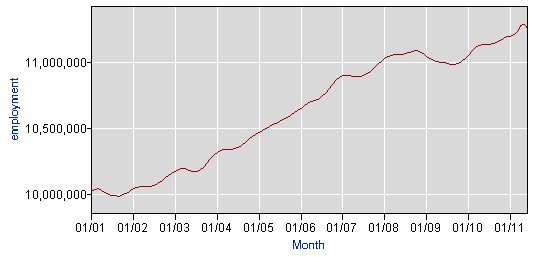
This may not look like anything special, but I’ve been looking closely at employment data for a couple years now and I’ve become very accustomed to seeing data that looks like this.
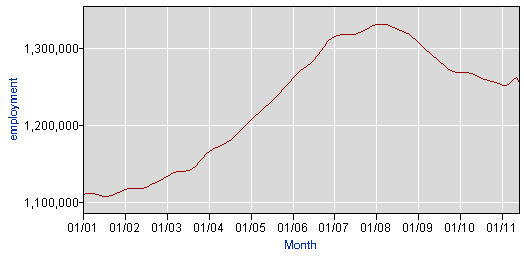
In a “normal” employment data set, we can easily look at it and say “Yep, that’s where the recession happened. Sucks to be us.” But not with Texas. With Texas, we say “Damn. Looks like they’ve recovered already.”
(To get to this data, go to this link http://data.bls.gov/cgi-bin/dsrv?la then select the state or states you want, the select “Statewide”, then select the states again, then select the metrics you want to see.)
But if Texas has so many jobs, why do they have such a high unemployment rate? Let’s take a closer look at that data.
As a percentage of the number of pre-recession jobs, here is a chart of the growth of a selection of states. (For clarity, in this chart I selected a number of the largest states and tried to focus on states that have relatively good economic reputations. I did not chart all 50 states b/c it would have taken me too long.)
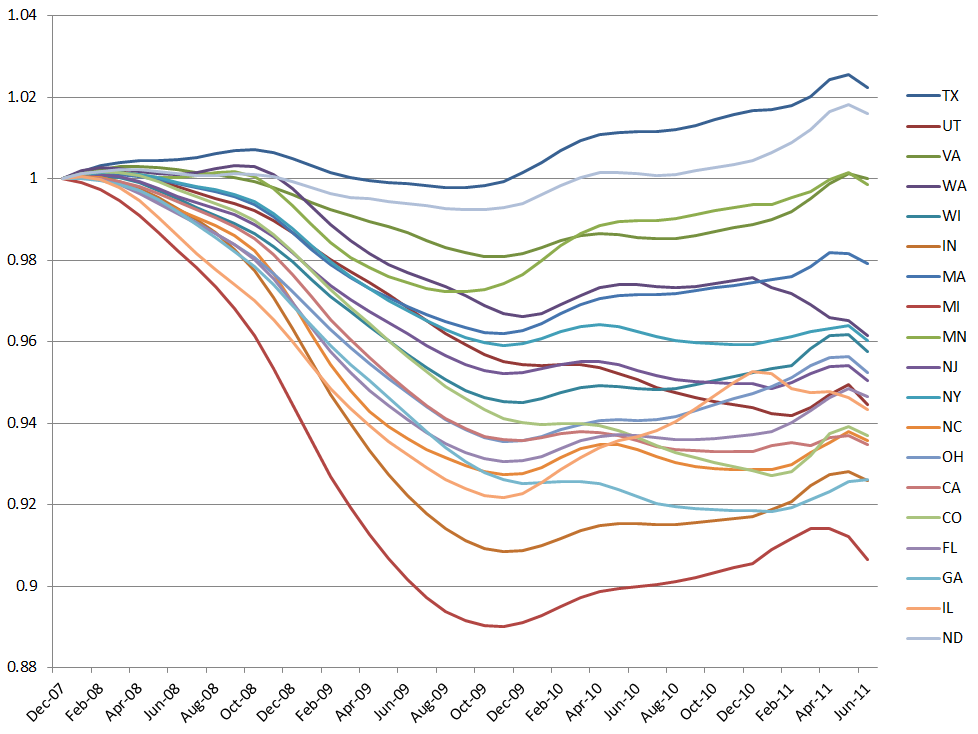
We can see that Texas has grown the fastest, having increased jobs by 2.2% since the recession started. I want to take a moment and point out that second place is held by North Dakota. I added North Dakota to my list of states to show something very important. North Dakota currently has the lowest unemployment rate of any state at 3.2%. And yet Texas is adding jobs at a faster rate than North Dakota. How can this be?
The reason is that people are flocking to Texas in massive numbers. Starting at the beginning of the recession (December 2007), let’s look at how this set of states have grown in their labor force.
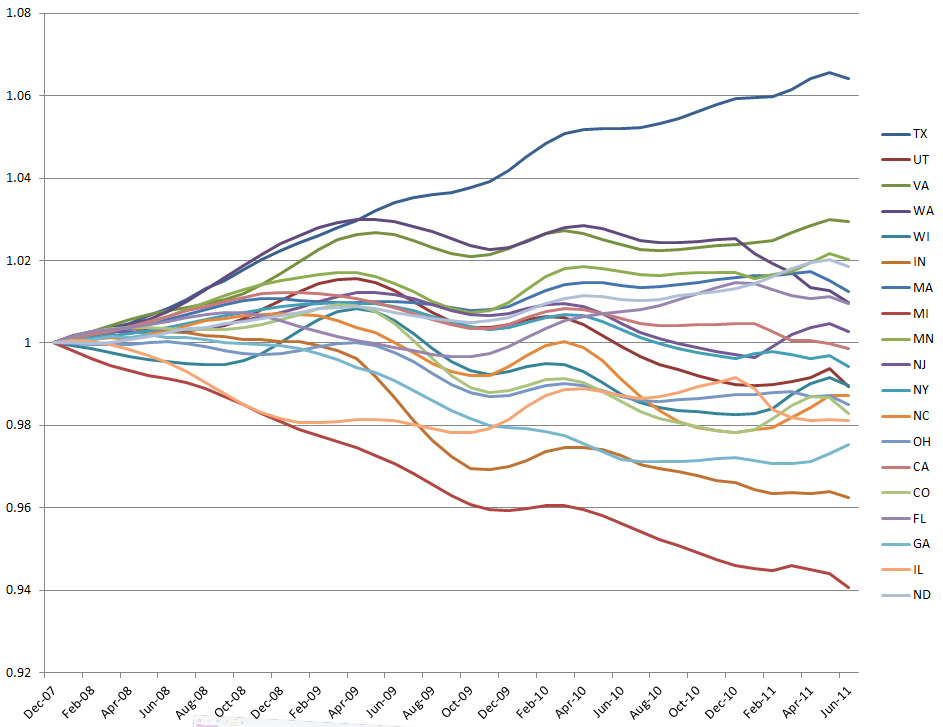
As you can see, Texas isn’t just the fastest growing… it’s growing over twice as fast as the second fastest state and three times as fast as the third. Given that Texas is (to borrow a technical term) f***ing huge, this growth is incredible.
People are flocking to Texas in massive numbers. This is speculative, but it *seems* that people are moving to Texas looking for jobs rather than moving to Texas for a job they already have lined up. This would explain why Texas is adding jobs faster than any other state but still has a relatively high unemployment rate.
“Sure, Texas has lots of jobs, but they’re mostly low-paying/minimum wage jobs”
Let’s look at the data. Here’s a link: Occupational Employment and Wage Estimates
Texas median hourly wage is $15.14… almost exactly in the middle of the pack (28th out of 51 regions). Given that they’ve seen exceptional job growth (and these other states have not) this does not seem exceptionally low.
But the implication here is that the new jobs in Texas, the jobs that Texas seems to stand alone in creating at such a remarkable pace, are low paying jobs and don’t really count.
If this were true, all these new low-paying jobs should be dragging down the wages data, right? But if we look at the wages data since the beginning of the recession (click to enlarge, states are listed alphabetically)
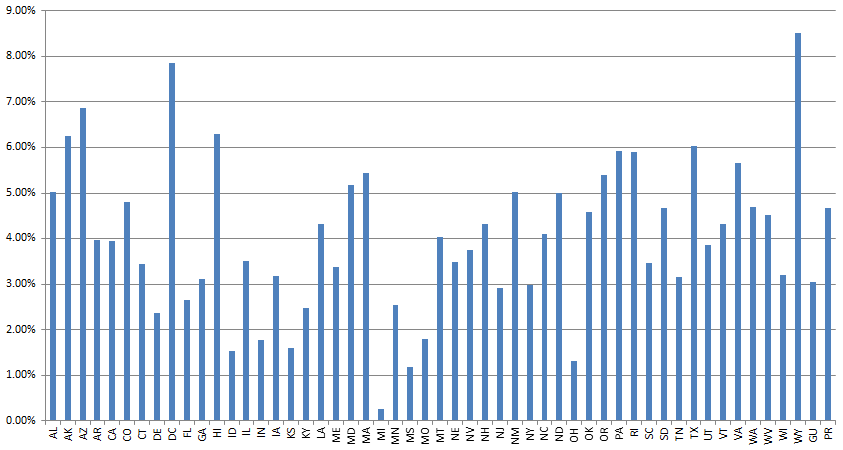
And it turns out that the opposite is true. Since the recession started hourly wages in Texas have increased at a 6th fastest pace in the nation.
As a side note, the only blue state that has faster growing wages is Hawaii. Just thought I’d get that jab in since so many people have been making snarky “Yeah, I could get a job in Texas is I wanted to flip burgers!” comments at me on Twitter.
“Texas is oil country and the recent energy boom is responsible for the incredible jobs increase.”
In identifying “energy jobs” I cast as wide a net as possible. If you want to replicate my findings, go to this link: http://www.bls.gov/sae/data.htm, click on “One-Screen Data Search”, then select “Texas”, then select “Statewide”, then in Supersectors select “Mining and Logging”, “Non-Durable Goods” and “Transportation and Utilities” and then in Industries select “Mining and Logging”, “Natural Gas Distribution”, “Electric Power Generation” and “Petroleum and Coal Products Manufacturing”.
Tedious, I know, but transparency is important and this is how you get the data.
When we finally get the data, we discover that energy isn’t really the biggest part of the Texas economy. Increases in jobs in the energy sector (or closely related to it) account for about 25% of the job increases in the last year. Since the energy sector only makes up 3% of all employment, there is some truth to this claim.
However, take the energy sector completely out of the equation and Texas is still growing faster than any other state. This indicates to us that the energy sector is not a single sector saving Texas from the same economic fate as the rest of the states. It’s not hurting, but Texas would still be growing like a weed without it.
“Texas has 100,000 unsustainable public sector jobs that inflate the growth numbers.”
I’m not sure where this one comes from, but the numbers are these (and can be found by selecting government employment from the data wizard at this link http://www.bls.gov/sae/data.htm):
Counting from the beginning of the recession (December 2007) the Texas public sector has grown 3.8%, or a little under 70,000 employees. This is faster than normal employment, but it’s not off the charts.
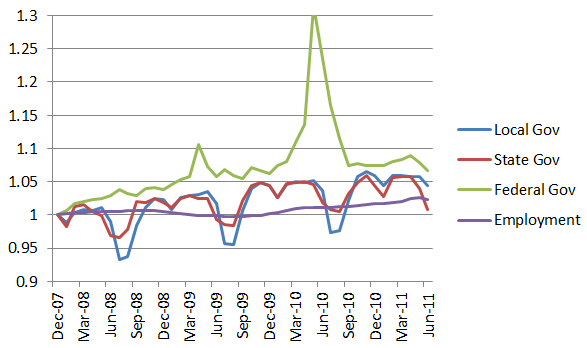
Given that the Texas economy has grown so much and private sector jobs have grown so much, that doesn’t strike me as an unsustainable growth in the public sector.
But, just in case you’re really worried about it, you can lay your fears to rest because in the last year the Texas public sector has shrunk by 26,000 jobs. In the last 12 months, Texas lost 31,300 federal employees, trimmed 3,800 state jobs, and increased local government jobs by 8,400 jobs.
(To be fair, this was partially driven by the role Texas employees played in the census, which inflated federal job numbers this time last year. Since the census numbers stabilized, federal employment has been at about break-even.)
As you can see, we’re nowhere near the “100,000 unsustainable jobs” number.
My Personal Favorite Chart
I’ll leave you with my personal favorite chart. I mentioned at the beginning that Texas is seeing high unemployment in a large part because they’re growing so damn fast. The problem with this from a charts and graphs perspective is that it leaves worse states off the hook, making them look better than they actually are. Looking at unemployment alone, we would conclude that Wisconsin has a better economy than Texas. But Wisconsin is still 120K short of it’s pre-recession numbers. The only reason they look better than Texas is because 32,000 people fled the state.
During that time, 739,000 people fled into Texas. Anyone who takes that data and pretends that this is somehow bad news for Texas is simply not being honest. At the worst, I’d call it a good problem to have.
So, to give something of a better feeling for the economic situation across states, this chart takes the population of the states I selected above and judges the current job situation against the population as it stood at the beginning of the recession.
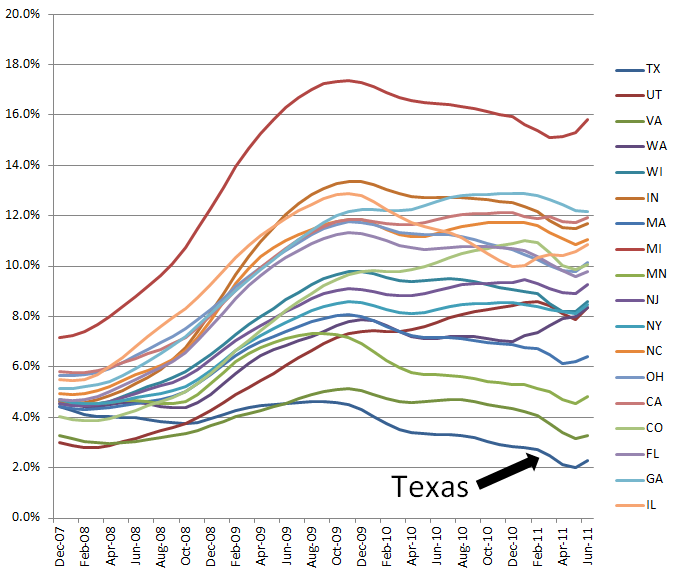
Using that metric, Texas would have a very low unemployment rate of 2.3%. But the fact that unemployment in the United States is fluid means that the unemployed flock to a place where there are jobs, which inflates its unemployment rate (at least in the short term). It’s not a bad thing for Texas… it just looks bad when dealing with the isolated “unemployment %” statistic.
UPDATE: @francisgagnon on Twitter felt that this chart was dishonest because it charts Texas as having 2.3% unemployment and (in his words so I don’t get him wrong): “It assumes immigrants create no jobs. But more people = more consumers = more jobs.”
He is absolutely right about this. I tried to be clear above that this chart doesn’t account for the fluid nature of an economy with immigration and departures of hundreds of thousands of people, but I don’t want to leave anyone with the wrong impression. So here it is: This chart doesn’t account for the fluid nature of an economy with immigrations and departures of hundreds of thousands of people. The point of this chart is not to say “Texas should have 2.3% unemployment if only things were fair.” Instead, it is an attempt to chart job growth in such a way that controls for people leaving one job market to enter another. To say “Wisconsin has a better job market than Texas because its unemployment rate is 0.6% lower” is a wholly untrue statement even though it cites accurate numbers. What this chart is meant to do is not posit a counter-factual, but to give a visual representation of the employment reality that is obscured by the way we calculate unemployment numbers.
END UPDATE
And… that’s it.
You may have noticed that I don’t mention Rick Perry very much here. That is because Rick Perry is, in my opinion, ancillary to this entire discussion. He was governor while these these numbers happened, so good for him. Maybe that means these jobs they are his “fault”. Maybe the job situation is the result of his policies. Or maybe Texas is simply the least bad option in a search for a favorable economic climate.
That is not an argument I’m having at this exact moment. My point is to show that most of the “excuses” you will hear about Texas’ job statistics are based in nothing more than a hope that Rick Perry had nothing to do with them and not on a sound understanding of the data.
My advice to anti-Perry advocates is this: Give up talking about Texas jobs. Texas is an incredible outlier among the states when it comes to jobs. Not only are they creating them, they’re creating ones with higher wages.
One can argue that Perry had very little to do with the job situation in Texas, but such a person should be probably prepare themselves for the consequences of that line of reasoning. If Rick Perry had nothing to do with creating jobs in Texas, than why does Obama have something to do with creating jobs anywhere? And why would someone advocate any sort of “job creating” policies if policies don’t seem to matter when it comes to the decade long governor of Texas? In short, it seems to me that this line of reasoning, in addition to sounding desperate and partisan, hogties its adherents into a position where they are simultaneously saying that government doesn’t create jobs while arguing for a set of policies where government will create jobs.
Or, to an uncharitable eye, it seem they are saying “Policies create jobs when they are policies I like. They don’t create jobs when they are policies I dislike.”
People will continue to argue about the data. But hopefully this will be helpful in sorting out reality from wishful and desperate thinking. I mentioned on Twitter that the Texas jobs situation was nothing short of miraculous. This is why I said that and why I’m standing by that statement.
Is your population data for TOTAL population, or for LABOR force population?
It seems like some of the dramatic increase in population could be explained by natural population forces like births, especially since Texas has a large hispanic population and the hispanic population is younger and the hispanic birth rate is higher than the average birth rate in this country. Without knowing what the population chart represents, I would hesitate to conclude, as you and your commenters do, that people are “flocking to Texas” to look for jobs.
I appreciate the detail of analysis here and admit as a liberal democrat from upstate NY, I am a sucker for most of these lines of reasoning (though they have been tempered with this analysis). This may be much trickier (if not impossible to accomplish), but I would be curious to see how many of these jobs are “new” vs “stealing” from other states. I keep seeing proclamations by conservative pundits that Texas has “created” approximately 1 million “new” jobs since 2003, but seriously doubt that many of these jobs are really new positions added to the aggregate US economy. For instance, my wife’s company relocated to Dallas and offered its 300 employees the chance to stay on board if they relocated with significant cuts to their salaries. Therefore, any of the positions that could not be filled through relocation would be hired locally in Texas at much lower wage, thus creating no new jobs nationally, but a decent handful in Texas and ultimately continue the trend of distributing wealth to the top of the company/upper class Americans. Unfortunately for those of us in upstate NY, there have been several companies who have done this, at the expense of the hard working middle class American. For this reason, some serious analysis on how many of these jobs are new jobs for “Americans” should really be performed to determine if this isn’t really Texas pouching jobs from other states and the subsequent arrival of service industry jobs (fast food joints, etc) to accommodate the shifting job base in America’s aggregate economy. However, with that said, NY is guilty of the same tricks, stealing 1,200 great paying jobs from Austin through the creation of a semi-conductor industry up here, claim the creation of “new” jobs. Sadly, they may be great paying “new” jobs for us New Yorker’s, but they are simply recycled jobs for the American economy. Hopefully, this isn’t what our great country will be reduced to as it attempts to reinvent its economy for the 21st century and certainly isn’t a winning strategy for either political party to chase after.
Problem number Two:
Your description of the population growth in Texas makes it sound recent and tied to economic trends. This is not the case. Let’s look at the data from the census department: Texas grew by 27.1% from 1970 to 1980; then by 19.4% from 1980 to 1990; then by 22.8% from 1990 to 2000; and then by 20.6% from 2000 to 2010. So Texas has grown by about 2% per year for more than 40 years – Whether Democrats Preston Smith, Dolph Briscoe, Mark White or Ann Richards was Governor or Republicans Bill Clements, George Bush or Rick Perry were serving as Governor.
So what is the driving force in the population growth? Have a look at http://www.nytimes.com/imagepages/2011/02/18/18texas_graphic.html?ref=us. From 2000 to 2010 about 2/3 of the population growth was due to the increase in the Hispanic population. This was predominately caused by immigration and a high birth rate. Because the Hispanic population of Texas is quite young there are nearly 9 births for every death. That is simply not driven by differently economic conditions between the states.
Wow. Great work, man. Well done.
@B. Samuel Davis–If you truly believe benefits are responsible for “destroying the African American community” in the US, you have a small-minding view of history and no understanding of the challenges that face black youth in America today.
Pervasive, statistically proven glass ceilings still exist, in mid-western cities, such as Kansas City and Chicago, blockbusting created black ghettos (after black families moved in public services, like bus routes and trash pickups were systematically discontinued), which influenced school district re-zoning to preserve segregated schools as recently as the 1970’s. The all-black schools, that existed into the 1980’s (in Kansas City) and later, haven’t ever been the equivalent of their white suburban counterparts.
While the civil rights movement happened in the 60’s, attitudes in many places remained unchanged for decades (or even still), limiting equal access to jobs or opportunity. Over time, the symptoms of poverty develop in communities (white, black or otherwise), and feelings of powerlessness, teen pregnancies, drug use and high crime take their toll on a culture.
Throughout the world, there is no other developed country that has the kind of discrepancy in educational performance across classes as the United States has. This, not benefits, is the biggest problem we have as a nation.
Very interesting and informative info. I too am not a Perry supporter, but this analysis seems to dispel the talking points against the Texas job situation.
Great job! I’m sure that this post represents untold hours of work. I’m glad you love your hobby that much. I know that I, and probably many others truly appreciate non-ideologically driven data and analysis. Please keep up the great work.
Does your mother know what a potty mouth you are
Of course you are a liberal so its understadable
As one of the folks that moved here in the last ten years, I can tell you what I found “special” about Texas.
When I moved here from Michigan, Jenifer Granholm had just become Governor. Her response to essentially the same situation her predecessor found himself in when taking office was the exact opposite of his: She increased spending, increased taxes, increased regulations and increased fees.
My business was in the computer field as a contractor /sub-contractor.
I moved to Houston.
Immediately, my income increased without increasing my rates. (Lost the 4% state income tax.)
When I filled my gas tank, I was paying 25 -40 cents less per gallon.
When I went to the store, food prices were significantly less for just about all of it, and particularly for fish and seafood.
Property taxes were less. Housing prices were less.
Business taxes: As an LLC, I ended up filling out a one page form yearly. Any business income less than $150,000 is not taxed.
If you make $50,000 a year, and live in Houston, you would need to make:
Almost $61,000 in Chicago http://www.bestplaces.net/col/?salary=50000&city1=54835000&city2=51714000
Over $91,500 in New York http://www.bestplaces.net/col/?salary=50000&city1=54835000&city2=53651000
and over $79,000 in Los Angeles http://www.bestplaces.net/col/?salary=50000&city1=54835000&city2=50644000
Further, besides being the most affordable of the top 5 cities by population in the US, Houston is also the most diverse, in terms of the racial make up of it’s neighborhoods. People are friendly, there is an incredible diversity in terms of food, music, and culture in general.
The state legislature meets for 120 every TWO YEARS! (Unless called into special session as was done this year.)
I love it here!
Perry may have been ancillary to the discussion, and a mere beneficiary of everything that went on in his state, but at least he had the good sense to sit back, let it happen, and not do anything to screw it up. That’s worth something.
@John “You really miss the whole cause and effect paradigm. Your statement is like saying that if you want smaller fires, send fewer fire trucks.”
I was talking about correlations, not causation.
I know that people often make the mistake of attributing causality to correlations, and I know it is fun to point it out when they do. But there can sometimes be value in talking about simple correlations!
We can debate and argue till the pigs come home. the fact of the matter is that the liberals see Perry as a big risk for Obama-Texas is working -no matter how you look at it and try and skew the numbers. I live in California and for the past 40 years have seen a great state decline-morally, mentally and economically- all because of the inability of liberals and progressives to face REALITY. I know of many people moving to Texas from California-homes are much cheaper and in my opinion there is much more American common sense in Texas. Perry will be slandered and lied about until the next presidential elections-the press will be the attack dogs and propagandists for the Obama administration -truth will fall by the wayside-this is how liberals role. A low paying job is better than no job to a man whiling to do an honest days work. Some jobs are starter jobs that require low skills -the world has always been this way. The problem with many on the left is their belief that all jobs should be high pay union jobs-even starter jobs like clerks in a 7-eleven This type of mentality is what destroyed the Soviet Union.
I think this is great work and information sadly most won’t make it through. My only comment would be with respect to the last point that roughly says you can’t say Perry had nothing to do with jobs and Obama could have something to do with them. I conclude from this data that much of job creation here is the result of low taxes and regulation and descent weather (a bit hot) all of which predate Perry and perhaps Bush. In addition the Texas governor is one of the weakest governors by design – the drafters of the TX constitution having a living memory of Santa Ana. So I think an argument could be made that Perry did little
and Obama could do more. But I would agree also that there are any other of bigger and better reasons not to support Perry. Thanks for doing this work.
Old TY has to try and be critical of his Governor even though he benefits from his policies. Remember he is a democrat and a dying breed who will wither away with Osama sorry I mean Obama. I betcha he is a liberal with my tax money and a conservative with his own??? What u betcha???
Very nicely done. It’s so rare to find thoughtful analysis in this political climate, especially when the data don’t support one’s political preferences. Thank you!
I am all in favor of anyone who wants to shrink the size of government – all government – federal, state and local. When you get too many people employed in the government sector and in public unions, you will see these people either finding a place to hide and sleep or trying to justify their jobs by harassing private citizens. All public sector unions should be de-certified, all public sector pensions should be privatized into 401-K’s and social security, all public sector health insurance should be privatized and funded at the same level as the majority of those in the private sector. There are actually only two classes of people in the U.S.: those on the public dole (either as handouts or in employment) and those that aren’t.
Your research, charting and analysis was awesome. That was a great post.
ObaMAO is going down…
– in the polls
– in the next election
– on George Soros as usual
Thanks. Your efforts are appreciated. Oh, if only the Chris Matthews of the world could read and understand your analysis we could have a discussion about policies instead of vitriolic rants.
Very informative. Thank you from a Virginian for Perry.
My analysis of the public sector jobs story comes out quite differently, as a commenter pointed out.
It looks to me like you mistakenly used seasonally unadjusted data–you can’t compare Dec07 to Jun11 using NSA (not seasonally adjusted) data. If you use the correct (seasonally adjusted) data, you would have gotten 112K increase gov’t jobs over that span.
BTW, I used the annual data to avoid any seasonal issues but mainly because the BLS does not provide seasonally adjusted data for the private sector which is an important part of my comparison.
See if this changes your mind at all: http://jaredbernsteinblog.com/texas-and-the-gov%e2%80%99t-better-friends-than-you%e2%80%99d-think/
First off who are you ? You sound like another liberal that puts out crap that does’t put his name to anything . You web site looks like it too . I believe with all the flap that Carney’s getting getting right now calling for him to be replaced says it all about you and your next story Tim Carney’s Awesomeness Theory of Capitalism says it all . Try snowing people that don’t know what is going on in America like maybe Iran . They love crap like your writing .
Another great post, thanks
Here’s the link and data you missed.
http://www.bankrate.com/brm/news/mortgages/home-values1f.asp?caret=2
One of the main reasons Texas has done well over the last few years was the non-existence of a housing bubble here. When you always have more land to expand, it’s cheaper just to build new houses. We never had an inflationary house price bubble here, and so when it popped nationally Texas came out ahead. The recession didn’t even hit here until 2009, and even then was largely mitigated by high energy prices…which *helps* Texas (and as you note account for a good portion of the gains).
DennisPearl, remember that those numbers, like interest on savings accounts, compound. A 20% increase in the first decade leaves 120% of what it began with. Therefore, the 20% increase the second decade is 20% of 120%, etc., for each decade. Even if it still leaves an average of 2% per year the compounded number at the end, even of 2%, is still large.
Interesting post. But I think there’s a huge hole in your analysis. Using BLS data, here is Texas total _private_ employment over the past decade:
8.84 million in December 2007
8.63 million in December 2010
Meanwhile, government jobs increased by 100,000 over the same time period. Education and healthcare jobs increased by 120,000 over the same time period.
I think this data is pretty difficult to square with the notion that Texas has enjoyed some kind of private-sector boom.
@Richard Thom: if you didn’t find a job in Texas as a surveyor, then come try again. Every county in Texas needs a licensed surveyor, and even small cities usually have one. But frequently these entities hire civil engineers, because there aren’t enough surveyors to go around. Avoid the big cities and look to the mid-size and little places. And good luck!
Great stuff!
Just to ask you to consider Jared Bernstein point on seasonally adjusted data on public sector jobs. I found your analysis very compelling, and I’ll love to know who is right here. Bernstein is no slouch with data either…
Maybe if California collected an excise tax on oil and gas production, like Texas does, its government could stimulate the economy too. It’s possible that the Texas Miracle comes from a tax! Yaaay oil tax!
@rghurst: You wrote: As a native Texas, just let me say one thing. If you’re movin’ to Texas, don’t come down here and start tryin’ to make Texas more like the place you came from. The reason Texas has jobs, and the place you came from doesn’t, is because Texas is different … low taxes, reasonable cost of living, reasonable expectation that you can take care of yourself and not expect the government to do everything for you.
We have a good thing goin’ here is Texas. Don’t Mess with It!!
rghurst, I could not have said it better myself. I am a 66 year old native Texan and I am sick and tired of jerks who come here for a better life and then want to change Texas to look and think like the place they left. What idiots! I have always said that people immigrating into Texas should be given a test first. They do not pass, we do not let them in. I like Texas and I do not want California, New York, Washington, Oregon, etc., etc. So if you do not like our way of thinking and work ethic, stay away!!!!!
how do you deal with some of these facts?
http://www.bls.gov/ro6/fax/minwage_tx.htm
and the fact that TX has the 4th highest poverty rate in the nation
Could it be that Texas numbers are inflated significantly by a larger increase in discouraged workers? That would account for discrepancy before mathblogger and Max Jones’ numbers.
I’d like to see some analysis of the important, unanswered question concerning the causal link between job growth and population growth — does job growth increase population (by attracting job seekers) or does population growth increase jobs (by stimulating demand, e.g., for houses, food, clothes, which local employers can only fill by hiring workers).
If the latter, then Texas’s record is unexceptional — it’s added jobs just because its population has increased, much in the same way that its total volume of garbage generated, water consumption, etc., have also undoubtedly been going up.
Yet, without any evidentiary support, you simply seem to assume that the other causal relationship predominates. That’s the whole point of your arbitrary conclusion that “my favorite chart” somehow reflects “employment reality.” @francisgagnon tried to educate you on this, but your UPDATE seems to have wholly missed the point.
The real lesson is probably that comparative studies in a highly fluid environment (like the job market in a country with freedom of movement) is tricky business, at best. Pepole who think they can draw solid conclusions from this data, by itself, are kidding themselves.
You also do not appear to have read anything that explains the “unsustainable public sector jobs” point. The premise to this argument is that Perry’s budget is relying on accounting tricks to avoid having to lay off 100,000 public workers. However, these accounting tricks are in the nature of one-time only shenanigans, meaning that Perry is merely kicking the can down the road a little, delaying the inevitable termination of these jobs. In turn, this argument says that an honest appraisal of Perry’s record would discount Texas’s employment figures by these 100,000 jobs. I’m not sure about the strengths of this argument, but if you’re purporting to “deal with” the argument, it seems like you should at least understand it and present it fairly.
Jason Bennett, how is it that you have such an excellent analysis and still manage such a puerile conclusion? If Governor Perry’s policies have been ones to “continue or expand previously existing ones in terms of state-business relations”, then quite simply the (obvious) exact opposite of that is impeding the terms of country-business relations, which President Obama has been happy to oblige.
One could say Perry’s assisting the economic development of his state by continuing what works and recognizing the factors that have facilitated the stability of the region is, in or of itself, genius.
I would like to give my kudos to a well researched, well stated and UNBIASED article stating the job situation in Texas. Great job in trying to cover all the variables which have happened in our society during the last few years. I especially was happy to see how you let the reader make up their own mind about the role Governor Perry has played in the economy of Texas. You provided the information and the reader can make up their own mind!!! Excellent!!!
Your data is the same as that found on the Texas Workforce Commission/NTI website. The median wage in the US is $16.27, so for a state that is very affordable to live in with no personal income tax, low property tax/insurance, etc. Texas is working! The change in income from 2005 to December 2010 was only $6,254 ($33,185 to $39,493).
The fastest growing industry is Healthcare; not “energy” or oil/gas. Some of the posts here have erroneously stated that the oil & gas industry have had the largest growth – along with Obama. Actually the energy sector jobs have stayed relatively stable over the past four years.
Our unemployment rate has not budged much during 2010-11 from a low of 8.1% to a high of 8.3% compared to the unemployment rate in 2006 at 5.0% (seasonally adjusted).
The fact of the matter is that the cost of living in Texas is currently ranked 2nd with Oklahoma being 1st.
Rick Perry and his entire administration have been very good stewards of keeping Texas alive and well during this horrifc economic downturn and job market.
Yes, Texas did take stimulus money – all 50 states did! Of the $15.3 billion allocated to Texas (based on population/unemployment/medicare & medicaid recipients, etc.)
for a pdf of the SELECT FEDERAL ECONOMIC STIMULUS PROVISIONS
IMPACTING TEXAS STATE BUDGET.
http://www.lbb.state.tx.us/Federal_Funds/Other_Publications/Conf_Provisions_Update_0309.pdf
The breakdown is:
Medicaid Programs, Education, Transportation, Workforce Assistance, Law Enforcement, Housing & Infrastructure
The Center for American Progress found that Rhode Island, Alaska, New York, Vermont, and New Jersey would receive the most money per capita, and Utah, Colorado, Virginia, Texas, and Florida received the least.
Having lived in California it is not surprising there are so many Californians thinking they can run into Texas and find the sweet life – they are so ADD! I doubt the relocating population from Michigan or Nevada have made much of an empact on our swelling population.
Wow, let’s just shoot Gov. Perry now for bringing in JOBS! Whether they are min. wage jobs or those paying $100k + (heaven forbid you make $251,000 lest you be considered a millionaire/billionaire for that “shared sacrifice” mantra being spewed by Obama!) Gov. Perry and his administration have lobbied for our state. Can he do this for the rest of the country – ABSOLUTELY! The man knows how to deal!
Habbit, I like your comment, it comes down to “If it ain’t broke, don’t fix it.”, Which is really difficult for a politician. So, if Gov. Perry was able to withstand the temptation, then he should reap the harvest of praise. So, I guess I concur.
Jason, what a great article. well done old bean.
I was just reading the following article when my friend linked to your comments here on FB. Now I am curios, do you think the following characterization/ information is accurate? http://jaredbernsteinblog.com/texas-and-the-gov%E2%80%99t-better-friends-than-you%E2%80%99d-think/ Thanks!
Yes, very good data. The next question is can every state in the union somehow arrange to have an influx of 700,000 plus people?
So, if low taxes and low regulations are what create a good jobs environment, wouldn’t that mean that conservative Republicans should be running the country instead of liberal Democrats? I used to live in corrupt, high-tax Illinois, and I am glad to be gone from there.
I thought the Stimulus didn’t create any jobs
What a bunch of garbage. If wages are growing fast, that means the jobs being created are not low paying jobs??? HUH? comparing apples and oranges here…just because you say you don’t like perry doesn’t mean…..
This is a great article and is well-researched. I would, however, like to see some type of analysis of the effect the energy sector has had from the perspective of a multiplier effect. Presumably the growth in energy jobs is responsible for an even larger share of the overall job growth than your numbers imply, as businesses involved in drilling/refining/etc consume products provided by non-energy-sector businesses.
I’d also be interested in extrapolating some of the implications that this might have from a policy perspective. Texas has a unique advantage in that it is able to convince businesses and talent to migrate from other less business-friendly states while still remaining in America, but that same advantage does not necessarily apply at the global level (or even the continental level), as a business cannot relocate even from Toronto to New York City as easily as one can move from New York City to Houston. Is there data available that demonstrates job creation and migration from country to country that might allow for some comparison?
Responding to the commenter regarding California being third in energy production, so why is it not getting the same benefit that Texas does? As a Californian who actually lives near Hollywood, I can assure you that there is a reason that the TV show we created was called “Dallas” and not “Bakersfield.”
It’s the same reason that Texas energy companies were able to manipulate our energy markets and cause our energy “crisis”. Namely, outside of Chevron, the vast majority of energy companies operating in California are based in Texas. When they extract oil from our wells we get a few oil rigger style jobs that a lot of my drag racing friends really enjoy having. They are high quality jobs and I got nothing bad to say about them.
But the actual profits from those operations largely end up in Texas. And not just the profits earned from their California operations, but profits earned by many of the largest energy companies on Earth end up in Texas. To think that all of that money sloshing around in their economy is not creating a large number of jobs that are not “energy related” is to miss a very large point.
From a macro-economic standpoint California is a large net energy importer, while Texas is a large net energy exporter. What that means is that higher energy prices scale in such a way as to cost California more and more, while those same increases mean more and more income for Texas. It’s exactly the same dynamic you see with the U.S. vs Saudi Arabia. High energy costs transfer wealth from importers to exporters.
Imagine the California economy if cars required movie tickets to operate and we tripled the price of them over the course of a few years. Our cost to produce movies has not changed but now we are making three times as much revenues for the same levels of output(jobs). Whether we create more movie jobs or not we are richer and you are poorer.
I don’t spend most of that new money producing new movies, because you are not going to dramatically increase how much you drive if I do. Instead I am gonna go buy a big expensive hat and a big expensive car and start living the good life. That money that I spend will support the local non-movie making economy and create all kinds of decent non-movie making jobs.
~Thomas