Full disclosure: I don’t like Rick Perry for our next president. I have my reasons that aren’t worth going into here. However, when I was watching the GOP debate and pro-Perry people started bringing up Rick Perry’s job numbers as a cudgel against other candidates, I looked into the BLS data on Texas jobs. Having familiarized myself with the data, I started noticing claims on the Texas jobs data that started popping up that directly contradicted what I was seeing in the data. So I wanted to clear up a couple of these common misconceptions.
Note: If you are going to comment and you want to introduce some new objection to the Texas job numbers, you MUST provide original data. I spent about 4 hours digging through raw data to write this post. I don’t want you to point to some pundit or blog post and take it on their authority, because I’ve already researched several idiot pundits who are talking directly out of their asses when it comes to the data. I want you to point to the raw data that I can examine for myself. This means links. I refuse to waste any more of my time on speculative bullshit or “Well, I’ll wager that the Texas jobs don’t really count because…” If you’re willing to wager, take that money and put it towards finding the actual data. In short, put up or shut up.
I’m not cranky, I swear.
Anyway, let’s deal with the complaints in no particular order:
“Texas has an unemployment rate of 8.2%. That’s hardly exceptional.”
See… that’s what I thought when I started looking at the data. I knew that Utah had a lower unemployment rate than Texas and I kept hearing that Texas was go great at jobs, blah, blah, blah, so I looked up the unemployment rate.
Nothing special.
So I was going to drive my point home that Texas was nothing special by looking at their raw employment numbers and reporting on those. That’s when I saw this:
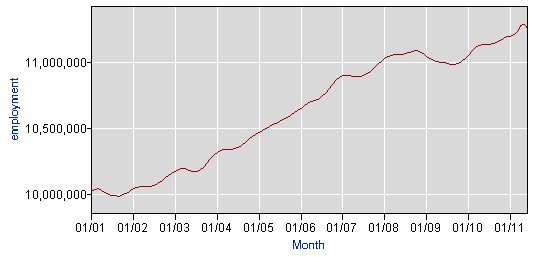
This may not look like anything special, but I’ve been looking closely at employment data for a couple years now and I’ve become very accustomed to seeing data that looks like this.
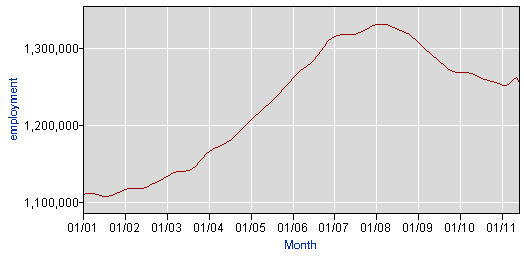
In a “normal” employment data set, we can easily look at it and say “Yep, that’s where the recession happened. Sucks to be us.” But not with Texas. With Texas, we say “Damn. Looks like they’ve recovered already.”
(To get to this data, go to this link http://data.bls.gov/cgi-bin/dsrv?la then select the state or states you want, the select “Statewide”, then select the states again, then select the metrics you want to see.)
But if Texas has so many jobs, why do they have such a high unemployment rate? Let’s take a closer look at that data.
As a percentage of the number of pre-recession jobs, here is a chart of the growth of a selection of states. (For clarity, in this chart I selected a number of the largest states and tried to focus on states that have relatively good economic reputations. I did not chart all 50 states b/c it would have taken me too long.)
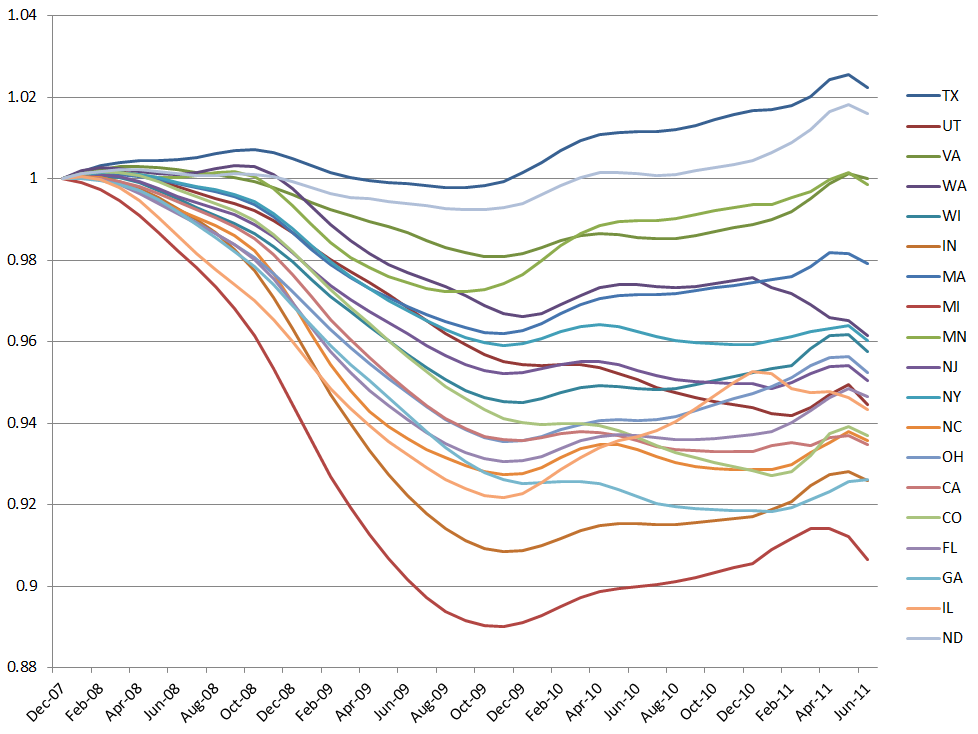
We can see that Texas has grown the fastest, having increased jobs by 2.2% since the recession started. I want to take a moment and point out that second place is held by North Dakota. I added North Dakota to my list of states to show something very important. North Dakota currently has the lowest unemployment rate of any state at 3.2%. And yet Texas is adding jobs at a faster rate than North Dakota. How can this be?
The reason is that people are flocking to Texas in massive numbers. Starting at the beginning of the recession (December 2007), let’s look at how this set of states have grown in their labor force.
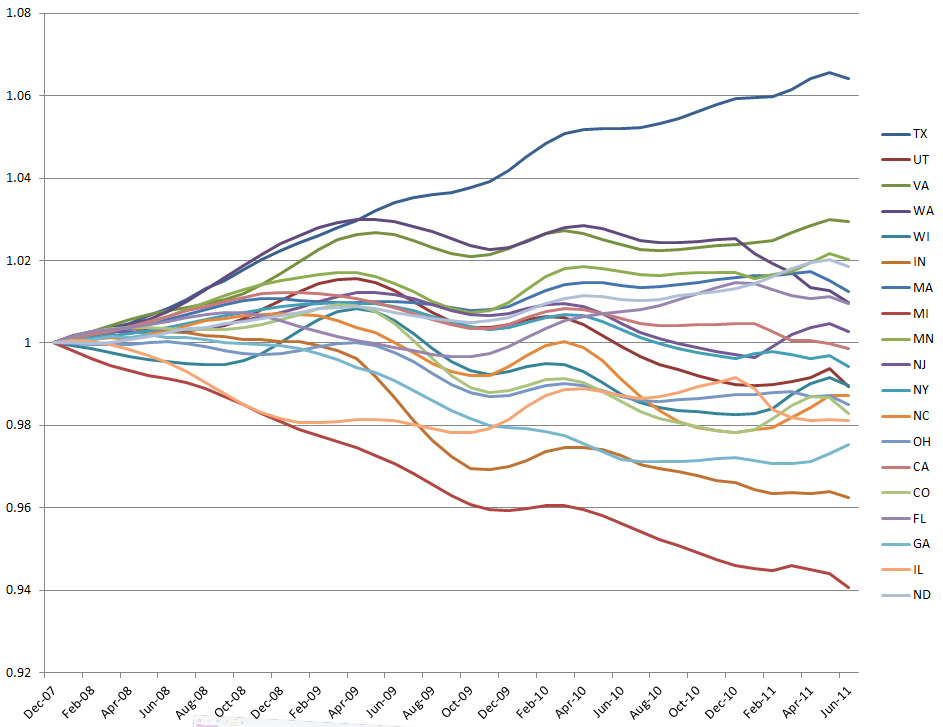
As you can see, Texas isn’t just the fastest growing… it’s growing over twice as fast as the second fastest state and three times as fast as the third. Given that Texas is (to borrow a technical term) f***ing huge, this growth is incredible.
People are flocking to Texas in massive numbers. This is speculative, but it *seems* that people are moving to Texas looking for jobs rather than moving to Texas for a job they already have lined up. This would explain why Texas is adding jobs faster than any other state but still has a relatively high unemployment rate.
“Sure, Texas has lots of jobs, but they’re mostly low-paying/minimum wage jobs”
Let’s look at the data. Here’s a link: Occupational Employment and Wage Estimates
Texas median hourly wage is $15.14… almost exactly in the middle of the pack (28th out of 51 regions). Given that they’ve seen exceptional job growth (and these other states have not) this does not seem exceptionally low.
But the implication here is that the new jobs in Texas, the jobs that Texas seems to stand alone in creating at such a remarkable pace, are low paying jobs and don’t really count.
If this were true, all these new low-paying jobs should be dragging down the wages data, right? But if we look at the wages data since the beginning of the recession (click to enlarge, states are listed alphabetically)
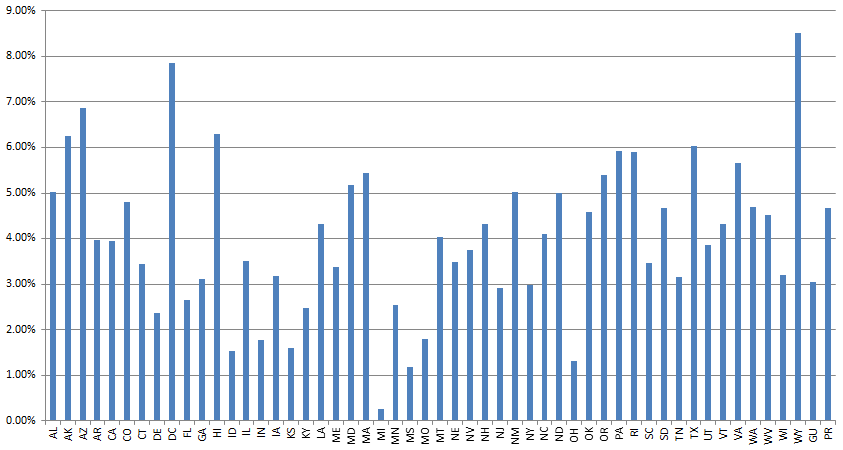
And it turns out that the opposite is true. Since the recession started hourly wages in Texas have increased at a 6th fastest pace in the nation.
As a side note, the only blue state that has faster growing wages is Hawaii. Just thought I’d get that jab in since so many people have been making snarky “Yeah, I could get a job in Texas is I wanted to flip burgers!” comments at me on Twitter.
“Texas is oil country and the recent energy boom is responsible for the incredible jobs increase.”
In identifying “energy jobs” I cast as wide a net as possible. If you want to replicate my findings, go to this link: http://www.bls.gov/sae/data.htm, click on “One-Screen Data Search”, then select “Texas”, then select “Statewide”, then in Supersectors select “Mining and Logging”, “Non-Durable Goods” and “Transportation and Utilities” and then in Industries select “Mining and Logging”, “Natural Gas Distribution”, “Electric Power Generation” and “Petroleum and Coal Products Manufacturing”.
Tedious, I know, but transparency is important and this is how you get the data.
When we finally get the data, we discover that energy isn’t really the biggest part of the Texas economy. Increases in jobs in the energy sector (or closely related to it) account for about 25% of the job increases in the last year. Since the energy sector only makes up 3% of all employment, there is some truth to this claim.
However, take the energy sector completely out of the equation and Texas is still growing faster than any other state. This indicates to us that the energy sector is not a single sector saving Texas from the same economic fate as the rest of the states. It’s not hurting, but Texas would still be growing like a weed without it.
“Texas has 100,000 unsustainable public sector jobs that inflate the growth numbers.”
I’m not sure where this one comes from, but the numbers are these (and can be found by selecting government employment from the data wizard at this link http://www.bls.gov/sae/data.htm):
Counting from the beginning of the recession (December 2007) the Texas public sector has grown 3.8%, or a little under 70,000 employees. This is faster than normal employment, but it’s not off the charts.
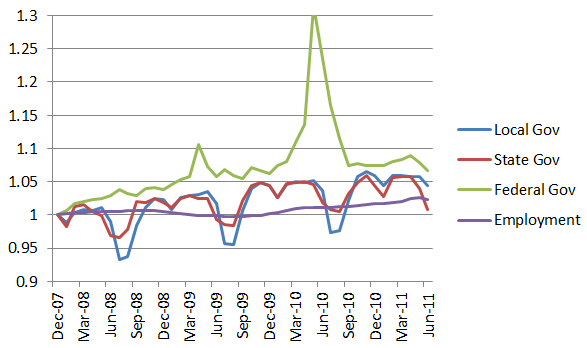
Given that the Texas economy has grown so much and private sector jobs have grown so much, that doesn’t strike me as an unsustainable growth in the public sector.
But, just in case you’re really worried about it, you can lay your fears to rest because in the last year the Texas public sector has shrunk by 26,000 jobs. In the last 12 months, Texas lost 31,300 federal employees, trimmed 3,800 state jobs, and increased local government jobs by 8,400 jobs.
(To be fair, this was partially driven by the role Texas employees played in the census, which inflated federal job numbers this time last year. Since the census numbers stabilized, federal employment has been at about break-even.)
As you can see, we’re nowhere near the “100,000 unsustainable jobs” number.
My Personal Favorite Chart
I’ll leave you with my personal favorite chart. I mentioned at the beginning that Texas is seeing high unemployment in a large part because they’re growing so damn fast. The problem with this from a charts and graphs perspective is that it leaves worse states off the hook, making them look better than they actually are. Looking at unemployment alone, we would conclude that Wisconsin has a better economy than Texas. But Wisconsin is still 120K short of it’s pre-recession numbers. The only reason they look better than Texas is because 32,000 people fled the state.
During that time, 739,000 people fled into Texas. Anyone who takes that data and pretends that this is somehow bad news for Texas is simply not being honest. At the worst, I’d call it a good problem to have.
So, to give something of a better feeling for the economic situation across states, this chart takes the population of the states I selected above and judges the current job situation against the population as it stood at the beginning of the recession.
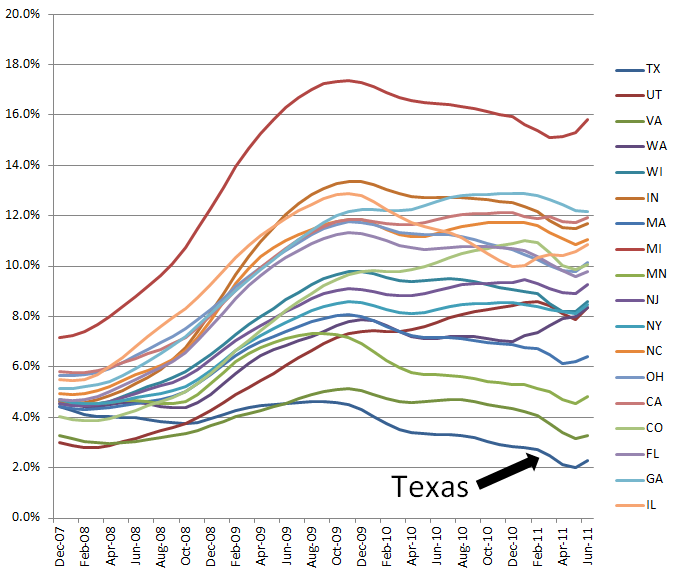
Using that metric, Texas would have a very low unemployment rate of 2.3%. But the fact that unemployment in the United States is fluid means that the unemployed flock to a place where there are jobs, which inflates its unemployment rate (at least in the short term). It’s not a bad thing for Texas… it just looks bad when dealing with the isolated “unemployment %” statistic.
UPDATE: @francisgagnon on Twitter felt that this chart was dishonest because it charts Texas as having 2.3% unemployment and (in his words so I don’t get him wrong): “It assumes immigrants create no jobs. But more people = more consumers = more jobs.”
He is absolutely right about this. I tried to be clear above that this chart doesn’t account for the fluid nature of an economy with immigration and departures of hundreds of thousands of people, but I don’t want to leave anyone with the wrong impression. So here it is: This chart doesn’t account for the fluid nature of an economy with immigrations and departures of hundreds of thousands of people. The point of this chart is not to say “Texas should have 2.3% unemployment if only things were fair.” Instead, it is an attempt to chart job growth in such a way that controls for people leaving one job market to enter another. To say “Wisconsin has a better job market than Texas because its unemployment rate is 0.6% lower” is a wholly untrue statement even though it cites accurate numbers. What this chart is meant to do is not posit a counter-factual, but to give a visual representation of the employment reality that is obscured by the way we calculate unemployment numbers.
END UPDATE
And… that’s it.
You may have noticed that I don’t mention Rick Perry very much here. That is because Rick Perry is, in my opinion, ancillary to this entire discussion. He was governor while these these numbers happened, so good for him. Maybe that means these jobs they are his “fault”. Maybe the job situation is the result of his policies. Or maybe Texas is simply the least bad option in a search for a favorable economic climate.
That is not an argument I’m having at this exact moment. My point is to show that most of the “excuses” you will hear about Texas’ job statistics are based in nothing more than a hope that Rick Perry had nothing to do with them and not on a sound understanding of the data.
My advice to anti-Perry advocates is this: Give up talking about Texas jobs. Texas is an incredible outlier among the states when it comes to jobs. Not only are they creating them, they’re creating ones with higher wages.
One can argue that Perry had very little to do with the job situation in Texas, but such a person should be probably prepare themselves for the consequences of that line of reasoning. If Rick Perry had nothing to do with creating jobs in Texas, than why does Obama have something to do with creating jobs anywhere? And why would someone advocate any sort of “job creating” policies if policies don’t seem to matter when it comes to the decade long governor of Texas? In short, it seems to me that this line of reasoning, in addition to sounding desperate and partisan, hogties its adherents into a position where they are simultaneously saying that government doesn’t create jobs while arguing for a set of policies where government will create jobs.
Or, to an uncharitable eye, it seem they are saying “Policies create jobs when they are policies I like. They don’t create jobs when they are policies I dislike.”
People will continue to argue about the data. But hopefully this will be helpful in sorting out reality from wishful and desperate thinking. I mentioned on Twitter that the Texas jobs situation was nothing short of miraculous. This is why I said that and why I’m standing by that statement.
I have a feeling, and no data, that the increase in wages has to do with an ever-widening income gap. As a member of the upper-middle class in Texas, I can assure you my wages aren’t going up, and I see plenty of low-wage jobs coming in. We are also chock-full of super-rich people, and it seems like those are the incomes going up. I’d like to see actual income distribution for new job creation as opposed to assuming that rising wages and increasing jobs means the new jobs are well-paying. Because I live here, and I am just not seeing that.
I hope you got paid for all of your research. Thank you for loading my shotgun of truth!
This seems to better explain the data to me. http://www.economicmodeling.com/2011/08/16/sizing-up-texas-job-growth-under-rick-perry/
I’ve heard numbers that Perry had about 75,000 net job growth from 2009-2011 (115K public sector gained, 40K private sector lost). Is this the case?
It would be interesting to see what percentage of those flocking to Texas are illegal aliens or hispanic. When the construction industry dried up where I am there were trucks loaded down “okie” style headed South towards the border. If I were an immigrant in a country and I saw the economy there going to hell I’d do what I could to get close to my home country too. Arizona enacted a bunch of scary laws so that state was out.. Texas is the logical spot to stop and see if things corrected before making the final dash for the border.
Paraphrasing:
“…Rick Perry is ancillary to the discussion…He was governor while these these numbers happened…”
This is due to tax policy, Texas is a very pro-business state. Creating a pro-business environment, encourages companies to move to Texas or expand in Texas and thus creates more jobs in Texas.
The point being that governments simply cannot “create” jobs, at least not ones that are sustainable. However governments can only create an environment that encourages private investment.
Terrific article on the stats.
As to the pol figures, if Perry didn’t, then Obama didn’t, etc. Pols have little to do with jobs. They simply take credit for what happens. A party system is based on irrational methods, so we don’t worry about a right-winger who says we needs to squash govt one day and the next, when he gains office, claims that all good comes from political action. Also “But more people = more consumers = more jobs.” If it worked that way my home state, California, might be in better shape. When I graduated HS it had ten million and now 40. Fast growth is very expensive in so many ways. Infrastructure and services can’t keep up & if you try the cost is overwhelming. If the immigrants are under-class this phenomenon is squared.
Excellent analysis. Government does not create jobs. The best thing government can do is create an environment where business can florish or perish based on that business’s ability. When compared to the Central Planning of the Obama administration that hands out 1/2 billion dollars to Evergreen Solar (filed for bankruptcy two days ago). It is clear. Centalized government ONLY has the power to destroy and waste money.
Hummmm, let me guess, you are a Ron Paul fan
Seems no one undertands what “race to the bottom” means. Like the first athelete who used steroids forcing others to rush in to cover the move we have a furious race to the bottom. In the long term what happens at 0? Short-sightedness is not generally considered a virtue or path to success.
The President NOR the governor can, per se, CREATE jobs. But their supported policies and economic focus on social services or private industry creation has a LOT to do with HINDERING job creation, slowing or frightening job creators from increasing employment opportunities, encouraging Capital Investment, Lending, and Private investors to support and fund growth a a business or industry group, and in a specific geographic or state domain.
If Perry has governed as Ann Richards did….Texas would be in the tank with other liberal states.
If Obama governed like Ronald Reagan to support private enterprise….the USA would not be in terrible debt.
That BUSH did not destroy Texas with massive unfunded spending while HE was Governor is the MIRACLE and likely if he HAD, Perry would have never become Governor. Bush set the pace for Obama’s presidential environment, and Obama and his campaign team were too busy getting elected to notice the clear signs of WHAT THEY WERE HEADED INTO….thus, he was totally unprepared by experience or with the experience of his selected administrative teams to cope with a sinking economic ship.
Unemployment figures don’t count discouraged job seekers. When there is job growth, people come back into the job market and actually increase the unemployment stats temporarily. The fact that TX is maintaining a robust job market and low unemployment means there are fewer discouraged job seekers. The stats are even better than they appear.
Hey, Political Math Guy,
I’m going to violate your injunction about having the data, but only because you’ve offered a hypothesis that isn’t backed up by any data: that people are moving to Texas in search of jobs, not because they have a job offer in hand.
If your hypothesis were true, it would imply that Texas unemployment rate would be lower if not for all those new people looking for jobs, too. You even created a chart to illustrate that point. But wait, why did all these people move there in the first place? Didn’t they read in the news that there are some 20 other states with lower unemployment rates?
Don’t you think a more plausible explanation is that Texas’s favorable business climate has induced a lot of new companies to move there, and those companies have either brought their employees with them, or they have recruited out of state because the local labor force lacks the skills they want?
If that is the explanation, then Texas’s unemployment rate is helped, not hurt by the influx of these new folks. They increase the size of the labor force without increasing the number of unemployed.
I agree that Texas job creation record is a credit to good policies and Rick Perry deserves credit for, if nothing else, not messing up good policies that were already in place. But I don’t think that record that needs to be embellished by implausible counterfactuals.
Hi Lauren,
Your concerns with the income data would be valid if the author used a ‘mean’ average of incomes whih is the normal average we use in our daily livres. That would mean if the rich are getting riher it would pull up the average wage numbers. However, he used a ‘median’ average. A median is you take everyones wage, line it up from lowest to highest, and if thier are 1 million jobs, you pick the 500,000th one and that is your median wage. This means that if he rich are gettin riche or the poor are getting poorer, it doesnt effect our average. So the rich getting richer doesnt explain the high median wage in Texas.
Your anecdotal evidence is valuable, but at best it isnt a picure of the overall Scene in texas. Maybe some industries arent doing so hot like yours while others are booming.
The author did a little research into energy jobs booming, but what other industries are booming in texas?
Remember the housing/economic crash in 2008. Started in 1990 by Frank/Dodd/Clinton/ Acorn(Obama) They forced lenders to get people into homes they couldn’t afford. Housing catastrophe! Economic crash!
Before that we had: Nine eleven 2001. War in Iraq and Afghanistan. MSNBC and most of the so called elite media blamed Bush. After 9-11-2001 we needed to do something mean to someone. Would have been hard to stop the Iraq war. Obama and McCain ran the 2008 presidential race campaigning against Bush. Obama won but has never worked at anything so doesn’t know how to run a large country. It shows. Our nation can be made whole again but Obama seems bent on crashing our economic system. He may do that. So we may not survive him.
Some of the arguments, especially the segway into comments about Obama contain specious logic. I think the most important fact, mentioned several times here and no doubt accurate, is the timing of the recession: December, 2007. This is the clearest indication of anything in the entire article and yet no mention is made of its implications:
Obama did not take office until January, 2008. The recession and subsequent sliggish economy and job growth are the product of 8 years of Republican policies.
Take away the jobs in Dr. Ron Paul’s district and Perry would still suck!
Texas is gaining jobs for many of the same reasons our nation is losing jobs – Texas has a low-tax, low-regulation business environment that is largely non-union workers. No personal income tax, property tax rates and red tape fees for home building are low. Putting it as plainly as possible, Texas is business friendly while Congress and the White House have become absolutely hostile to businesses, as have the local state government in many “Blue” states.
Big Government, Big Regulation Socialism fails, once again.
You can try and spin the numbers to tell a different story, but you’d know you’re lying as you were trying to do so. When I sold my home in Dallas, it was to a guy from California. We talked a bit at closing, and he was leaving and bringing his business with him because, in his own words, “The idiots in the California government simply do not want my business to succeed.”
Go figure.
Hello, I was referred here by stryck.livejournal.com. Interesting statistics here. OK to post a link on my Weebly?
Nice work. I’ve read that the biggest attraction for TX migrants is the low cost of living. So $15.41/hour ($600/wk) median income may be okay for 1/2 the workers in TX and only a few other low cost states. Low living costs may correlate to the absence of a housing bubble. It would be useful to see a distribution of wages by percent of jobs just to be sure nothing is being missed e.g. the preponderance of the lower 50% of the workers have minimum wage jobs. U also indicated that TX is 5th in wage growth. My concern is still valid regardless if this measures median, average or total wages.
@Lauren: A widening income gap won’t move the median much, if at all. Texas still has a great median wage, so the number of low income jobs that are being produced must be balanced by the number of higher income jobs, in a 1:1 proportion, or the median would be falling (or rising).
Justin, that is simply not consistent with the periods of the greatest widespread prosperity in this country. It is a conservative pipe dream, a myth that just won’t be laid to rest.
Just wondering if you can point out better which state is represented by which lines, etc. on your charts. All the different lines and similar colors make it hard to tell which line belongs to which state. Otherwise, great analysis!
So the “real story” on Texas is that there is increased consumer demand which increases the need for jobs and employees, and so on. That scenario can be achieved in several ways, however. In this instance, people relocating to Texas from other areas that were relatively worse off, whether Texas was or is all that great in itself or not, is fueling that increased demand. It can also be achieved via government stimulus that creates jobs and thereby creates employees with income to spend, thereby creating increased demand. The real story is that there isn’t just one way to stimulate an economy.
I have to pause a moment and really think about your comments on energy sector jobs. It seems that you did not take the proper accounting of the energy sector and the ancillary jobs that are created to support the industry. That is, energy investment in Texas is high, there are jobs created directly because of this. These jobs have ancillary services that directly and indirectly support that sector. In addition, those jobs then support services that are non energy related but are created because of the energy jobs i.e housing jobs, restaurants, road building, retail, appliances etc… All those are created because the energy jobs were there. I think you need to give more weight to why they have been created which is because of the energy and the way that the energy market has progressed over the last decade. [North Dakota is also one of the lucky recipients of the energy sector growth over the last decade or so. Their unemployment has been so low because people have not flocked to ND the way they have to Texas – so they do not have the issue that you have seen in Texas
And Justin, doesn’t Texas actually have strict regulation regarding mortgages?
Mr. Shapiro,
Great analysis. You are doing to to “policital scientists” what Steven McIntyre is doing to “climate scientists”. Keep up the good work.
You HUGE DICK HEAD.
What a load of squat flop.
Poo my munky flattus face.
“If this were true, all these new low-paying jobs should be dragging down the wages data, right? ”
Looks like it’s not just socialists and MSM that have issues with math. The median is not affected directly when vast numbers of low-paying jobs are added. In fact it is quite possible to have the median go up while all the job growth is at minimum wage – they refer to entirely different sections of the work force. The average wage might be affected more easily, unless there is an offsetting growth in the highest wages. In the end, statements on the quality of the created jobs can only be evaluated by looking at the wage distribution, and how it changes in time.
To answer your fair call for data, here it is. I compared BLS data on “State Cross-Industry estimates” from “May 2010 Occupational Employment and Wage Estimates” with “2001 Occupational Employment and Wage Estimates”. I believe annual wages to be more informative as they include changes in hours worked, so the comparison is on the fields a_wpct10 in the 2001 sheet and a_pct10 in the 2010 sheet. It shows that for the lowest 10%, annual wages went from 13,160 to 16,620. Using the BLS inflation calculator, this is a 2 percent increase over almost a decade. I think we can say that for low age earners in Texas, there has not been a wage raise.
Now, as to whether the new jobs have been dominated by low wage earners, we just have to look up the wage scale. Comparing the bottom 25% average annual wage (a_wpct25 and a_pct25), we see a change from 16,730 to 20,150. Correcting for deflation we see that this corresponds to a *decrease* in the average annual wage of about 2%. This clearly indicates that there has been a significant increase in the number of low-wage jobs, replacing higher paying jobs within the bottom 25%.
Summarizing, the data shows that low wage jobs pay a little better, but that higher paying jobs have been replaced with lower paying ones. The net effect is that the bottom quartile of workers is making less in 2010 than it did in 2001.
Excellent work. Thank you very much.
I wish you had labeled the vertial axis on each of your graphs. It is hard to judge the accuracy of your conclusions when the numbers in the charts don’t have units assigned. It seems like you know what you are talking about, but I really can’t say for sure. It is difficult to draw accurate conclusions with statistics because the analysis of the numbers is so tricky. I’m not saying that statistics have no value, but careful presentation of data can easily obscure the truth. Graphs that show no units are very suspicious. As an engineer, when I see a graph without units, it really jumps out at me. I am reminded of the saying about how there are lies, damned lies, and statistics. May the reader beware.
Reminds me of the old adage I learned in Statistics 101: “Figgers don’t lie, but liars can and do figger.”
Thanks for the info! We moved to Texas a year ago for a 100k private sector job and I have met a lot of people moving here making about the same. So there are definitely good paying jobs being created. With no income tax, good public schools and low housing prices, it is a huge draw. Our house is the same size but is 200k less than our old house. Also, there are lower food costs compared to other places that I’ve lived (I’ve lived in 4 different major metro areas around the country)
You devalued the impact of energy sector jobs on raising the hourly average making Texas look like it is getting higher paying jobs beyond the energy sector. The average energy sector job pays over 30$ an hour. If 75% of jobs pay 10$ an hour and the other 25% of jobs are 30$ an energy jobs you get the good sound 15$ an hour average. When the reality is outside of the energy sector the new jobs do not pay well. Also, Texas did retain more public sector jobs during the economic downturn than other states, government jobs tend to pay better than private sector (not factoring in education) which helps to make the hourly average in Texas look better than other states.
Great article. But still nothing to show that Perry was more than just the guy who happened to be in office at the time. Did he have a killer idea on top of existing policy which kicked job growth into high gear since 2007? Doubtful. Americans need to wise-up. The hero movement is over. There is no Superman who’s going to fly in to save the day, and certainly Perry is not woven of that cloth because he has not done anything in the way of thought-leadership or anything else to redefine the game. Just being the guy who was in-charge while things were going well isn’t enough, and if Americans are dumb enough to support him or anyone like him for President, then we deserve all the misery that is derived from such thinking.
Well done analysis. I was expecting, due to the preface, another slanted hack job/meme of the week. After reading your anaysis, and looking at the raw data, I bookmarked your site and will reference it along with Shadow Stats.
Keep up the good work.
“Obama did not take office until January, 2008. The recession and subsequent sliggish economy and job growth are the product of 8 years of Republican policies.”
Ladies and gentlemen, another well-informed Obama voter. I spot two very obvious problems with the above —
#1: In January 2008, noitand, Barack Obama was a senator from Illinois who had just won the Iowa caucus. He became president in January 2009, roughly two and a half months after he conspired with John McCain and Sarah Palin to steal the Hope Diamond from the Smithsonian Museum of Natural History.
(Actually, I think that last part may have just been something the South Park guys made up.)
#2: From January 2007 until January 2011, both the U.S. Senate and the U.S. House of Representatives were under Democratic control. Therefore, they had a significant hand in the “policies” of the government during that time, including some that may have contributed to our “sliggish economy.” And the Democrats, as you may have noticed, are not themselves Republicans. They actually take quite a bit of pride in it — Lord knows why.
It’s just a pity that my vote’s primary utility is to cancel out yours.
Economic prosperity is based on staying within the boundaries of and respect for natural law (God’s law, which grants certain inalienable rights as delineated in our Declaration of Independence). That means government gets out of the way making itself almost unnoticeable, just the opposite of what we have in our federal government, and what Texas must guard against in its state government. Statistics can be arbitrary and almost meaningless. Better to focus on whether our state and local governments are in compliance with natural law and the decentralized system that the original colonies operated under for 180 years prior to 1787 when they finally agreed to unite under the U.S. Constitution with the stipulation that Fedzilla would be put on the short leash of Article 1, Section 8, and that States Rights trumped federal rights. In my opinion Texas has been blessed IN SPITE of a lot of unconstitutional federal intervention, AND because God has protected us IN SPITE of Rick Perry and the other RINOS who run this state. The recent legislative session is testimony to how the newly elected representatives who gave Republicans the majority in the House, and were predominantly Tea Party representatives, had their Bills gutted or trashed by the old guard (RINOS) who loaded up the committees with liberals. The important changes that our newly elected representatives sought to make to State policies such as closing the borders, cutting off social services, education, medical and Social Security benefits to illegal immigrants, and other important matters were destroyed under the leadership of Governor Rick Perry, Lt. Governor Dewhurst and their chief attack dog Speaker Joe Strauss. Texas knows Rick Perry quite well. The rest of the country hasn’t had to endure 12 years of unfulfilled promises and watching him comb his hair. Why should we expect him to do anything differently if he becomes President?
Jared Bernstein (a very reputable economist) has this to say on the topic of gov’t jobs provided by Texas: http://bit.ly/q1sQeg
His source seems to be the same as yours (the BLS) but the stories are very different…any reason for this discrepancy?