Full disclosure: I don’t like Rick Perry for our next president. I have my reasons that aren’t worth going into here. However, when I was watching the GOP debate and pro-Perry people started bringing up Rick Perry’s job numbers as a cudgel against other candidates, I looked into the BLS data on Texas jobs. Having familiarized myself with the data, I started noticing claims on the Texas jobs data that started popping up that directly contradicted what I was seeing in the data. So I wanted to clear up a couple of these common misconceptions.
Note: If you are going to comment and you want to introduce some new objection to the Texas job numbers, you MUST provide original data. I spent about 4 hours digging through raw data to write this post. I don’t want you to point to some pundit or blog post and take it on their authority, because I’ve already researched several idiot pundits who are talking directly out of their asses when it comes to the data. I want you to point to the raw data that I can examine for myself. This means links. I refuse to waste any more of my time on speculative bullshit or “Well, I’ll wager that the Texas jobs don’t really count because…” If you’re willing to wager, take that money and put it towards finding the actual data. In short, put up or shut up.
I’m not cranky, I swear.
Anyway, let’s deal with the complaints in no particular order:
“Texas has an unemployment rate of 8.2%. That’s hardly exceptional.”
See… that’s what I thought when I started looking at the data. I knew that Utah had a lower unemployment rate than Texas and I kept hearing that Texas was go great at jobs, blah, blah, blah, so I looked up the unemployment rate.
Nothing special.
So I was going to drive my point home that Texas was nothing special by looking at their raw employment numbers and reporting on those. That’s when I saw this:
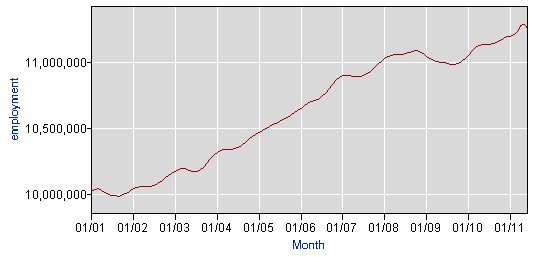
This may not look like anything special, but I’ve been looking closely at employment data for a couple years now and I’ve become very accustomed to seeing data that looks like this.
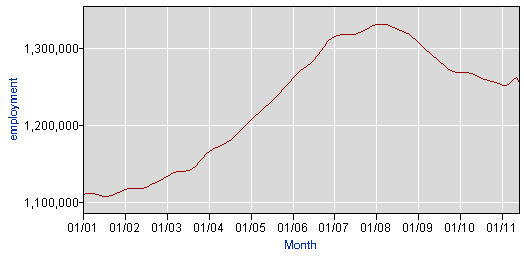
In a “normal” employment data set, we can easily look at it and say “Yep, that’s where the recession happened. Sucks to be us.” But not with Texas. With Texas, we say “Damn. Looks like they’ve recovered already.”
(To get to this data, go to this link http://data.bls.gov/cgi-bin/dsrv?la then select the state or states you want, the select “Statewide”, then select the states again, then select the metrics you want to see.)
But if Texas has so many jobs, why do they have such a high unemployment rate? Let’s take a closer look at that data.
As a percentage of the number of pre-recession jobs, here is a chart of the growth of a selection of states. (For clarity, in this chart I selected a number of the largest states and tried to focus on states that have relatively good economic reputations. I did not chart all 50 states b/c it would have taken me too long.)
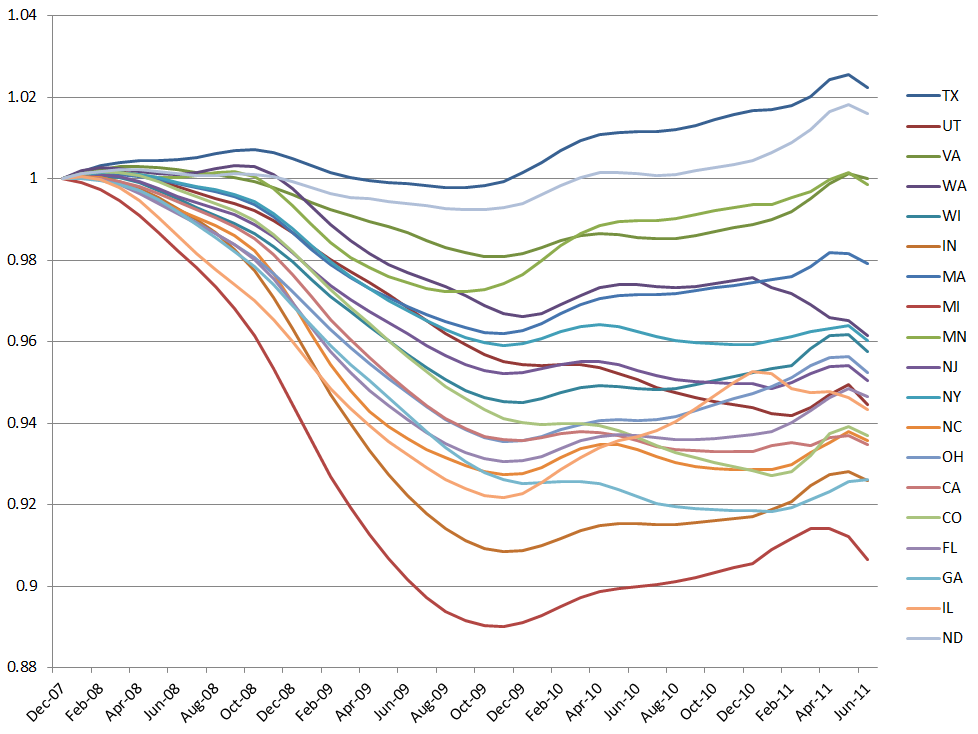
We can see that Texas has grown the fastest, having increased jobs by 2.2% since the recession started. I want to take a moment and point out that second place is held by North Dakota. I added North Dakota to my list of states to show something very important. North Dakota currently has the lowest unemployment rate of any state at 3.2%. And yet Texas is adding jobs at a faster rate than North Dakota. How can this be?
The reason is that people are flocking to Texas in massive numbers. Starting at the beginning of the recession (December 2007), let’s look at how this set of states have grown in their labor force.
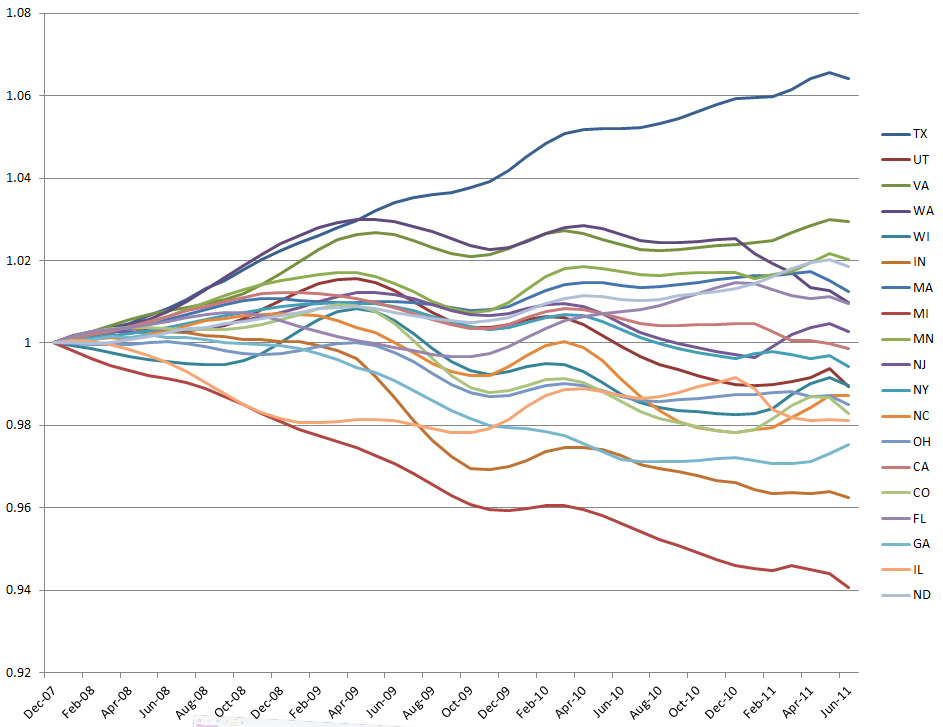
As you can see, Texas isn’t just the fastest growing… it’s growing over twice as fast as the second fastest state and three times as fast as the third. Given that Texas is (to borrow a technical term) f***ing huge, this growth is incredible.
People are flocking to Texas in massive numbers. This is speculative, but it *seems* that people are moving to Texas looking for jobs rather than moving to Texas for a job they already have lined up. This would explain why Texas is adding jobs faster than any other state but still has a relatively high unemployment rate.
“Sure, Texas has lots of jobs, but they’re mostly low-paying/minimum wage jobs”
Let’s look at the data. Here’s a link: Occupational Employment and Wage Estimates
Texas median hourly wage is $15.14… almost exactly in the middle of the pack (28th out of 51 regions). Given that they’ve seen exceptional job growth (and these other states have not) this does not seem exceptionally low.
But the implication here is that the new jobs in Texas, the jobs that Texas seems to stand alone in creating at such a remarkable pace, are low paying jobs and don’t really count.
If this were true, all these new low-paying jobs should be dragging down the wages data, right? But if we look at the wages data since the beginning of the recession (click to enlarge, states are listed alphabetically)
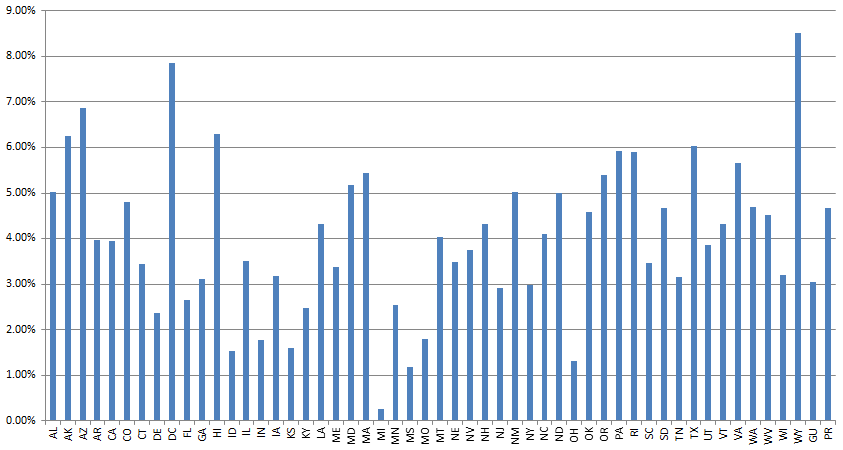
And it turns out that the opposite is true. Since the recession started hourly wages in Texas have increased at a 6th fastest pace in the nation.
As a side note, the only blue state that has faster growing wages is Hawaii. Just thought I’d get that jab in since so many people have been making snarky “Yeah, I could get a job in Texas is I wanted to flip burgers!” comments at me on Twitter.
“Texas is oil country and the recent energy boom is responsible for the incredible jobs increase.”
In identifying “energy jobs” I cast as wide a net as possible. If you want to replicate my findings, go to this link: http://www.bls.gov/sae/data.htm, click on “One-Screen Data Search”, then select “Texas”, then select “Statewide”, then in Supersectors select “Mining and Logging”, “Non-Durable Goods” and “Transportation and Utilities” and then in Industries select “Mining and Logging”, “Natural Gas Distribution”, “Electric Power Generation” and “Petroleum and Coal Products Manufacturing”.
Tedious, I know, but transparency is important and this is how you get the data.
When we finally get the data, we discover that energy isn’t really the biggest part of the Texas economy. Increases in jobs in the energy sector (or closely related to it) account for about 25% of the job increases in the last year. Since the energy sector only makes up 3% of all employment, there is some truth to this claim.
However, take the energy sector completely out of the equation and Texas is still growing faster than any other state. This indicates to us that the energy sector is not a single sector saving Texas from the same economic fate as the rest of the states. It’s not hurting, but Texas would still be growing like a weed without it.
“Texas has 100,000 unsustainable public sector jobs that inflate the growth numbers.”
I’m not sure where this one comes from, but the numbers are these (and can be found by selecting government employment from the data wizard at this link http://www.bls.gov/sae/data.htm):
Counting from the beginning of the recession (December 2007) the Texas public sector has grown 3.8%, or a little under 70,000 employees. This is faster than normal employment, but it’s not off the charts.
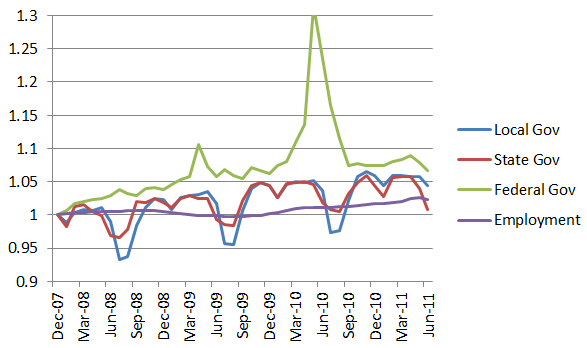
Given that the Texas economy has grown so much and private sector jobs have grown so much, that doesn’t strike me as an unsustainable growth in the public sector.
But, just in case you’re really worried about it, you can lay your fears to rest because in the last year the Texas public sector has shrunk by 26,000 jobs. In the last 12 months, Texas lost 31,300 federal employees, trimmed 3,800 state jobs, and increased local government jobs by 8,400 jobs.
(To be fair, this was partially driven by the role Texas employees played in the census, which inflated federal job numbers this time last year. Since the census numbers stabilized, federal employment has been at about break-even.)
As you can see, we’re nowhere near the “100,000 unsustainable jobs” number.
My Personal Favorite Chart
I’ll leave you with my personal favorite chart. I mentioned at the beginning that Texas is seeing high unemployment in a large part because they’re growing so damn fast. The problem with this from a charts and graphs perspective is that it leaves worse states off the hook, making them look better than they actually are. Looking at unemployment alone, we would conclude that Wisconsin has a better economy than Texas. But Wisconsin is still 120K short of it’s pre-recession numbers. The only reason they look better than Texas is because 32,000 people fled the state.
During that time, 739,000 people fled into Texas. Anyone who takes that data and pretends that this is somehow bad news for Texas is simply not being honest. At the worst, I’d call it a good problem to have.
So, to give something of a better feeling for the economic situation across states, this chart takes the population of the states I selected above and judges the current job situation against the population as it stood at the beginning of the recession.
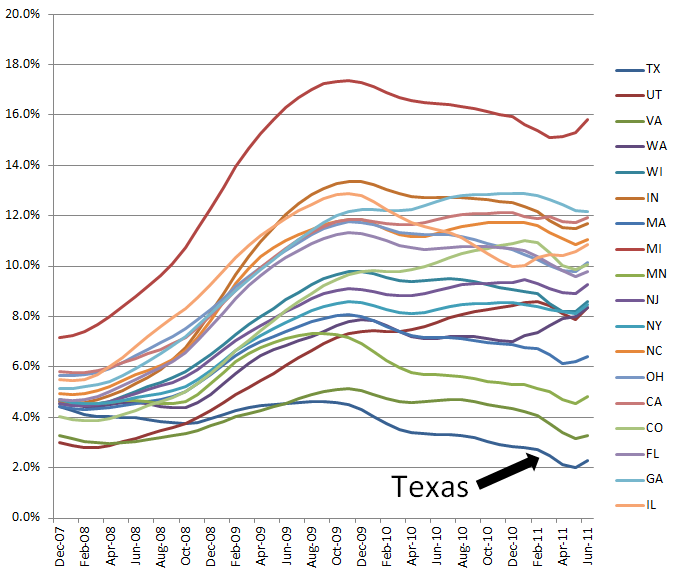
Using that metric, Texas would have a very low unemployment rate of 2.3%. But the fact that unemployment in the United States is fluid means that the unemployed flock to a place where there are jobs, which inflates its unemployment rate (at least in the short term). It’s not a bad thing for Texas… it just looks bad when dealing with the isolated “unemployment %” statistic.
UPDATE: @francisgagnon on Twitter felt that this chart was dishonest because it charts Texas as having 2.3% unemployment and (in his words so I don’t get him wrong): “It assumes immigrants create no jobs. But more people = more consumers = more jobs.”
He is absolutely right about this. I tried to be clear above that this chart doesn’t account for the fluid nature of an economy with immigration and departures of hundreds of thousands of people, but I don’t want to leave anyone with the wrong impression. So here it is: This chart doesn’t account for the fluid nature of an economy with immigrations and departures of hundreds of thousands of people. The point of this chart is not to say “Texas should have 2.3% unemployment if only things were fair.” Instead, it is an attempt to chart job growth in such a way that controls for people leaving one job market to enter another. To say “Wisconsin has a better job market than Texas because its unemployment rate is 0.6% lower” is a wholly untrue statement even though it cites accurate numbers. What this chart is meant to do is not posit a counter-factual, but to give a visual representation of the employment reality that is obscured by the way we calculate unemployment numbers.
END UPDATE
And… that’s it.
You may have noticed that I don’t mention Rick Perry very much here. That is because Rick Perry is, in my opinion, ancillary to this entire discussion. He was governor while these these numbers happened, so good for him. Maybe that means these jobs they are his “fault”. Maybe the job situation is the result of his policies. Or maybe Texas is simply the least bad option in a search for a favorable economic climate.
That is not an argument I’m having at this exact moment. My point is to show that most of the “excuses” you will hear about Texas’ job statistics are based in nothing more than a hope that Rick Perry had nothing to do with them and not on a sound understanding of the data.
My advice to anti-Perry advocates is this: Give up talking about Texas jobs. Texas is an incredible outlier among the states when it comes to jobs. Not only are they creating them, they’re creating ones with higher wages.
One can argue that Perry had very little to do with the job situation in Texas, but such a person should be probably prepare themselves for the consequences of that line of reasoning. If Rick Perry had nothing to do with creating jobs in Texas, than why does Obama have something to do with creating jobs anywhere? And why would someone advocate any sort of “job creating” policies if policies don’t seem to matter when it comes to the decade long governor of Texas? In short, it seems to me that this line of reasoning, in addition to sounding desperate and partisan, hogties its adherents into a position where they are simultaneously saying that government doesn’t create jobs while arguing for a set of policies where government will create jobs.
Or, to an uncharitable eye, it seem they are saying “Policies create jobs when they are policies I like. They don’t create jobs when they are policies I dislike.”
People will continue to argue about the data. But hopefully this will be helpful in sorting out reality from wishful and desperate thinking. I mentioned on Twitter that the Texas jobs situation was nothing short of miraculous. This is why I said that and why I’m standing by that statement.
Thank you for honest and frank numbers and cutting through the B***S*** of all the talking heads on TV. Fed jobs go a boost from bringing a US Army Division from Germany to Fort Bliss TX(El Paso). Hmmmm maybe if some smart candidate thought of it, bringing troops back from Korea and Germany could help two additional states and save department of Defense dollars
Great analysis. I’m not a Perry fan and never will be, but I love when someone takes a sharp pencil to generally accepted beliefs.
I wonder, though, on a deeper level, if oil/gas boom jobs and high wages represent one part of the job growth while immigration pop grow/low wages represents another part, something of a bimodal distribution.
If that were true (and if I care enough, I might actually come up with a way to analyze the problem), then one could make a case that the governor/legislature cannot affect gas/oil prices and have no impact on the creation of higher wage jobs, while the low investment, low regulatory environment they do impact creates little more than low wage service jobs.
Wow, excellent breakdown. That was indeed a lot of work. Living in Houston, TX, I can vouch for the fact that we are rather busy here. Thanks for the sound reasoning and thorough investigation of the facts.
Jerry
I know of several people who have moved to Texas over the past 4 years leaving behind the hopeless situation they were in in other states. When I think about it, most were from what are commonly labeled “blue states”. I guess they were just escaping the blues.
Fantastic article! And graphs that are easy to decipher to boot. Too bad this can’t be made required reading for anyone writing about how Texas a) really isn’t creating jobs, or b) is creating only poor paying and/or no benefits jobs, or c) is “stealing” jobs from other states (well, DUH!! Competition, anyone?), or d) (list your own asanine reason here). Just goes to show how a business-friendly policy works for everyone.
“Yeah, I could get a job in Texas is I wanted to flip burgers!”
Well, maybe that is the truth for those who render such comments (and even the grammatically correct equivalent).
Sabrina: Illegal aliens ARE getting all sorts of welfare benefits, food stamps, free medical…the list goes on. I just heard some statistics of illegal immigration. There are 23.5 million illegals in this country today, 5.5 million illegal children in our public schools, since Jan 2006 $34.7 Billion has been wired to Mexico, $400 Billion has been given to illegals through social services, there are 779,488 fugitive illegals in this country and there are 14 million Americans out of work, yet 12.3 million illegals hold SKILLED jobs. We are being LIED to by our government and that is why so many people are against ILLEGAL immigration. While they talk of cutting social security, medicare and the military, the illegals are taking OUR money and jobs. WAKE UP AMERICA!
Facts will out…let’s hope that the voters get the straight scoop…and vote accordingly.
It’s fair to say that the MSM will attack any Republican candidate’s record by finding whatever data or information can paint them in a bad light. If Chris Christie were running it would be no different.
That Obama had no record, indeed appeared to have spent his whole life trying to ensure that there was no trace of evidence indicating his true beliefs or guiding principles, was never a concern of the MSM. In fact, he regularly noted that people saw him as a blank slate on which they could project their own feelings about him–never offering, you know, to fill in the emptiness to give people a better picture of who he was and how he would govern, although for those of us who never drank the Kool-Aide it was pretty clear anyway.
Perry may have had a lot or a little to do with the “Texas Miracle,” but anyone at the top in a state or nationally gets to take the credit and gets stuck with the blame for economic conditions if they are around long enough. It’s true that executive power in Texas is limited but the fact is that Perry didn’t screw things up and helped to support and carry on policies that also allowed Texas to be a jobs machine in the 1990s as well, creating more jobs than average even when the economy was booming and energy prices were low.
If we’re looking at comparative data, how about including data from health, education, public services, etc.
This article certainly brings up some good points based on data. I’m curious how you would respond to the claims of this article:
http://thinkprogress.org/economy/2011/08/17/297556/report-texas-ranks-dead-last-in-total-job-creation-accounting-for-labor-force-growth/
Which are, namely, that if you account for the rapid growth in labor force, the job-growth rate in Texas looks far less impressive.
I feel like maybe you were addressing that in your article, but frankly I’m a little confused (partially by terminology, partially by not being an expert, or even considerably knowledgable, about this stuff). Can you clarify your position in regards to those claims of labor-force-growth-rate?
Almost all the negative articles regarding GOP candidates are being written about Perry. Why is that? Why has the left decided that HE is the candidate to go after. I did not see one negative article on Bachmann (who won the Iowa straw poll) or Romney, the presumed favorite, in the press lately. One political hack, who calls himself a “journalist”, claimed that Perry benefitted from FDR’s rural electricity program because the cotton farm he grew up on had electricity.
Is that because no one can argue with the success of Texas economically? What other state is seeing 5,000 people a week move to Texas from other states, with it’s population increase of 5 million in ten years, provide jobs for the majority of those people. Yeah, I realize some are children, but those children have parents looking for jobs.
A good economic indicator is U-Haul. And it is easy to do. Check the U-Haul rates from Houston to Los Angeles then from Los Angeles to Houston. If it costs more to rent a U-Haul going to Houston, that is an indicator of where the nation is moving. Or do it for any other city (Detroit to Dallas, New York to San Antonio, etc.)
** two Texas based journalists make the claim that Perry can be credited largely with “stealing” jobs from other states**
The way he “stole” those jobs was to create a climate in which businesses could succeed — tort reform and low business taxes (unlike many other states that litigate and tax business to death). This is no big secret, Perry himself is proud of it and even talks about it in speeches. Liberal-run states could do the same (to keep the jobs), they just won’t.
Can you put a link on this page so I can share it on Facebook and Twitter?
Here is another interesting link pointing out that a lot of the jobs that have been created in Texas are in fact government jobs. So while Perry and many other Republicans may rail against “big government” they don’t seem to be doing much about it at home. If you were to remove the massive increase in government employment how would that effect your picture of Texas as a job creator?
http://jaredbernsteinblog.com/texas-and-the-gov%E2%80%99t-better-friends-than-you%E2%80%99d-think/
Thank you very much for an unbiased analysis of REAL data.
Excellent piece of work. I greatly appreciate the goodly amount of work you put into this analysis.
I have one of the fastest growing small businesses in America. My secret is tied to one thing–presenting empirical data to my clients in a way that makes sense. By understanding the data, it is possible to recommend targeted solutions to achieve a measurable end result.
I always said that if a similar methodology can be taken in creating national or local government policy, keeping the politics out of the process, America would regain its strength. It would also bridge the gap between partisan politics.
Matthias blog is an example of taking the first step in cutting through the partisanship and evaluating arguments based on empirical data. My congratulations to Matthias.
Matthias feel free to reach out to me. I can provide a window into what is actually happening inside the medical practitioners’ office based on the data.
Great article with facts to support the Texas miracle. A friend of mine here in Ohio owns a professional job-placement firm which places high-end professionals. He told me recently that over 90% of all his job placements are in Texas. The contrast between Texas and the country as a whole couldn’t be more stark-that is why Perrry will crush Obama-capitalism beats socialism every time.
A fantastic post, great analysis. Congrats.
Thanks for sharing the great analysis. I want to highlight one aspect of the growth of “energy jobs” that you might have missed. People point the growth in energy jobs in Texas and assume that they occurred solely due to exogenous factors like increases in commodity price. This line of thinking ignores the impact of energy technical innovation that occurred in Texas. Shale gas and shale oil give the principal examples. Thousands of people are employed globally now because of innovations that George Mitchell and his company developed while experimenting in Texas. http://www.forbes.com/2009/07/16/george-mitchell-gas-business-energy-shale.html In fact, I don’t think it’s an exaggeration to say that North Dakota’s oil boom and jobs boom was born in Texas.
I haven’t reviewed all the comments in this thread so maybe this point has already been raised and addressed.
The unemployment rate that is broadly reported is only one measure of employment (U-3). That measure does not include persons who have stopped looking for work (discouraged workers) and those taking part-time work out of necessity rather than choice (underemployed workers).
BLS does track unemployment measures that include discouraged and underemployed workers in a measure known as U-6. That measure by state is here:
http://www.bls.gov/lau/stalt.htm
The current national U-6 unemployment measure is 16.3 percent, for Texas it is 14.3. Thus the argument that 8.2 is not exceptional seems to also hold for Texas on this broader measure.
Unfortunately the measure for U-6 only goes back to 2003. But year by year 2003 – 2010, here is where Texas has ranked on this measure. Nothing exceptional here and it tracks with its U-3 numbers:
2003 11.5 percent
2004 10.6 percent
2005 9.3 percent
2006 8.6 percent
2007 7.7 percent
2008 9.1 percent
2009 13.7 percent
2010 14.4 percent
One point you make is that Texas has grown in population since what you state is the beginning of the recession (2007).
That may be the case (although it is difficult to access the degrees in your chart since the axis isn’t labeled), during that time, the population of unemployed and underutilized has nearly doubled in size both by the U-6 measure outlined (7.7 percent in 2007, 14.4 percent in 2010) above and the traditional unemployment measure (4.3 percent in 2007, 8.0 percent in 2010).
More people may be coming to Texas (and/or reaching employment age) but that increase in labor force has only been 6 percent (if I am reading your chart correctly). They don’t appear to be getting employed any better than the folks in the labor force before the recession.
Moreover, if we weight the Texas unemployment numbers to control for this increase in labor force, there isn’t a dramatic change in the numbers (7.55 unemployment U-3, 13.58 percent U-6).
Overall, I don’t see any compelling evidence that the Texas recovery during the recession has been anything special; U3/U6 rates – 4.3/7.7 percent unemployment in 2007 versus 8.0/14.3 today. By contrast, North Dakota which has also seen unusual growth in its labor force is at 3.8/7.2 percent now and was at 3.2/5.8 percent in 2007.
Again, the data referenced in this comment that was not from the post above may be found here:
http://www.bls.gov/lau/stalt.htm
What many fail to recognize in not giving credit to Rick Perry for Texas jobs growth is that sometimes the best politician is the one who doesn’t interfere! He didn’t have to “do anything” other than keep out of the way of business which develops naturally given the right conditions. If it ain’t broke, don’t fix it. That laissez faire philosophy alone would put Perry in the upper echelon of politicians in my book.
Great data, great analysis, and even if Perry doesn’t have an original idea in his head, if he uses the political climate of Texas as a model for which to base the entire nation, things will improve dramatically over Obama’s passion for creative manipulation.
Wondering how the stimulus factors into this? Since that’s not really Perry’s doing… It looks like that has created around 45-53,000 jobs in Texas the last two years (looking at the recovery.gov Data Explorer). Additionally, the stimulus pretty much single-handedly balanced Texas’ budget last year (http://money.cnn.com/2011/01/23/news/economy/texas_perry_budget_stimulus/index.htm). How many jobs would have been lost had that money not been available?
Though data displays trends, and disproves some arguements, it doesn’t seem to prove or even attempt a link to Perry’s performance. Causality seems like a key issue here. For the past 40 years, Texas has outpaced the nation by about 1% growth, on average–is there any evidence that Perry has actually increased that number in his 10 years in office?
Additionally, while the energy industry may not completely account for the growth, the growth of the energy industry may influence other industries indirectly. Service industries and real estate should be affect by the growth too, right?
Also, just that fact that people are moving to Texas should have some effect on growth. Whether they are employed or not, they still buy gas, groceries, pay a mortgage/rent, shop, dine out, etc. Immigrants, legal and not, do the same with Texas being a logical first stop/settling place for those coming from Mexico. How do you measure their contribution to the economy of Texas as a whole? Last, what effect has SB1070 had?
Good analysis.
As this guy wants to argue (along with Roubini): it’s all Bush’s fault. Roubini is a hack.
http://blogs.ajc.com/jay-bookman-blog/2011/08/17/how-did-we-get-in-this-mess-nouriel-roubini-explains/
This is awful. You didn’t correct for population growth. You fail both demography 101 and macro econ 101.
On the counterargument side, it is widely acknowledged that TX governorship is at minimum less powerful than most. And some argue that it is generally neutered.
But I’m not an expert on TX political science. No doubt TX is doing fantastically well on the job creation front.
Thanks for the great work. Very useful information!
Excellent work. I learned quite a bit from this an I appreciate you digging through the data and making it into something that the average person can digest and learn from.
Excellent analysis. As a Texan and a Democrat I’m pleased to see that my state is doing well. I question somewhat the minimization of the impact of the oil & gas business on jobs, because Houston particularly is a headquarters town for worldwide oil businesses, so the strong oil pricing all over the world contributes to jobs in Houston. Texas is a strong exporter at present, and that is also a largely attributable to the oil & gas business.
The question of Rick Perry’s responsibility for this, however, is questionable. In my opinion there are several factors related to migration that have driven the increase of population and jobs. One is the absence of a state income tax. This not specifically a Perry policy, but is a sacred cow that has been around as long as I have been alive and I’m in my late ’50s. I think when businesses, especially large ones decide to relocate or expand, this factor is particularly important to the senior officers thinking about their personal situations. A second fact is that when conservatives from the North or other parts of the country decide to move, there is a preference for Texas over Florida or California. The state has actually become more conservative over the last 20 years, and its I think this is a significant factor. In my view this factor is more responsible for Perry being elected than Perry accomplishing anything for the state.
Another factor that is not always understood is Austin as a LIBERAL enclave within Texas. Austin is now the 14th largest city in the US, which absolutely blows the mind of this UT-Austin graduate from the 70s, when Austin was sleepy government and university town. The high tech boom involves a convergence to some degree of the conservative no-state income tax factor with an attractiveness to more liberal migrants from California and other liberal states. Two key businesses – Dell and Whole Foods — are Austin founded and HQ’d there, and this enclave has been a key driver of growth in the state.
Another factor affecting Houston, where I live, is the consolidation of regional O&G companies in Houston. For instance, when Phillips merged with Conoco, with Phillips the acquiring company, the HQ of the merged company was nonetheless moved to Houston from Bartlesville OK. This trend has been enhanced by the impact of the big hurricanes Katrina and Rita that blasted Louisiana in 2005. Many New Orleans based O&G companies picked up stakes and moved to Houston. I think many evacuees of Katrina came here and stayed. Rick Perry and George W. Bush presided over the state during this time, but had little to do with it.
Rick Perry is a clever, Teflon kind of politician, and the issue with him is hypocrisy. For instance, the only reason the 2009 legislature was able to balance the budget is because of stimulus funds form the feds, but Perry was making headlines with his pandering “secession” talk. More seriously, at the time when Democrats left the state senate in opposition to the Tom Delay gerrymander of congressional districts, Perry pushed through something called the Trans-Texas Corridor, which was a plan to build huge new highway, pipeline and — supposedly — rail corridors. This was to be more or less a doubling up of the interstate highway system to be financed as toll roads, and operated by a SPANISH company. It would would have required the condemnation of millions of acres of farm and ranch land, and was one of the most incredible boondoggles in recent memory. It aroused huge opposition in rural Texas, a Republican stronghold, and Perry quietly acquiesced in the termination of the plan a few years later, but never paid a political price. Recently, he has backed a right-wing fad to cut back research at the University of Texas and impose teaching measurables drawn from the for-profit university industry. This hasn’t gone anywhere either, but as always Perry pays no political price. He even once tried to outsource the functions of Child Protective Services to private companies, but couldn’t make that stick either.
Another hypocrisy is his failure to do anything to cut back on the state lottery system. True religious conservatives are always trying to do away with this, but that goes nowhere with Perry.
I think when you look at Texas and the election of Rick Perry, the best way to look at is to understand that the citizens of Texas’s biggest cities basically pay no attention to state government. That’s too bad because it has allowed Perry and the Republican legislature to cut radically state funding for education, which, along with highways, is the most important state responsibility. He even refused to allow the State’s rainy day fund to be used to balance the 2011 budget. If the recent financial crisis is not a rainy day, what is?
The picture that the national electorate should take away from Rick Perry is that he will cut government services radically and cut taxes too. In Texas we are used to a lack of services, and those of us in the big cities look to our local governments to fill the slack. I’m not sure though that citizens of other states that expect more services will like his approach, assuming he is elected. But given his proven hypocrisy, if elected president, he will pander to the right and talk big about how he’s going to bring us to right wing nirvana, but then drop any initiative that threatens his political standing. It will ultimately be a squeeze on government revenues through tax cuts or funneling of government spending to Republican cronies through privatization. I don’t think the country will like that if we get it, but that’s what Rick Perry will bring to the presidency if he’s elected.
If the price of oil and energy inflates Texas numbers, how do you explain the situation in California where they are very abundant in energy and oil? (its a fact, look it up)
People migrate to where the jobs are. If it wasn’t for the difficulty in selling their house, there would be even more people moving to TX.
It’s not he weather. Most of TX is dry arid and hot as hell, and the streets of Dallas is a nightmare to drive. However, as much as those d**n texans are irritating, they seem to have a workable solution to the jobs problem.
I’m sick of the ostriches on the left throwing out nice theories, fake numbers, and not saying anything about how to make their ideas work. Just look at the data and take a long hard look in the mirror the next time someone wants to discuss more socialist utopias.
Informative article but what is the reason for the job growth or more specifically why are people flocking to Texas which itself seems to stoke job creation? Will there come a point where population growth outstrips the need for the jobs needed to employ the population? More importantly, what is Texas doing that the rest of the country should emulate?
As a Professional Land Surveyor licensed to practice in 5 Northern states, I tried Texas. While there may be jobs I was seen as an outsider. Nepotism and who you know is a strong factor in hiring. But if one can get a job there its an excellent place to live and raise a family.
Aaron took the words out of my mouth. I also appreciate your digging through the data and compiling it into a concise, readable form, which attacks and debunks the anti-Perry Texas jobs talking points. Thank you!
The next election will be fought over two diametrically opposed views.
On one hand, we have the commonly held views of establishment GoP and Dem political elite, that gave everyone Homeland security, mandatory health insurance, consumer protection agency. An active interventionist view that technocrats are the solution for everything that ails us.
On the other hand, we have this guy who appears to say he wants to shrink federal government to a size he can drown in a bathtub.
The first camp grew government and spending over about 10 years giving us large new entilements and new federal agencies with rapidly expanding mandates that are prominent in our daily lives — whether we travel by planes or if some kid wants to set up a lemonade stand, or when we read about some town manager with seven-digit compensation packages, the first came gave a government that is pervasive. And no real jobs.
The second camp wants to make the federal government as inconsequential in our daily lives as possible. And the guy pushing this view runs a state that has created many real jobs.
This choice is about clarity.
Very good analysis. One wonders where the numbers would be if Obama/the feds had not put such major restrictions on drilling. I know the entire Gulf Coast still has thousands of unemployed offshore oil workers because the government stopped almost all drilling in the Gulf. The EPA and Interior have both caused major delays in drilling on both government and private leases in many areas of the country, not just Texas. I wonder what this has done to the prices you are paying for gasoline, or diesel fuel, or heating oil? And now the EPA wants to shut down several power plants just when Texas is in peak electrical demand, very nearly using the maximum avalable power. If these plants are shut down, as Obama/the EPA want, and we have rolling blackouts, first, some of our older, weaker, poor people will die (check the highs today for Houston and Dallas) and second, people will be out of work because there won’t be electricity avalable for businesses. As much as I dispise Obama, I can’t believe he wants deaths, but I can believe in his pleasure at any other pain he could inflict on Texas, for our defiance of him.
Texas Jack,
The EPA is one agency that should see budgets halved every year for 8 years. Many agencies are just wasted productivity but don’t do any damage directly. The EPA has mandates that will deliberately and directly kill jobs.
Problem number One:
Looks like you are making a common mistake – thinking that increases in the number of jobs reflects a strong record in new jobs. That is not the case. The change in the number of jobs is the difference between two components:
1) new jobs (through business starts or business expansions or business re-locations in) and
2) jobs lost (through business contractions or business ends or business re-locations out)
The BLS reports this data at the state level on a quarterly basis and the latest report is at http://www.bls.gov/news.release/cewbd.t06.htm
As you will see Texas lags behind the nation in new jobs. For example, they created only about 7.4% of the new jobs added in the U.S. in the fourth quarter of 2010 despite having more than 8% of the population/workforce.
The data on job retention (i.e. avoiding job losses) do look pretty good for Texas – though taking into account the nature of their workforce it turns out that even that is no different than what would be expected.
Great job of getting the facts and not spinning them.Giving credit or blame to governors if done should use the same yardstick for all states and should not cherry pick what you measure to skew the facts. Every legislature in different states is a major player in the outcomes.
The way it works in the United States is that if the economy of a state or the nation as a whole is doing well, the governor or President as the case may be, gets the credit. Except if the Governor or President is a Republican, in which case the credit is minimized. That’s why the media will first seek to minimize the achievements of Texas, then will say that Perry had nothing to do with it.
Also, as to what a commentator says about government benefits – what Texas vs. rest of the nation shows is that if you offer lots of benefits it hurts your economic performance. And besides – who says government should provide benefits? I don’t want government to take from someone else to give to me, I and my family can do it on our own thank you – we don’t need money to be taken from someone else to give to us.
Besides benefits are poison. Look how benefits have destroyed the African American community – first by destroying the family, which leads to unbelievable amounts of crime and no will to be educated, then its leaders get hooked on the poverty gravy train, leading to lack of real will to make conditions better, then making sure the media adopts a policy (“political correctness’) under which none of that can be mentioned – African Americans were destroyed by a benefit structure which ensured the family could not stay together. The Latino community would be well advised to learn from this when deciding which party to support – there is poison attached to government benefits, and the Latino community is already down the path to destruction as a result of reliance on government benefits – that part never seems to get mentioned.
Actually, revisiting this–31 states out perform the nation in terms of unemployment. Of those, Texas actually ranks 25th. Seems pretty average. So what exactly makes Texas so special?
On a side note–did the author look not just at energy, but also at commodities? It seems like there may be a link between commodity-rich states and economic recovery: http://online.wsj.com/article/SB10001424052748704034804576025411275078954.html. With agriculture and energy, there are a ton of other industries affected by their growth–chemical companies, transportation, utilities, service, engineering, construction, communication, infrastructure, etc. What is the total effect of the growth of these industries?
Thanks very much for an informative, well-thought out, and helpful analysis. Great job.
As a native Texas, just let me say one thing. If you’re movin’ to Texas, don’t come down here and start tryin’ to make Texas more like the place you came from. The reason Texas has jobs, and the place you came from doesn’t, is because Texas is different … low taxes, reasonable cost of living, reasonable expectation that you can take care of yourself and not expect the government to do everything for you.
We have a good thing goin’ here is Texas. Don’t Mess with It!!
Thanks for the breakdown of the unemployment numbers. I am so very tired of the nonsensical numbers thrown out to support really bad ideas or unsupportable positions. I cannot understand why there are so few responsible journalists that will apply even the simplest of analysis to the disinformation they love to repeat.
Ty – facts are funny things. I stopped reading your post when you threw in the in the “Tom Delay gerrymander” jab. If you will recall, the Texas districts had been horrendously distorted by the DEMOCRATS for decades. The Republicans used their first opportunity to redraw the lines legitimately. But even after their efforts, the definition of the districts gave an edge to Democratic candidates. Of course, that is just an opinion – of the Supreme Court after they heard the facts.
Pearl – If you are trying to say that no one wants an old job – that only new jobs count – you may want to rethink that!