Full disclosure: I don’t like Rick Perry for our next president. I have my reasons that aren’t worth going into here. However, when I was watching the GOP debate and pro-Perry people started bringing up Rick Perry’s job numbers as a cudgel against other candidates, I looked into the BLS data on Texas jobs. Having familiarized myself with the data, I started noticing claims on the Texas jobs data that started popping up that directly contradicted what I was seeing in the data. So I wanted to clear up a couple of these common misconceptions.
Note: If you are going to comment and you want to introduce some new objection to the Texas job numbers, you MUST provide original data. I spent about 4 hours digging through raw data to write this post. I don’t want you to point to some pundit or blog post and take it on their authority, because I’ve already researched several idiot pundits who are talking directly out of their asses when it comes to the data. I want you to point to the raw data that I can examine for myself. This means links. I refuse to waste any more of my time on speculative bullshit or “Well, I’ll wager that the Texas jobs don’t really count because…” If you’re willing to wager, take that money and put it towards finding the actual data. In short, put up or shut up.
I’m not cranky, I swear.
Anyway, let’s deal with the complaints in no particular order:
“Texas has an unemployment rate of 8.2%. That’s hardly exceptional.”
See… that’s what I thought when I started looking at the data. I knew that Utah had a lower unemployment rate than Texas and I kept hearing that Texas was go great at jobs, blah, blah, blah, so I looked up the unemployment rate.
Nothing special.
So I was going to drive my point home that Texas was nothing special by looking at their raw employment numbers and reporting on those. That’s when I saw this:
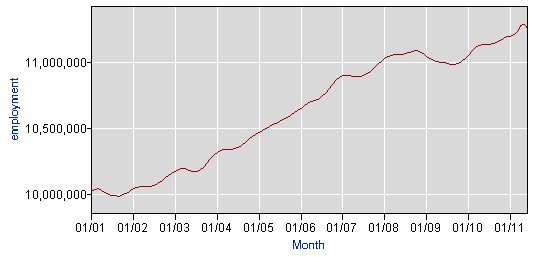
This may not look like anything special, but I’ve been looking closely at employment data for a couple years now and I’ve become very accustomed to seeing data that looks like this.
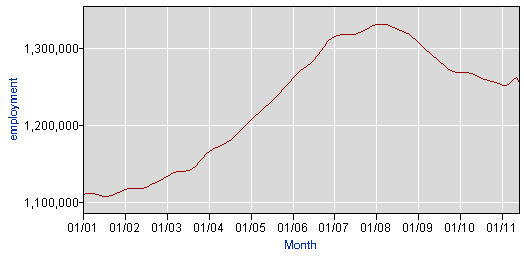
In a “normal” employment data set, we can easily look at it and say “Yep, that’s where the recession happened. Sucks to be us.” But not with Texas. With Texas, we say “Damn. Looks like they’ve recovered already.”
(To get to this data, go to this link http://data.bls.gov/cgi-bin/dsrv?la then select the state or states you want, the select “Statewide”, then select the states again, then select the metrics you want to see.)
But if Texas has so many jobs, why do they have such a high unemployment rate? Let’s take a closer look at that data.
As a percentage of the number of pre-recession jobs, here is a chart of the growth of a selection of states. (For clarity, in this chart I selected a number of the largest states and tried to focus on states that have relatively good economic reputations. I did not chart all 50 states b/c it would have taken me too long.)
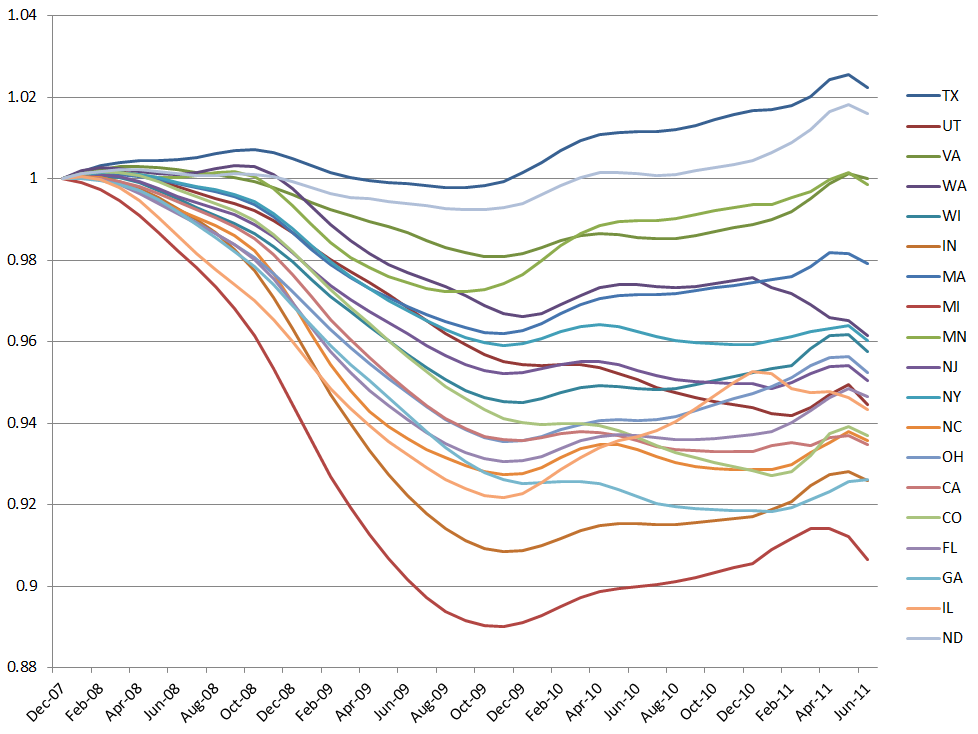
We can see that Texas has grown the fastest, having increased jobs by 2.2% since the recession started. I want to take a moment and point out that second place is held by North Dakota. I added North Dakota to my list of states to show something very important. North Dakota currently has the lowest unemployment rate of any state at 3.2%. And yet Texas is adding jobs at a faster rate than North Dakota. How can this be?
The reason is that people are flocking to Texas in massive numbers. Starting at the beginning of the recession (December 2007), let’s look at how this set of states have grown in their labor force.
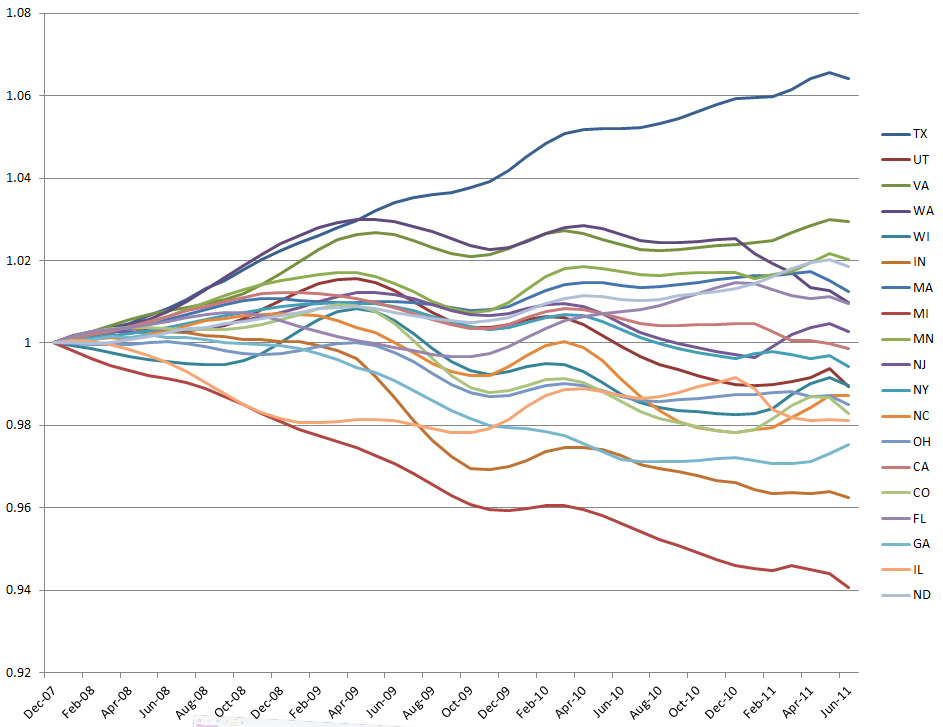
As you can see, Texas isn’t just the fastest growing… it’s growing over twice as fast as the second fastest state and three times as fast as the third. Given that Texas is (to borrow a technical term) f***ing huge, this growth is incredible.
People are flocking to Texas in massive numbers. This is speculative, but it *seems* that people are moving to Texas looking for jobs rather than moving to Texas for a job they already have lined up. This would explain why Texas is adding jobs faster than any other state but still has a relatively high unemployment rate.
“Sure, Texas has lots of jobs, but they’re mostly low-paying/minimum wage jobs”
Let’s look at the data. Here’s a link: Occupational Employment and Wage Estimates
Texas median hourly wage is $15.14… almost exactly in the middle of the pack (28th out of 51 regions). Given that they’ve seen exceptional job growth (and these other states have not) this does not seem exceptionally low.
But the implication here is that the new jobs in Texas, the jobs that Texas seems to stand alone in creating at such a remarkable pace, are low paying jobs and don’t really count.
If this were true, all these new low-paying jobs should be dragging down the wages data, right? But if we look at the wages data since the beginning of the recession (click to enlarge, states are listed alphabetically)
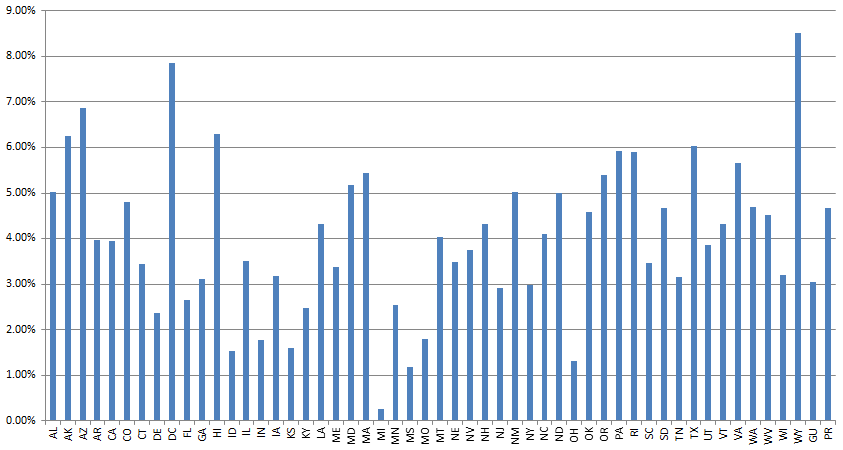
And it turns out that the opposite is true. Since the recession started hourly wages in Texas have increased at a 6th fastest pace in the nation.
As a side note, the only blue state that has faster growing wages is Hawaii. Just thought I’d get that jab in since so many people have been making snarky “Yeah, I could get a job in Texas is I wanted to flip burgers!” comments at me on Twitter.
“Texas is oil country and the recent energy boom is responsible for the incredible jobs increase.”
In identifying “energy jobs” I cast as wide a net as possible. If you want to replicate my findings, go to this link: http://www.bls.gov/sae/data.htm, click on “One-Screen Data Search”, then select “Texas”, then select “Statewide”, then in Supersectors select “Mining and Logging”, “Non-Durable Goods” and “Transportation and Utilities” and then in Industries select “Mining and Logging”, “Natural Gas Distribution”, “Electric Power Generation” and “Petroleum and Coal Products Manufacturing”.
Tedious, I know, but transparency is important and this is how you get the data.
When we finally get the data, we discover that energy isn’t really the biggest part of the Texas economy. Increases in jobs in the energy sector (or closely related to it) account for about 25% of the job increases in the last year. Since the energy sector only makes up 3% of all employment, there is some truth to this claim.
However, take the energy sector completely out of the equation and Texas is still growing faster than any other state. This indicates to us that the energy sector is not a single sector saving Texas from the same economic fate as the rest of the states. It’s not hurting, but Texas would still be growing like a weed without it.
“Texas has 100,000 unsustainable public sector jobs that inflate the growth numbers.”
I’m not sure where this one comes from, but the numbers are these (and can be found by selecting government employment from the data wizard at this link http://www.bls.gov/sae/data.htm):
Counting from the beginning of the recession (December 2007) the Texas public sector has grown 3.8%, or a little under 70,000 employees. This is faster than normal employment, but it’s not off the charts.
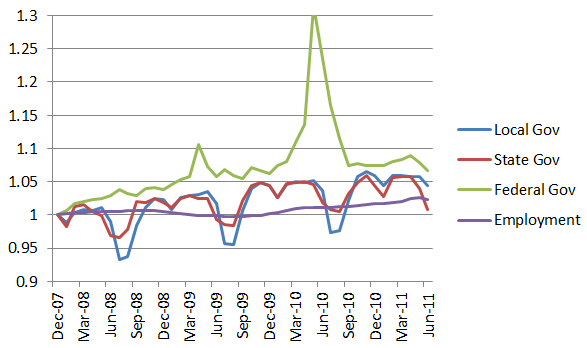
Given that the Texas economy has grown so much and private sector jobs have grown so much, that doesn’t strike me as an unsustainable growth in the public sector.
But, just in case you’re really worried about it, you can lay your fears to rest because in the last year the Texas public sector has shrunk by 26,000 jobs. In the last 12 months, Texas lost 31,300 federal employees, trimmed 3,800 state jobs, and increased local government jobs by 8,400 jobs.
(To be fair, this was partially driven by the role Texas employees played in the census, which inflated federal job numbers this time last year. Since the census numbers stabilized, federal employment has been at about break-even.)
As you can see, we’re nowhere near the “100,000 unsustainable jobs” number.
My Personal Favorite Chart
I’ll leave you with my personal favorite chart. I mentioned at the beginning that Texas is seeing high unemployment in a large part because they’re growing so damn fast. The problem with this from a charts and graphs perspective is that it leaves worse states off the hook, making them look better than they actually are. Looking at unemployment alone, we would conclude that Wisconsin has a better economy than Texas. But Wisconsin is still 120K short of it’s pre-recession numbers. The only reason they look better than Texas is because 32,000 people fled the state.
During that time, 739,000 people fled into Texas. Anyone who takes that data and pretends that this is somehow bad news for Texas is simply not being honest. At the worst, I’d call it a good problem to have.
So, to give something of a better feeling for the economic situation across states, this chart takes the population of the states I selected above and judges the current job situation against the population as it stood at the beginning of the recession.
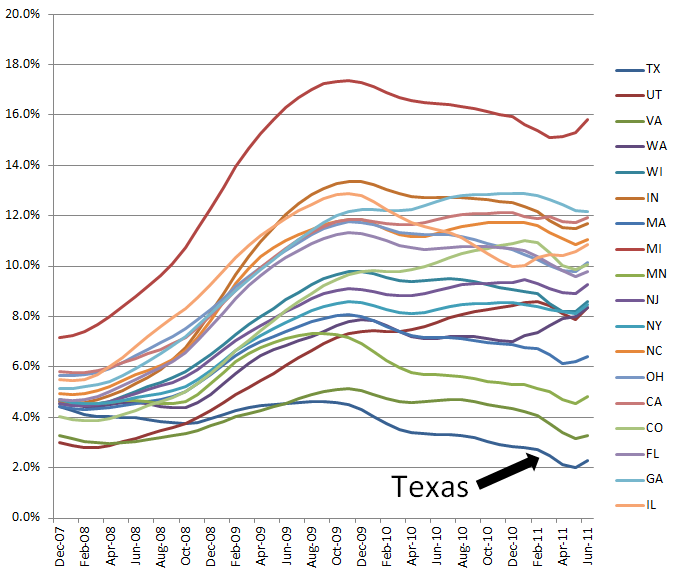
Using that metric, Texas would have a very low unemployment rate of 2.3%. But the fact that unemployment in the United States is fluid means that the unemployed flock to a place where there are jobs, which inflates its unemployment rate (at least in the short term). It’s not a bad thing for Texas… it just looks bad when dealing with the isolated “unemployment %” statistic.
UPDATE: @francisgagnon on Twitter felt that this chart was dishonest because it charts Texas as having 2.3% unemployment and (in his words so I don’t get him wrong): “It assumes immigrants create no jobs. But more people = more consumers = more jobs.”
He is absolutely right about this. I tried to be clear above that this chart doesn’t account for the fluid nature of an economy with immigration and departures of hundreds of thousands of people, but I don’t want to leave anyone with the wrong impression. So here it is: This chart doesn’t account for the fluid nature of an economy with immigrations and departures of hundreds of thousands of people. The point of this chart is not to say “Texas should have 2.3% unemployment if only things were fair.” Instead, it is an attempt to chart job growth in such a way that controls for people leaving one job market to enter another. To say “Wisconsin has a better job market than Texas because its unemployment rate is 0.6% lower” is a wholly untrue statement even though it cites accurate numbers. What this chart is meant to do is not posit a counter-factual, but to give a visual representation of the employment reality that is obscured by the way we calculate unemployment numbers.
END UPDATE
And… that’s it.
You may have noticed that I don’t mention Rick Perry very much here. That is because Rick Perry is, in my opinion, ancillary to this entire discussion. He was governor while these these numbers happened, so good for him. Maybe that means these jobs they are his “fault”. Maybe the job situation is the result of his policies. Or maybe Texas is simply the least bad option in a search for a favorable economic climate.
That is not an argument I’m having at this exact moment. My point is to show that most of the “excuses” you will hear about Texas’ job statistics are based in nothing more than a hope that Rick Perry had nothing to do with them and not on a sound understanding of the data.
My advice to anti-Perry advocates is this: Give up talking about Texas jobs. Texas is an incredible outlier among the states when it comes to jobs. Not only are they creating them, they’re creating ones with higher wages.
One can argue that Perry had very little to do with the job situation in Texas, but such a person should be probably prepare themselves for the consequences of that line of reasoning. If Rick Perry had nothing to do with creating jobs in Texas, than why does Obama have something to do with creating jobs anywhere? And why would someone advocate any sort of “job creating” policies if policies don’t seem to matter when it comes to the decade long governor of Texas? In short, it seems to me that this line of reasoning, in addition to sounding desperate and partisan, hogties its adherents into a position where they are simultaneously saying that government doesn’t create jobs while arguing for a set of policies where government will create jobs.
Or, to an uncharitable eye, it seem they are saying “Policies create jobs when they are policies I like. They don’t create jobs when they are policies I dislike.”
People will continue to argue about the data. But hopefully this will be helpful in sorting out reality from wishful and desperate thinking. I mentioned on Twitter that the Texas jobs situation was nothing short of miraculous. This is why I said that and why I’m standing by that statement.
Two things often overlooked when discussing social and economic statistics in Texas are, firstly, it’s a majority-minority state, and secondly, it’s the second youngest state in the nation by median age. Considering the moderately increased likelihood for minorities to earn minimum wage and the extremely disproportionate likelihood for younger people to earn minimum wage, Texas is in fact well above the national average. Even still, it’s misleading to claim that Texas has the second-most workers working at the federal minimum wage, because other states have statewide minimum wages (Texas does not) that drastically reduce the percentage of their population making the federal minimum wage, even if they’re only making $0.10 more an hour. This tends to have little effect on median income.
Likewise, statistics such as SAT scores when broken down by the students’ ethnicities prove to be well above the national average despite being overall below states like Wisconsin with more homogeneous populations. See: http://iowahawk.typepad.com/iowahawk/2011/03/longhorns-17-badgers-1.html
Dan, I have a lot of trouble believing that Texas ranks 47th in SAT scores, mostly because almost no one in Texas takes the SAT. State schools in Texas use the ACT for admission criteria, so students in Texas typically take the ACT.
The SAT is the predominant test for the Northeast and the West Coast. The rest of the country goes with the ACT for the most part.
Where does Texas fall in ACT rankings?
While a finish in the top 10% of your class guarantees you admission to a state school in Texas, it does not necessarily guarantee you admission to the state school of your choice. My niece, with a 3.95 GPA, an IB diploma and one place removed from being in the top 10% of a senior class of over one thousand, was turned down at the University of Texas at Austin. Her Hispanic heritage didn’t even help, much to her mother’s consternation. Instead, she wound up at UT Arlington, where they are, for all practical purposes, paying her to attend, given the amount of scholarship money they threw her way.
There is a reason it is so hard to get into UT Austin, a school with tens of thousands of students. There are a lot of very smart kids in Texas.
As a resident of South Texas I have seen huge numbers of new people in the community. Many of them are illegals, but many are also Mexican citizens fleeing their drug torn communities. Perry has done nothing to help Texas out with the illegal immigration problem. Nor has he bothered to check out the extreme amount of Medicare and Medicaid fraud at the newest biggest hospital in the Rio Grande Valley and in the countless Rehabilitation or Home Healthcare Services that are costing the U.S. tax payers so very much. Jobs are being lost in Texas, too. We are finally catching up to the rest of the nation. Perry will have to do some real turn arounds to convince me he is our best candidate against evil Obama and his Socialist backers.
You can’t say that if you take out energy jobs the employment would still be growing like weeds. The salary made from energy jobs feeds industries that provide services and products to those energy job employees.
would you care to estimae a multiplier for the oil industry ?
I have heard, anecodotally, from friends from texas, that those jobs pay very well, particularly in regard to education level.
so maybe there is a multiplier to ?
You don’t mention lack of regulation.
If in WI or NY or CA, you are required to get a license for a hazardous chemical ( I work in the biotech biz, and costs can be significant) and you don’t in TX, it is just like biz moving to china cause they don’t have those pesky osha/epa things goin on
ditto with child health insurance; I’m sure you have seen the numerous blog posts that tx is tops,or near tops in this catagory (don’tknow if that includes illegals…)
sure, if the cost of biz is lower, jobs will move there; not a great strategy, but what the heck..
I don’t want to diss all the good and hard work you did, but i find your graph showing a 6% increase in labour force, to use a technical term, ***ing unbelievalbe..
another thing is tha perhaps TX avoided what looks like outlandish retirement bennies; without getting into a long protracted arguments, at least some fraction of retirement in NE states are wrong (2 examples: today, in Boston, a jury AQUITTED a fireman who had retired on disability, to pained by his back to even shuffle paper; the fireman then entered competitive body building contests; the LIRR (commuter rail in NY) is the most dangerous place to work in america: some 90% of employees retire early on medical disability; these may be a small % of total govt retirement bennies, but they add up
which sort of gets to my next point, all these numbers, without some sort of idea as to why, are sort of unsatisfactory…
would you care to estimae a multiplier for the oil industry ?
I have heard, anecodotally, from friends from texas, that those jobs pay very well, particularly in regard to education level.
so maybe there is a multiplier to ?
You don’t mention lack of regulation.
If in WI or NY or CA, you are required to get a license for a hazardous chemical ( I work in the biotech biz, and costs can be significant) and you don’t in TX, it is just like biz moving to china cause they don’t have those pesky osha/epa things goin on
ditto with child health insurance; I’m sure you have seen the numerous blog posts that tx is tops,or near tops in this catagory (don’tknow if that includes illegals…)
sure, if the cost of biz is lower, jobs will move there; not a great strategy, but what the heck..
I don’t want to diss all the good and hard work you did, but i find your graph showing a 6% increase in labour force, to use a technical term, ***ing unbelievalbe..
another thing is that perhaps TX avoided what looks like outlandish retirement bennies; without getting into a long protracted arguments, at least some fraction of retirement in NE states are wrong (2 examples: today, in Boston, a jury AQUITTED a fireman who had retired on disability, to pained by his back to even shuffle paper; the fireman then entered competitive body building contests; the LIRR (commuter rail in NY) is the most dangerous place to work in america: some 90% of employees retire early on medical disability; these may be a small % of total govt retirement bennies, but they add up
which sort of gets to my next point, all these numbers, without some sort of idea as to why, are sort of unsatisfactory…
Listen Y’all. This is a most interesting bit of research. I will definitely be keeping it on hand to use with folks who just listen to all the blah blah pundits. I have lived in Texas most of my life. Born here. Mother born here. As a matter of fact, this family has been here for 6 generations. Went to California to get my degree. Didn’t hurt me none. Life has always been good here. Plenty to do. Plenty of money. A place on earth that resonates with good will. All Y’all Yankees with a prune face…just stay right where you are and keep on believing the lies.
I do not believe that Government or it’s policies policies can create private sector jobs. Only free-markets do that. At best, “well-intentioned” policies alter what jobs are filled. They push the air around in the balloon that is the economy, or throw the seed to a differnt flock of birds. However, these policies with other intentions (i.e. greening the environment, distributing the wealth, or giving everyone “free” health care) have a decidedly negative impact on the work of the free-market players who do create jobs. When employers are driven away, out of markets they could be in or even states or countries, jobs go with them.
Associatedcontent.com under Richest and Poorest States ranks the states from richest to poorest based on cost-of-living-adjusted median household income.
Some partial results:
Texas 54,836
California 46,418
New York 43,769
Texas ranks 24 places ahead of California and 28 places ahead of New York and has a typical household yearly purchasing power $8,418 ahead of California.
What economic statistic is even close to being as important as that?.
It’s also important to point out that it’s the Liberal demographic that causes the great majority of crime, poverty, and low test scores.
Texas, California, and New York all have a large bottom end population, but Texas’ upper 50% is much more Conservative which is a prime reason for their much greater affluence.
Just a point for those curious about the spikes in the 4th graph (public sector jobs), besides the 2010 census, Austin TX is also where most of the IRS data entry happens, so there’s a huge influx of mid-range workers every April 15th, which you can see in the data for Federal Employees. That soaks up a lot of college kids from University of Texas, but even more housewives and underemployed that enter then exit the labor market for a few months each year. Great article, by the way.
Graph 5 gives a nice portrayal of the #2 position for wage growth: DC. Nice to know they are increasing pay in DC better than anywhere but Wyoming. At least WY is likely due to oil and gas services. DC is getting wealthy taking from us and giving to them.
all the states used to have the same dynamic optimism that is being discussed on this thread. Nowadays, say about five of them retain it. What happened to the other 45 is 45 different stories –but each one is knowable. Each story has a telling time when something or other went hinky and the state did not in the usual cyclical way bounce back.
Each of the 45 stories will be a ‘people story’ because all stories are people stories. Since it was people then, who caused the distress evident everywhere including here on this thread, then it is people who can return the 45 stories back to fine uplifting literature and away from whatever it is or is becoming now.
It seems clear that step 1 is in honestly identifying in your own mind and heart what went wrong –and then you’ll know the whos and the whitcheewhys to never listen to nor follow ever again.
perry made TX better for business so jobs moved to TX. that doesn’t scale for whole nation. need to create not import jobs.
There is another consideration to modify your graph for the low paying section. The Texan wages can purchase a whole lot more living in Texas than in California where the same minimum wage employee enjoys only about 60% of the Texan’s lifestyle.
{^_^}
You asked what about the difference between Obama’s record on jobs and Perry’s. One thing that’s not always obvious to people outside of Texas is that under our Reconstruction-era state constitution, the Governor is either the fifth or sixth most powerful elected position in the state. Perry has some advantages over other Texas governors, including his extremely long tenure and the inability of Democrats to win any state-wide office recently. That sorta-kinda makes him on the team that can claim responsibility for the current results, but it’s hardly a guarantee.
Saudi Arabia has 21% of the workforce in the Energy industry. So oil has nothing to do with the wealth of the Saudis?
You forgot indirect job creation from the energy sector.
It’s not just the indirect job creation from the energy sector, but also all the energy jobs that don’t roll up in any of the categories above. All of the energy consultants, bankers, accountants, etc. would fall under “business and professional services,” but no question those are energy jobs.
And that’s the difference in between Texas and other nearby (much poorer) energy-producing states (Louisiana, Arkansas, Oklahoma, New Mexico)–Texas is the intellectual capital of the energy industry, not just where it is produced.
Do you prefer Obama vs. Rick Perry?
Thanks for the perspective, politicalmathblog.com!
One more stat: the Houston Chronicle recently reported that 70% of the 1.4 million illegal immigrants in Texas are on welfare. Obviously this drives up the state’s unemployment rate and its rate of uninsured citizens.
Thank you for your work, it’s very helpful to the discussion.
Great Analysis! Thanks for the work you put into this!
Very intriguing analysis. In this issue of bloggingheads:
http://bloggingheads.tv/diavlogs/38122
two Texas based journalists make the claim that Perry can be credited largely with “stealing” jobs from other states (at work so I can’t find the location). Do you know of any way to evaluate this claim with data?
Thank you for an informed, well-researched and well-reasoned article. I wish everything I read in the blogosphere was of this quality.
Great piece. Thanks for sharing.
Mr. Perry has done some good things in Texas, and he has the right ideas with reducing regulations and reducing government spending. He’s created an environment where business can, well, do business. So I think Governor Perry should be congratulated. However, I read yesterday morning how he has raised $150 million in his political career from only 37 donors, and that there is possibly a link between that and contracts, etc. You think there is a payoff there? This is the kind of thing I’ve grown sick of seeing in Washington and, two months ago, launched my own candidacy for president. I’m just a regular citizen who’s fed up. I’m an unknown, but that is changing–the campaign site passed 130,000 hits yesterday. I’ve written on why we need to eliminate the deficit and how to do it, how to get the country going again economically and a host of other issues facing America. The thing which separates me from the other candidates is that I am not owned by the “moneymen.” I’m not beholden to anyone. At any rate, check it out, and if you like what you see, spread the word. http://www.gradyforpresident.com.
Great analysis! Great blog! Speaking as a fello math, stats & Excel “geek,” political junkie and proud Texan… Thank you!
Policy in Texas is the business of the Legislature, not the governor. The governorship is practically a ceremonial job. And you may not like Perry for president but you did a really disingenuous job of softpedaling the real cause of the so-called Texas Miracle: energy prices. You can’t just say, “oil boom = jobs creation” because that isn’t the point. The point is the flood of money into the state owing to insane energy prices.
Thanks for this- I’m not a Perry fan either, but you’re right- it’s best to debate in the light of day 🙂
I think your share to FB button is broken. I keep pushing it so that I can share your awesomeness with thousands of my friends but it crashes my browser. What gives?
Thanks!
Sorry, Maria–the jobs boom in Texas was going on long before energy prices spiked. Besides, what has Obama done to oil drilling and production out of the Gulf? Pretty sad to emphasize one point and completely ignore the other–you must be a KoolAid drinking Liberal.
Toward the end, you wrote, “But the fact that unemployment in the United States is fluid means that the unemployed flock to a place where there are jobs, which inflates its unemployment rate (at least in the short term).” This is not entirely true. People flock to where they believe that they can find a job. You admit as much further up with “This is speculative, but it *seems* that people are moving to Texas looking for jobs rather than moving to Texas for a job they already have lined up.” A meaningful analysis will have to include a perceptions survey in addition to the above data.
Texas has worked very hard to give itself an image of being pro-business and therefore by implication of being pro-jobs creation. That is what people believe because that’s what they’ve been told. While almost anyone could find the information you post here, very few have the inclination or time or ability to analyze it in any meaningful manner.
As for the data itself, there are long-term structural advantages from which Texas benefits which no one, Perry or otherwise, could possibly control, not least of which is ready access to oil fields, cheap labor, and physical location. A few of these structural advantages are outlined here: http://blog.chron.com/txpotomac/2011/07/ten-reasons-why-the-texas-economy-is-growing-that-have-nothing-to-do-with-rick-perry/
So, yes, Texas is doing well, and as a Texan, I’m quite happy about that fact. But, Perry’s policies, as such, have largely been to continue or expand previously existing ones in terms of state-business relations. So, in that sense, he does indeed have something to do with jobs in our state but not in the way most people think. That is, continuing ideas not his own. In fact, many of the policies and business relationships have been in place for decades. A few are old enough to be entrenched in our state constitution. Because of the policies established before he was even born, Perry merely reaps the benefit of the status quo.
Obama, by contrast, wanted to change the fundamental nature of the government-business relationship and businessmen are fighting it as is only right from their point of view. And when the two are fighting, jobs will be compromised in the process.
So, Perry’s jobs genius, if it is such, is that he didn’t really do all that much beyond continuing what his predecessors started.
Having done all this research, could you easily give a run-down of exactly where the jobs have been created, other than the energy sector? Would really be helpful to have the full picture.
Thanks!
Excellent! Thank You for the well researched information. This should be placed in every mailbox in America.
Impressive research! Here is an anecdote:
I close friend of mine here in NJ had an advanced degree but no luck finding a job last year. He has a job now, a nice one, pays real well. Where? In Texas. And you can bet your bottom dollar (if you have any left, after paying real estate tax here…) there are some people with advanced degrees in NJ who are doing the moral equivalent of flipping burgers.
Of course, Gov. Christie is as every bit as conservative as Gov. Perry, but NJ isn’t a job machine, because of course developing a pro-business environment conducive to job creation takes a lot of long term effort, over the course of years.
And this really is the big problem with the Obama administration. There is no magic formula for short or even medium term job creation. But at least it’s worth pursuing policies that are conducive to private sector economic activity. However, the Obama administration has been remarkably hostile, both in tone and substance, to the business community in general. At least that’s the business community’s perception, but when it comes to encouraging investment and job creation, perception counts, for a lot.
It’s hard to tell who is more hostile toward whom, Obama to the business community or the business community to Obama. The struggles of middle class Americans (housing, health care, education, et al), the explosion of Financial Speculation as America’s chief economic “product”, and the rising gap between rich and poor, all make for a pretty clear mandate from Obama’s voters to which he’s adhered, but with limited success and some would argue his tactics have been more centrist than left-leaning. Of course the far Right would dispute this, so he’s cursed from both sides.
If business “likes” the incumbent, they tend to be more relaxed and open for growth. So does that mean any GOP president or governor will have this advantage? Can the DEMs serve their popular base and still court business? Given the wildly polarized climate we live in, that seems nearly impossible.
To the author, This is great!!
To Marcus… I know this isn’t your quote, but seriously, how on EARTH can illegal immigrants be on welfare? I’m not calling you or anyone at the HC a liar, I’m just saying that if it’s true what the HELL are we doing cutting defense spending, when we can stop supporting ILLEGAL activity (ie, being here ILLEGALLY). I can’t help but wonder.. if we stopped carrying their (illegal immigrants) cozy asses, what kind of $$ this country would be saving.
If ILLEGAL ‘workers’ can get on welfare, it must be DAMMED easy for legal ‘workers” to get the same entitlement benefits.
This is a really informative collection and analysis of the data. When you say that “Increases in jobs in the energy sector (or closely related to it) account for about 25% of the job increases in the last year” are you accounting for the job multiplier effect for each energy industry job and, if so, in what way did you factor this in? Estimates vary wildly, but a 2009 PwC report indicates each energy sector job supports over 3 other jobs. There seems to be a slightly lagging yet strong correlation between the price of crude and the Texas employment numbers (http://quotes.post1.org/historical-crude-oil-price-chart/). Texas is also an historically major center for the defense industry, which has similarly been outperforming the broader economy and likely has a high job multiplier effect.
The web is already making it hard to access this site. I have already downloaded it all to my hard drive into a Word Document, just in case, it is removed all together.
Another major news source (the Washpost I think) has already mentioned your mathematical analysis on the Texas Jobs as a tool that will be very difficult to argue against; the spinners and twisters in the (Obama adoring and Liberal) media are going to have a hard time swalling these numbers.
Please take care…
The claim that “70% of illegal immigrants are on welfare” is misleading.
Here’s that actual Houston Chronicle article:
http://blog.chron.com/txpotomac/2011/04/study-70-of-texas-illegal-immigrant-families-receive-welfare/
The report includes just about any government program as “welfare.” Including school lunches. It also shows that, contrary to popular opinion, immigrants families are more likely than others to have somebody working. It’s just that they are often stuck in low wage jobs and therefore their kids qualify for extra help. But they are working and productive.
Furthermore, the group that wrote that study, CIS, is hardly unbiased or a respected research organization among actual social scientists.
http://www.splcenter.org/publications/the-nativist-lobby-three-faces-of-intolerance/cis-the-independent-think-tank