Full disclosure: I don’t like Rick Perry for our next president. I have my reasons that aren’t worth going into here. However, when I was watching the GOP debate and pro-Perry people started bringing up Rick Perry’s job numbers as a cudgel against other candidates, I looked into the BLS data on Texas jobs. Having familiarized myself with the data, I started noticing claims on the Texas jobs data that started popping up that directly contradicted what I was seeing in the data. So I wanted to clear up a couple of these common misconceptions.
Note: If you are going to comment and you want to introduce some new objection to the Texas job numbers, you MUST provide original data. I spent about 4 hours digging through raw data to write this post. I don’t want you to point to some pundit or blog post and take it on their authority, because I’ve already researched several idiot pundits who are talking directly out of their asses when it comes to the data. I want you to point to the raw data that I can examine for myself. This means links. I refuse to waste any more of my time on speculative bullshit or “Well, I’ll wager that the Texas jobs don’t really count because…” If you’re willing to wager, take that money and put it towards finding the actual data. In short, put up or shut up.
I’m not cranky, I swear.
Anyway, let’s deal with the complaints in no particular order:
“Texas has an unemployment rate of 8.2%. That’s hardly exceptional.”
See… that’s what I thought when I started looking at the data. I knew that Utah had a lower unemployment rate than Texas and I kept hearing that Texas was go great at jobs, blah, blah, blah, so I looked up the unemployment rate.
Nothing special.
So I was going to drive my point home that Texas was nothing special by looking at their raw employment numbers and reporting on those. That’s when I saw this:
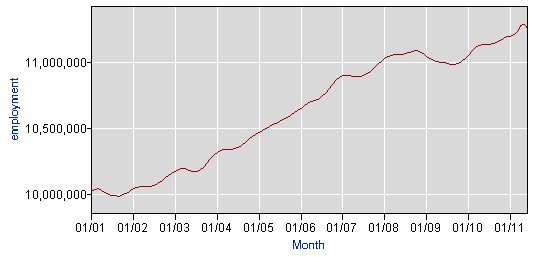
This may not look like anything special, but I’ve been looking closely at employment data for a couple years now and I’ve become very accustomed to seeing data that looks like this.
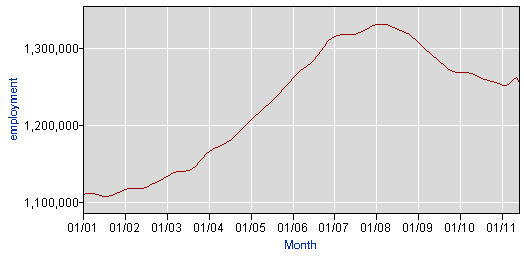
In a “normal” employment data set, we can easily look at it and say “Yep, that’s where the recession happened. Sucks to be us.” But not with Texas. With Texas, we say “Damn. Looks like they’ve recovered already.”
(To get to this data, go to this link http://data.bls.gov/cgi-bin/dsrv?la then select the state or states you want, the select “Statewide”, then select the states again, then select the metrics you want to see.)
But if Texas has so many jobs, why do they have such a high unemployment rate? Let’s take a closer look at that data.
As a percentage of the number of pre-recession jobs, here is a chart of the growth of a selection of states. (For clarity, in this chart I selected a number of the largest states and tried to focus on states that have relatively good economic reputations. I did not chart all 50 states b/c it would have taken me too long.)
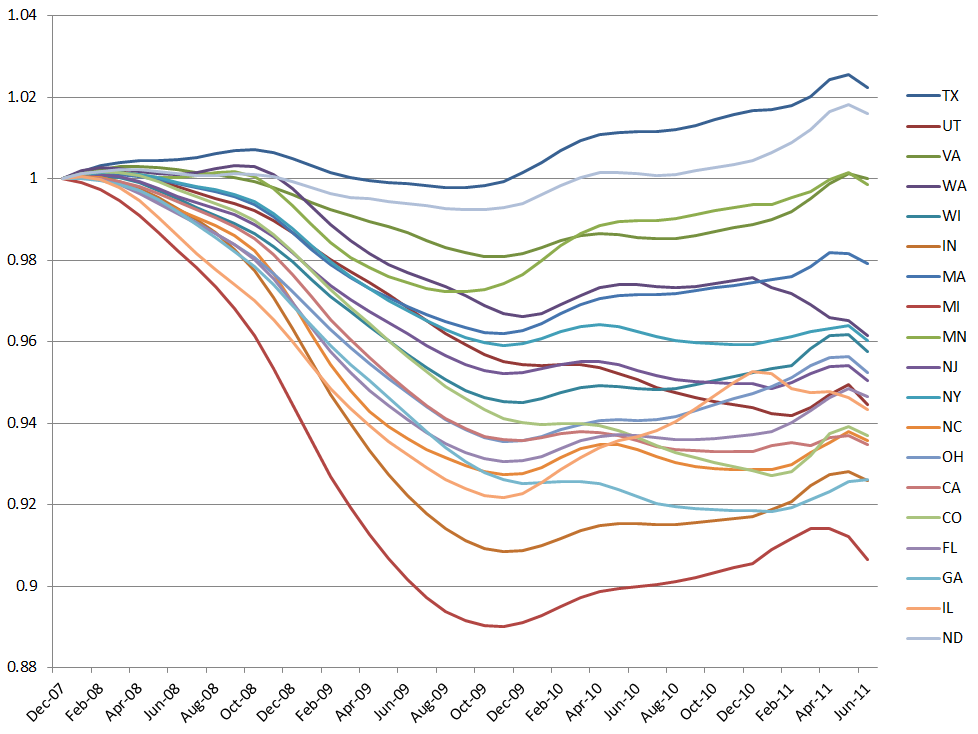
We can see that Texas has grown the fastest, having increased jobs by 2.2% since the recession started. I want to take a moment and point out that second place is held by North Dakota. I added North Dakota to my list of states to show something very important. North Dakota currently has the lowest unemployment rate of any state at 3.2%. And yet Texas is adding jobs at a faster rate than North Dakota. How can this be?
The reason is that people are flocking to Texas in massive numbers. Starting at the beginning of the recession (December 2007), let’s look at how this set of states have grown in their labor force.
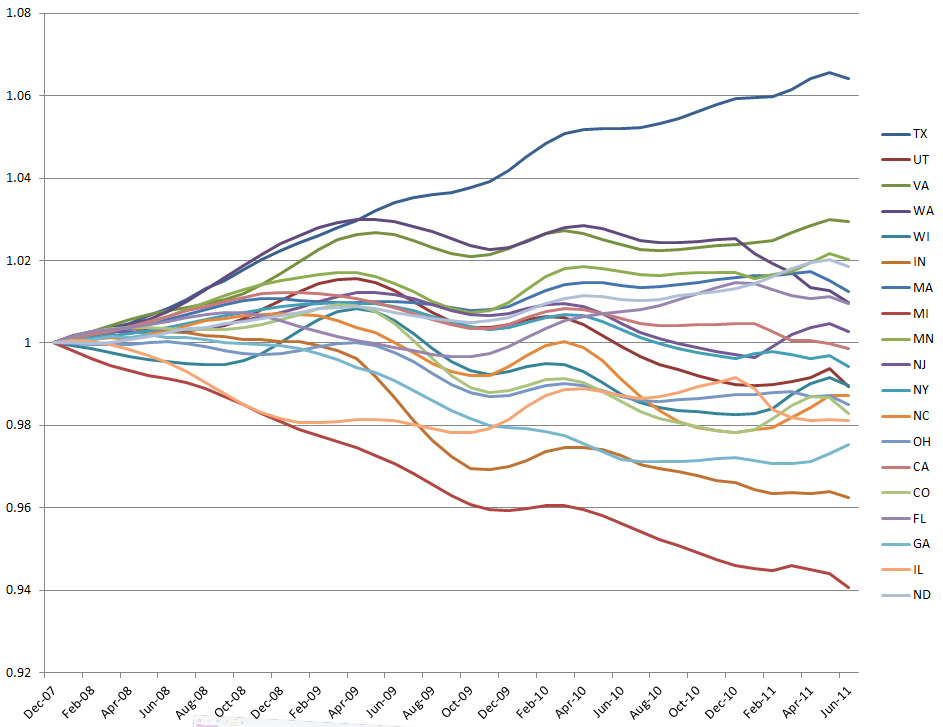
As you can see, Texas isn’t just the fastest growing… it’s growing over twice as fast as the second fastest state and three times as fast as the third. Given that Texas is (to borrow a technical term) f***ing huge, this growth is incredible.
People are flocking to Texas in massive numbers. This is speculative, but it *seems* that people are moving to Texas looking for jobs rather than moving to Texas for a job they already have lined up. This would explain why Texas is adding jobs faster than any other state but still has a relatively high unemployment rate.
“Sure, Texas has lots of jobs, but they’re mostly low-paying/minimum wage jobs”
Let’s look at the data. Here’s a link: Occupational Employment and Wage Estimates
Texas median hourly wage is $15.14… almost exactly in the middle of the pack (28th out of 51 regions). Given that they’ve seen exceptional job growth (and these other states have not) this does not seem exceptionally low.
But the implication here is that the new jobs in Texas, the jobs that Texas seems to stand alone in creating at such a remarkable pace, are low paying jobs and don’t really count.
If this were true, all these new low-paying jobs should be dragging down the wages data, right? But if we look at the wages data since the beginning of the recession (click to enlarge, states are listed alphabetically)
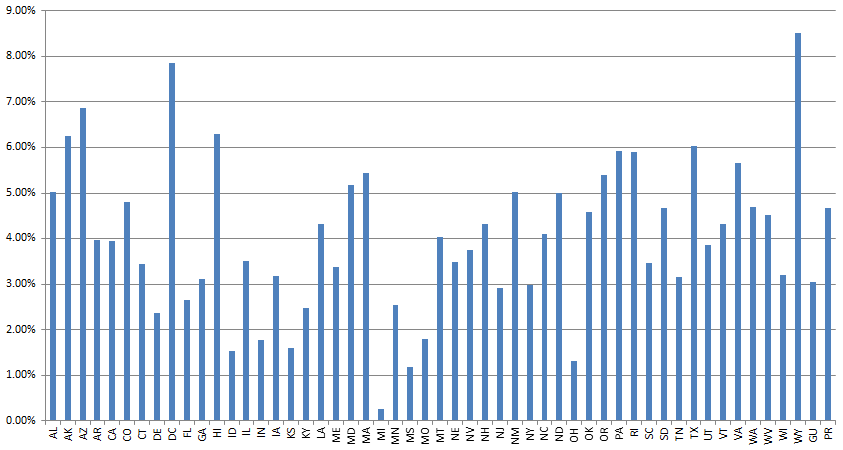
And it turns out that the opposite is true. Since the recession started hourly wages in Texas have increased at a 6th fastest pace in the nation.
As a side note, the only blue state that has faster growing wages is Hawaii. Just thought I’d get that jab in since so many people have been making snarky “Yeah, I could get a job in Texas is I wanted to flip burgers!” comments at me on Twitter.
“Texas is oil country and the recent energy boom is responsible for the incredible jobs increase.”
In identifying “energy jobs” I cast as wide a net as possible. If you want to replicate my findings, go to this link: http://www.bls.gov/sae/data.htm, click on “One-Screen Data Search”, then select “Texas”, then select “Statewide”, then in Supersectors select “Mining and Logging”, “Non-Durable Goods” and “Transportation and Utilities” and then in Industries select “Mining and Logging”, “Natural Gas Distribution”, “Electric Power Generation” and “Petroleum and Coal Products Manufacturing”.
Tedious, I know, but transparency is important and this is how you get the data.
When we finally get the data, we discover that energy isn’t really the biggest part of the Texas economy. Increases in jobs in the energy sector (or closely related to it) account for about 25% of the job increases in the last year. Since the energy sector only makes up 3% of all employment, there is some truth to this claim.
However, take the energy sector completely out of the equation and Texas is still growing faster than any other state. This indicates to us that the energy sector is not a single sector saving Texas from the same economic fate as the rest of the states. It’s not hurting, but Texas would still be growing like a weed without it.
“Texas has 100,000 unsustainable public sector jobs that inflate the growth numbers.”
I’m not sure where this one comes from, but the numbers are these (and can be found by selecting government employment from the data wizard at this link http://www.bls.gov/sae/data.htm):
Counting from the beginning of the recession (December 2007) the Texas public sector has grown 3.8%, or a little under 70,000 employees. This is faster than normal employment, but it’s not off the charts.
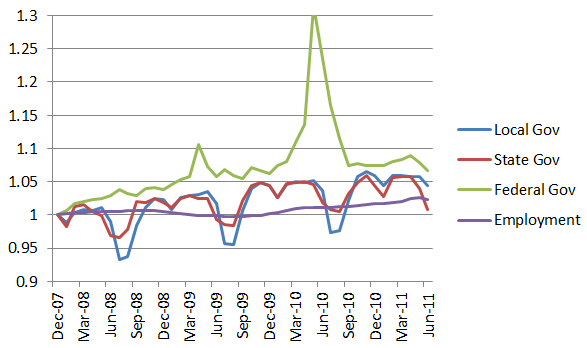
Given that the Texas economy has grown so much and private sector jobs have grown so much, that doesn’t strike me as an unsustainable growth in the public sector.
But, just in case you’re really worried about it, you can lay your fears to rest because in the last year the Texas public sector has shrunk by 26,000 jobs. In the last 12 months, Texas lost 31,300 federal employees, trimmed 3,800 state jobs, and increased local government jobs by 8,400 jobs.
(To be fair, this was partially driven by the role Texas employees played in the census, which inflated federal job numbers this time last year. Since the census numbers stabilized, federal employment has been at about break-even.)
As you can see, we’re nowhere near the “100,000 unsustainable jobs” number.
My Personal Favorite Chart
I’ll leave you with my personal favorite chart. I mentioned at the beginning that Texas is seeing high unemployment in a large part because they’re growing so damn fast. The problem with this from a charts and graphs perspective is that it leaves worse states off the hook, making them look better than they actually are. Looking at unemployment alone, we would conclude that Wisconsin has a better economy than Texas. But Wisconsin is still 120K short of it’s pre-recession numbers. The only reason they look better than Texas is because 32,000 people fled the state.
During that time, 739,000 people fled into Texas. Anyone who takes that data and pretends that this is somehow bad news for Texas is simply not being honest. At the worst, I’d call it a good problem to have.
So, to give something of a better feeling for the economic situation across states, this chart takes the population of the states I selected above and judges the current job situation against the population as it stood at the beginning of the recession.
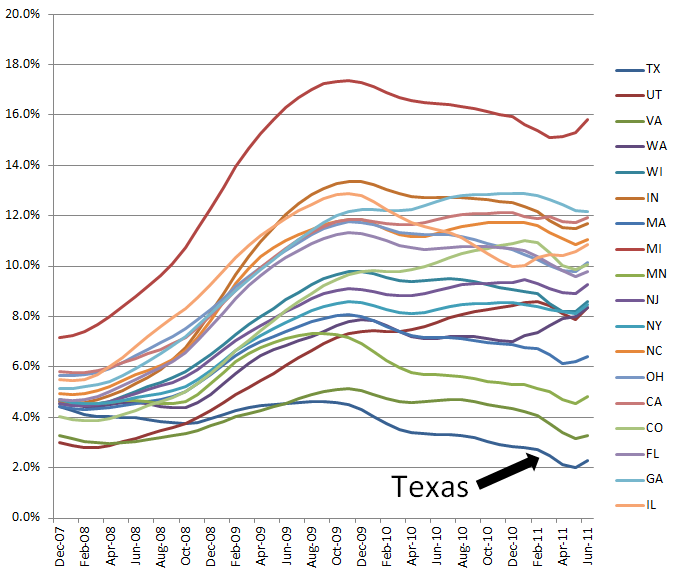
Using that metric, Texas would have a very low unemployment rate of 2.3%. But the fact that unemployment in the United States is fluid means that the unemployed flock to a place where there are jobs, which inflates its unemployment rate (at least in the short term). It’s not a bad thing for Texas… it just looks bad when dealing with the isolated “unemployment %” statistic.
UPDATE: @francisgagnon on Twitter felt that this chart was dishonest because it charts Texas as having 2.3% unemployment and (in his words so I don’t get him wrong): “It assumes immigrants create no jobs. But more people = more consumers = more jobs.”
He is absolutely right about this. I tried to be clear above that this chart doesn’t account for the fluid nature of an economy with immigration and departures of hundreds of thousands of people, but I don’t want to leave anyone with the wrong impression. So here it is: This chart doesn’t account for the fluid nature of an economy with immigrations and departures of hundreds of thousands of people. The point of this chart is not to say “Texas should have 2.3% unemployment if only things were fair.” Instead, it is an attempt to chart job growth in such a way that controls for people leaving one job market to enter another. To say “Wisconsin has a better job market than Texas because its unemployment rate is 0.6% lower” is a wholly untrue statement even though it cites accurate numbers. What this chart is meant to do is not posit a counter-factual, but to give a visual representation of the employment reality that is obscured by the way we calculate unemployment numbers.
END UPDATE
And… that’s it.
You may have noticed that I don’t mention Rick Perry very much here. That is because Rick Perry is, in my opinion, ancillary to this entire discussion. He was governor while these these numbers happened, so good for him. Maybe that means these jobs they are his “fault”. Maybe the job situation is the result of his policies. Or maybe Texas is simply the least bad option in a search for a favorable economic climate.
That is not an argument I’m having at this exact moment. My point is to show that most of the “excuses” you will hear about Texas’ job statistics are based in nothing more than a hope that Rick Perry had nothing to do with them and not on a sound understanding of the data.
My advice to anti-Perry advocates is this: Give up talking about Texas jobs. Texas is an incredible outlier among the states when it comes to jobs. Not only are they creating them, they’re creating ones with higher wages.
One can argue that Perry had very little to do with the job situation in Texas, but such a person should be probably prepare themselves for the consequences of that line of reasoning. If Rick Perry had nothing to do with creating jobs in Texas, than why does Obama have something to do with creating jobs anywhere? And why would someone advocate any sort of “job creating” policies if policies don’t seem to matter when it comes to the decade long governor of Texas? In short, it seems to me that this line of reasoning, in addition to sounding desperate and partisan, hogties its adherents into a position where they are simultaneously saying that government doesn’t create jobs while arguing for a set of policies where government will create jobs.
Or, to an uncharitable eye, it seem they are saying “Policies create jobs when they are policies I like. They don’t create jobs when they are policies I dislike.”
People will continue to argue about the data. But hopefully this will be helpful in sorting out reality from wishful and desperate thinking. I mentioned on Twitter that the Texas jobs situation was nothing short of miraculous. This is why I said that and why I’m standing by that statement.
Defending poor, backwards Texas from the racist left. A data-filled dance through fields of wisdom:
http://iowahawk.typepad.com/iowahawk/2011/03/longhorns-17-badgers-1.html
Interesting analysis on numbers… but can you relate the numbers to anything Perry can take credit for? As mentioned, Texas can lure businesses and employees down to Texas because it is centrally located and you typically don’t have to deal with severe winters here. (I live in Texas.) Perhaps tax breaks and no state income tax lure people here away from other states. How is this formula going to work for the US?
Don’t forget that the official unemployment figures are only calculated using people who are actively looking for a job. There are millions of ‘discouraged’ workers around the country who are no longer looking for work because they have given up in disgust. I would suppose (but have not put the time into number crunching that our host has) that there is a much smaller percentage of these discouraged workers in Texas than in other states with ‘officially’ lower unemployment. Looking at the labor force participation rates of some of the various states might be interesting.
Gustav, you recognize that your basic argument is: “Texas is growing because it has a good economic climate compared to other states” Yes, I think we all agree that is happening. Perhaps someone should think about changing the economic climate of those other states to lure these people back.
It’s pretty clear that the unemployment problem is directly related to the bursting of the housing bubble, and it seems that those states with higher home prices had further to fall. Interestingly, it was Texas’ nanny-state regulation in regards to home refinancing that is driving their current success.
Jim,
Yes, that paper is really nifty, and no one on this thread is disagreeing that, historically and generally, there is a “pretty clear correlation between unemployment rates and how long it takes to find a job”. That is absolutely true.
But what YOU are missing is that, also historically and generally, populations are fairly stable – higher unemployment results from fewer jobs available, which increases unemployment BECAUSE there aren’t enough jobs. Shortage of jobs causes unemployment to rise and keeps it there by making it hard to find another job.
That is, you aren’t taking causation into account AT ALL, and you are making a hard rule out of a historical soft trend.
Job availability is the driver. Length of unemployment is an effect. Population movement relative to job availability can (and does) disrupt the trend.
Greg Q gave a great example (go read it again), but in the interest of making this even more clear, here’s a simpler one:
In state X, there are 800 jobs available and 1,000 job seekers out of a population of 10,000. In state Y, there is 1 job available and 100 job seekers out of a population of 10,000. The current unemployment rate in X is 10 times HIGHER than the rate in Y, but the chances of actually getting a job in X are *80* times better.
Can you see that in that simple example? I don’t give a crap how low your unemployment is, if there are no jobs available, your chances of getting a job are **0**. I don’t care how high your unemployment is, if there are more jobs available than people to fill them, your chances of getting a job are VERY VERY good.
Unemployment level only TENDS to predict how easy or hard it will be to get a job – it’s a decent rule of thumb, nothing more.
“I did check the foot notes, did you? Could you possibly find some sources that are not blatantly aligned with socialist ideology?”
What does ideology have to do with performance numbers? Sure, some polling / opinion things could definitely be swayed by ideology, but you can’t say that things like ratings in SAT performance are ideologically biased ….
Or maybe you can, but then you’d make your own ‘math’ seem just as equally biased.
Just because the numbers show horrible performance does not make them ideologically biased ….
Texas by the numbers:
47th in SAT scores
50th in percentage of population over 25 with a high school diploma
5th in percentage of children living in poverty
32nd in per capita income
49th in child immunization
1st in population without health insurance
3rd in poverty
3rd in malnourishment
5th in teenage birth rate
7th in obesity
18th in heart disease
1st in air pollution emissions
1st in carbon dioxide emissions
42nd in average hourly earnings
2nd in income equality between rich and poor
50th in homeowner’s insurance affordability
50th in electric bill affordability
6th in total crime rate
12th in violent crime rate
Jim, I am with you on that, I don’t think Perry can do anything, but I don’t believe any President can. Presidents cant create jobs, but they can quickly destroy them. Disconcerting government regulations either overly burdensome or overly complicated can quickly kill businesses. Scaling back government involvement to simple, easy to follow and understand, and evenly enforced regulations could help a great deal.
All of these graphs obscure the simple fact of the numbers: that Texas employment has grown almost evenly with its increase in population. More people live there, so more people work there.
Here’s a graph that shows the real story: http://research.stlouisfed.org/fredgraph.png?g=1CV
In fact, as the graph shows, employment has grown *slower* than population.
If you want to compare to other states, you have to compare apples to apples – let’s see whether other states’ employment has grown or shrunk *in relation to* the population. And that number, really, is just the unemployment rate – which as has been pointed out, is not that hot in Texas.
Here’s another graph that shows part of the picture: how does Texas keep its employment up — to the extent that it does? The right way: by ensuring that public sector employment grows with population, rather than cutting public sector jobs like the GOP claims we should do: http://thinkprogress.org/yglesias/2011/08/16/296986/socialism-texas-style/
The facts merely say that the Texas has the largest increase in population and the largest increase in employed population.
Not sure why anyone thinks this discredits Paul Krugman’s column. An apt point that Krugman makes is that Texas has a very LOW COST OF LIVING especially so for a warm weather state. It’s not surprising that people forced out of their homes in pricier markets would migrate to Texas.
Texas also has half the rate of underwater mortgages as the national average (12% vs. 24%) This may have something to do with the fact that it has unusually strong predatory lending laws, which is something Krugman points out as well, and which has nothing to do with Perry or Republican policies.
[source links redacted because they apparently trip the spam detector]
Well, lets start with with the first one:
47th in SAT scores.
College bound students are required to take this test, however, its not used for admission selection for most because of the top 10% rule (10% of each high school grads get admitted into college). So its not a make or break for students here, they will be admitted regardless of SAT results.
For most of these could you maybe find numbers that have removed the large illegal alien population, why would you expect them to a high school diploma, not live in poverty, have a low income, not have their immunizations (Although Mexico has universal health care strangely enough), health insurance.
3rd in malnourishment/7th in obesity?? Come ON! Cant you see how freaken bias this report is?
pls
Boyd is right –the question has moved beyond the fiscal –the question is, what does the fiscal reality have to do with DC spending our new tax money? Seems a simple question, and it is, but lordy mercy it cost a-plenty and repeats a-many to learn to ask it.
John, great work, good on ya.
Jim, if you’re not a Mad Ave copywriter, you should be. The boilerplate is high quality and nearly indistinguishable from information.
Dmitry, you have the same given name and professional field as my new son-in-law. Are you in fact he, or him, and if so, how’s the weather way up there, and please say hi to Sarah for me!
I live in Midland and actual for employment is 3.5 check it Your self I think the war cry will be anyone but Obama the same dems on Bush I’ve always done well job wise when Repubs were leading just the facts
Dan, if this was true:
“More people live there, so more people work there.”
Then New York and California would not have any economic issues. You seems to be conflating cause and effect. People don’t move some where and magically jobs appear. But I would like to see per-capita public sector employment of other states become similar to Texas. Which interestingly enough was the first comment made in the comments section of the link you provided.
most jobs in Midland or well paying oil related the problem is Skilled trades is dieing no one likes to get dirty any more well except me lol as machine trades down here i get paid as well as union azzwipes no complaints
also I’m a former Yankee from upstate N.Y. I’ve seen what Representation has done There we made everything at one time in N.Y. from TV radio Car parts etc Thanks to unions enviro Nazis thats all gone and not coming back
Deoxy: I think your examples confuses an important point, it’s still possible to get a job in a state with negative overall job growth, and in fact your chances can be better than in a state with positive job growth. Perhaps I haven’t worked hard enough to explain this, sorry about that. Here goes:
In state X, there are 1,000 people unemployed already looking for a job out of a population of 10,000. Net job growth that month is positive, with 500 people losing their jobs and 600 gaining new jobs. That’s a net growth of 100 jobs. You have 500 people plus the original 1,000 looking for jobs, so 1,500 applicants for 600 jobs. That’s 2.5 applicants per job.
In state Y, there are 500 people unemployed already looking for a job out of a population of 10,000. Net job growth that month is negative, with 600 people losing jobs and 500 people gaining new jobs (the reverse of State X). Despite this, we have have 1,100 people applying for 500 jobs. Here we have 2.2 applicants per job.
Thus we’ve seen an example of a state with negative job growth where your chance of getting a job is better than one with positive job growth.
I’m not claiming that’s what is going on here, just pointing out that it’s not a given that raw positive growth numbers are the right metric to use to judge whether a state’s job growth should be deemed a “miracle”. We’ve been offered a view here that seems to accept it as a given.
Do you see what I’m saying?
“Then New York and California would not have any economic issues.”
Maybe California, but what economic issues does New York (or that liberal bastion, Massachusetts) have?
Unemployment (June 2011)
Massachusetts 7.6%
New York 8.0%
Texas 8.2%
California 11.8%
http://www.bls.gov/lau/
If you libs think Texas is so bad, please, please, please stop moving here! And keep your monolithic, DC-centric, over-burdensome regulatory regimes in your shrinking blue states.
Until May of this year, I made lots of disparaging remarks to friends from TX whenever Perry’s name came up as a possible candidate. Then I had the opportunity to look at a potential business deal and to seek some investment capital from friends in S. TX. I can tell you that you have not seen anything yet regarding the TX economy. $20 per hour required for general labor when 5 years ago $15/hr in TX or LA would have been big bucks. Then the deal itself which at 183% ROI during the STARTUP year was not enough profit to get these guys interested at all. 183% ROI????? Two years ago, these same guys were close to putting up twice the money for another deal with 25% ROI annually for 5 years.
There are more jobs in Texas than available workers. I’m in the construction business in West Texas and cannot find enough qualified workers for my needs. The 8.2% unemployment is misleading because the majority can’t pass a drug test or refuse to work at all. Why work, when Uncle Sam pays you not to.
Mike:
For New York the obvious answer is lower labor force participation rate:
http://www.bls.gov/lau/lalfprderr.pdf
For Massachusetts, it appears that people are leaving faster than the jobs are. Given their median income is high, it would allow them to be mobile in that regard:
http://data.bls.gov/timeseries/LASST25000003
thanks for this, it is getting so rare so to someone one do a bit of homework. Your conclusions are interesting and your commentary is articulate and cogent, again thanks
I found a link to this on twitter. Fascinating stuff. One thing that leaps out at me is that we do not have a graph or series of graphs on the demographics of those who are moving to TX. I am postulating that perhaps what we are seeing is a large influx of retired folks moving into TX, perhaps not taking jobs, but given age requirements actually driving a jump in some jobs in the medical care or nursing fields. It would be interesting to see graphs on the job growth by industry as well here. I am not saying this is an explanation, just a thought on what could be a major part of the engine driving this growth. It may be useful to compare against other retirement destination states as well. Perhaps the key is TX, given its size is still inexpensive vs FL and other states and the migration of retirees to the sun belt is major factor here. Just a thought.
@John
When comparing your analysis to the author of this article I can’t help but notice he explains the data with a point/counterpoint perspective, something you conveniently fail to provide. Substance and depth compared to cherry-picked figures with no basis for the reasons behind the numbers. Typical of the liberal mind; I’m correct, so you don’t merit a veiwpoint.
look at forbes we’re getting a 1000 plus a day from other states migration map
According to the BLS Quarterly Census of Employment and Wages, the average annual wage in 2010 (preliminary), for all workers and for private sector workers, was higher in Texas than it was in the U.S. overall. With respect to all workers the average wages were Texas: $46,956; U.S.: $46,742. For the private sector only the average wages were Texas: $47,615; U.S.; $46,451. Note that the gap is wider for private sector workers because Texas has relatively few federal government workers who tend to bring up the U.S. average wage for the all worker calculation, and because state and local government workers in Texas are paid less than they are in the U.S. overall.
In May 2010, I was traveling from Dallas to El Paso and decided to stop at a Motel 6 in Van Horn, TX. A couple U-haul trucks with trailers were parked out front and inside at the counter were 4 young couples in their early 30’s negotiating with the counter for two rooms with temporary beds for 8 adults and 5 children. One young man ran his fingers through his hair and mentioned they had been on the road for 17 hours.
I asked, where are you from? He said Seattle. I asked where are you going? He said Houston. I said why are you going to Houston and all the adults pointed to one person and said simultaneously “Because HE got a job.” 13 people moving to Texas because one got a job. Gave me something to think about on the rest of my trip.
having been to Midland many times I can relate to what Steven is saying! like a whole different world…….in my state most businesses are NOT even taking applications…….Gov Perry apparently is doing much right, unlike most of the rest of the Nation. GOD BLESS TEXAS & GOV PERRY!
You couldn’t pay me enough to move to Texas. All the flaky lemmings from the sun belt states can have it.
Good Bob Stay away I got no problem with That the lefties tend to try to bring There B/S with them to Austin Not working to well for Them there don’t bring your liberal Shit won’t be know Shit cause I can tell you we don’t put up with it No pc ever come from me I did mention I was born and raised in Up State N.Y. also I respect southern opinion
As a small business owner in Texas who has been making payroll every 2 weeks since 1986, I have my own perspective. It’s easy to overlook a few salient points.
During the lame duck period when Bush announced his run from president and Perry was going to be governor, the Democratic controlled legislature deliberately passed bills that overspent the state budget. Democratic insiders announced this as a deliberate move to force Perry to raise taxes so they could go to the people and claim that Governor Perry raised your taxes.
When Perry took office, he worked with most every agency in the state and got them to reduce their budgets. He also vetoed numerous appropriations passed by the Democrat controlled legislature. The next two years he did it again.
I firmly believe this frugality is one reason Texas was able to weather the tough times that caused problems for other states.
As the Texas legislature passes budgets for 2 years at a time, naysayers were pronouncing a huge budget shortfall for Texas due to reduced tax revenue from the down economy. Numbers as high as 26 billion were thrown around by the negative people. Perry was able to work with departments within Texas to resolve the budget shortfall.
One thing I can say about Rick Perry is he has the ability to say NO. When the intellectuals elitists and media editorialsist are claiming he doesn’t care about your children or your grandparents, he still has the cojones to say NO.
Perry understands the affect the huge rise in regulatory agencies with their own police forces is having on the private sector. My feeling is he has represented the citizens of Texas in their long term best interest.
Even the Trans Texas Corridor which opponents shot down was a long range forward thinking attempt to improve the economy of Texas and surrounding states. The huge amount of goods that bypass California ports by shipping into Mexico and then transporting by rail to inland ports in Kansas City and St. Louis could be coming through Texas ports. And, a good highway to the coast would benefit fly-over country states when they secede from the left and right coast as the United States becomes less united.
There is no comparison between the Ivy League educated Bush and the A&M yell leader Perry. Perry is connected to the little guy.
I might as well add things i do miss about NY is the forests the lakes [fresh seafood] things I don’t miss are panhandlers Attitudes freepers pinkos i could go on so called educated Asses
I also agree with you Buckstopshere and thanks for your support just think what might have happened if Ross Perot got the job way back when God Bless each and everyone of Us FREEDOM LOVERS
Steven, anytime brother, anytime! & I will put myself out on a limb, the country apparently was not ready for the first historic first, so HELL TO THE NO regarding estrogen & PMS……….time for a MAN with BALLS that won’t take time to scratch ’em, but rather digs in BY PUTTING AMERICA FIRST & PUTTING IT’S CITIZENS TO WORK……….
Steven, you can bet all that is holy, if Perot had gotten the office, NAFTA/GATT may have been staved off PERMANANTLY………………..
The Man We have in there Now Hates Texas hence Hammer us with the epa Here in Midland West Tx they tried with a 3 inch lizard didn’t work we’ve got tons of them friendly lil critters too but they got more smarts the any Demoncrate I stated and stand by it under Republicans leadership I’ve always had a good paying Job When Regan was building up our Military might I could have worked around the clock sometimes I did Today as everyday I thank Our Lord above for have The Good skills that does keep me gainfully Employed The only bill I have is my Mortgage and standard bills that go with Long live The proud Folks of Texas
I Agree Buck As i did Vote For him when he ran met him in person Too! scary smart If You haven’t read his Books Buck do so that was part of blue print to living my life and Great mentors are hard to come now a days and Had a few
Any one with Brain knows Gov’t can only grow Gov’t as far Jobs go Thats private biz savvy sector It was funny Buck the other day i converted a greeny about Green energy Yes I’m in oil and Gas Green energy is a good concept but not far down the road with out the help of oil and Gas natural Gas is clean if You add hydrogen boost its even cleaner I also make Hydrogen cells on the side if Gov’t would just get of the way what a world we could have Oh and History of Now only proves Joe McCarthy was right They don’t even hide anymore !!!
Dissect them as you like, the proof is in the pudding. Everyone who wants a job in Texas has one, and it had nothing to do with government intervention. It has to do with a lost common sense, a non-interventionist mentality, and allowing people to keep the money they earn. Government cannot create jobs without destroying 20 in the process. Keep tinkering Obama, see how much we can tear down. It reminds me of an old quote: “Perhaps one of the most important accomplishments of my administration has been minding my own business.”
-Calvin Coolidge
Thank you for setting the bar so high in your reporting on the employment numbers in Texas. May your colleagues across the country try to leap over it in 2012. I’m no more likely to vote for Perry as a result of it, so why be afraid of the facts?
It reminded me of the favorite saying of one of my teachers: “In God we trust, everyone else bring data.”