Full disclosure: I don’t like Rick Perry for our next president. I have my reasons that aren’t worth going into here. However, when I was watching the GOP debate and pro-Perry people started bringing up Rick Perry’s job numbers as a cudgel against other candidates, I looked into the BLS data on Texas jobs. Having familiarized myself with the data, I started noticing claims on the Texas jobs data that started popping up that directly contradicted what I was seeing in the data. So I wanted to clear up a couple of these common misconceptions.
Note: If you are going to comment and you want to introduce some new objection to the Texas job numbers, you MUST provide original data. I spent about 4 hours digging through raw data to write this post. I don’t want you to point to some pundit or blog post and take it on their authority, because I’ve already researched several idiot pundits who are talking directly out of their asses when it comes to the data. I want you to point to the raw data that I can examine for myself. This means links. I refuse to waste any more of my time on speculative bullshit or “Well, I’ll wager that the Texas jobs don’t really count because…” If you’re willing to wager, take that money and put it towards finding the actual data. In short, put up or shut up.
I’m not cranky, I swear.
Anyway, let’s deal with the complaints in no particular order:
“Texas has an unemployment rate of 8.2%. That’s hardly exceptional.”
See… that’s what I thought when I started looking at the data. I knew that Utah had a lower unemployment rate than Texas and I kept hearing that Texas was go great at jobs, blah, blah, blah, so I looked up the unemployment rate.
Nothing special.
So I was going to drive my point home that Texas was nothing special by looking at their raw employment numbers and reporting on those. That’s when I saw this:
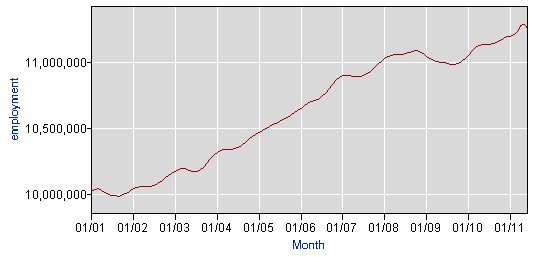
This may not look like anything special, but I’ve been looking closely at employment data for a couple years now and I’ve become very accustomed to seeing data that looks like this.
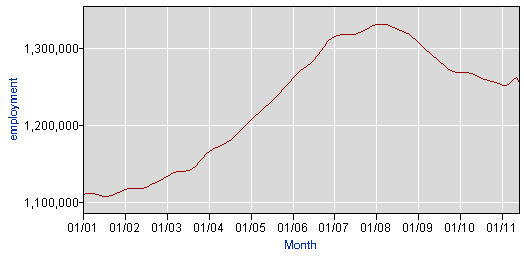
In a “normal” employment data set, we can easily look at it and say “Yep, that’s where the recession happened. Sucks to be us.” But not with Texas. With Texas, we say “Damn. Looks like they’ve recovered already.”
(To get to this data, go to this link http://data.bls.gov/cgi-bin/dsrv?la then select the state or states you want, the select “Statewide”, then select the states again, then select the metrics you want to see.)
But if Texas has so many jobs, why do they have such a high unemployment rate? Let’s take a closer look at that data.
As a percentage of the number of pre-recession jobs, here is a chart of the growth of a selection of states. (For clarity, in this chart I selected a number of the largest states and tried to focus on states that have relatively good economic reputations. I did not chart all 50 states b/c it would have taken me too long.)
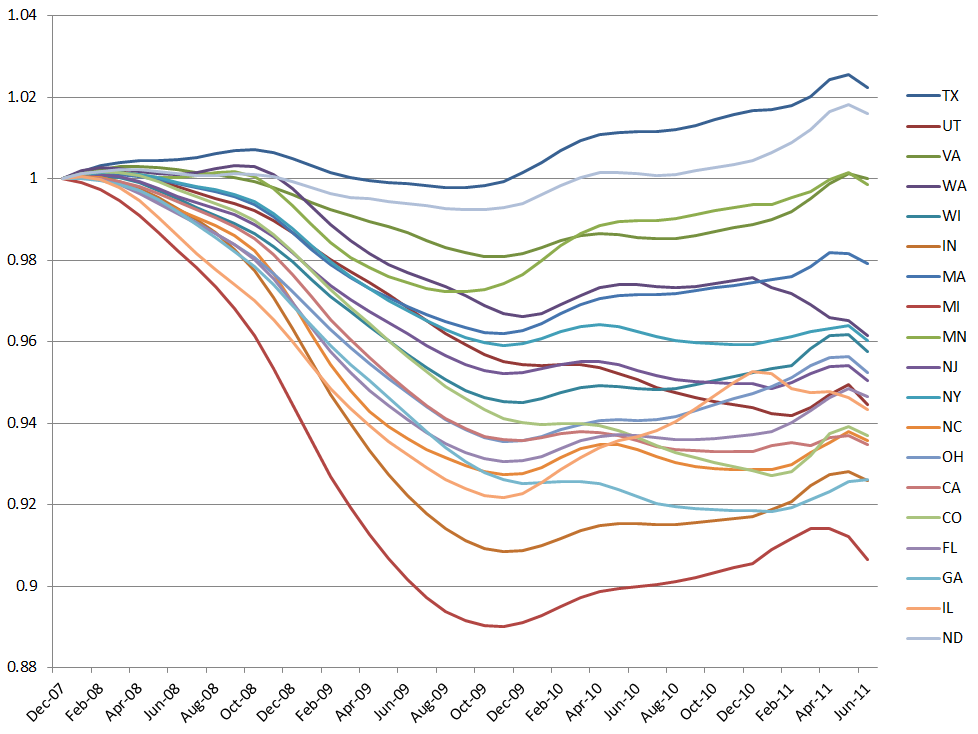
We can see that Texas has grown the fastest, having increased jobs by 2.2% since the recession started. I want to take a moment and point out that second place is held by North Dakota. I added North Dakota to my list of states to show something very important. North Dakota currently has the lowest unemployment rate of any state at 3.2%. And yet Texas is adding jobs at a faster rate than North Dakota. How can this be?
The reason is that people are flocking to Texas in massive numbers. Starting at the beginning of the recession (December 2007), let’s look at how this set of states have grown in their labor force.
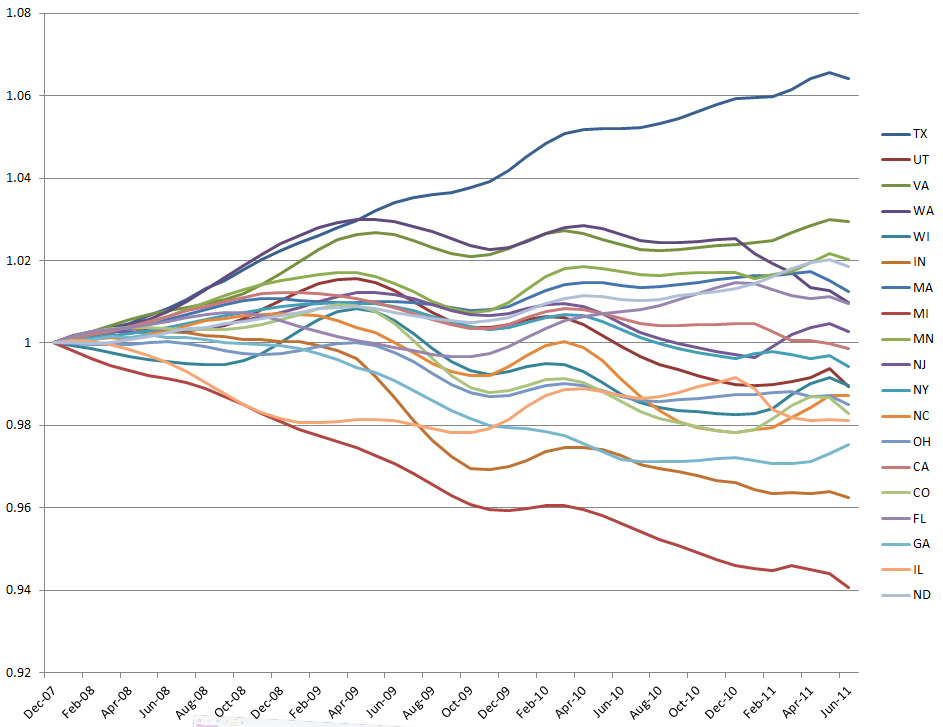
As you can see, Texas isn’t just the fastest growing… it’s growing over twice as fast as the second fastest state and three times as fast as the third. Given that Texas is (to borrow a technical term) f***ing huge, this growth is incredible.
People are flocking to Texas in massive numbers. This is speculative, but it *seems* that people are moving to Texas looking for jobs rather than moving to Texas for a job they already have lined up. This would explain why Texas is adding jobs faster than any other state but still has a relatively high unemployment rate.
“Sure, Texas has lots of jobs, but they’re mostly low-paying/minimum wage jobs”
Let’s look at the data. Here’s a link: Occupational Employment and Wage Estimates
Texas median hourly wage is $15.14… almost exactly in the middle of the pack (28th out of 51 regions). Given that they’ve seen exceptional job growth (and these other states have not) this does not seem exceptionally low.
But the implication here is that the new jobs in Texas, the jobs that Texas seems to stand alone in creating at such a remarkable pace, are low paying jobs and don’t really count.
If this were true, all these new low-paying jobs should be dragging down the wages data, right? But if we look at the wages data since the beginning of the recession (click to enlarge, states are listed alphabetically)
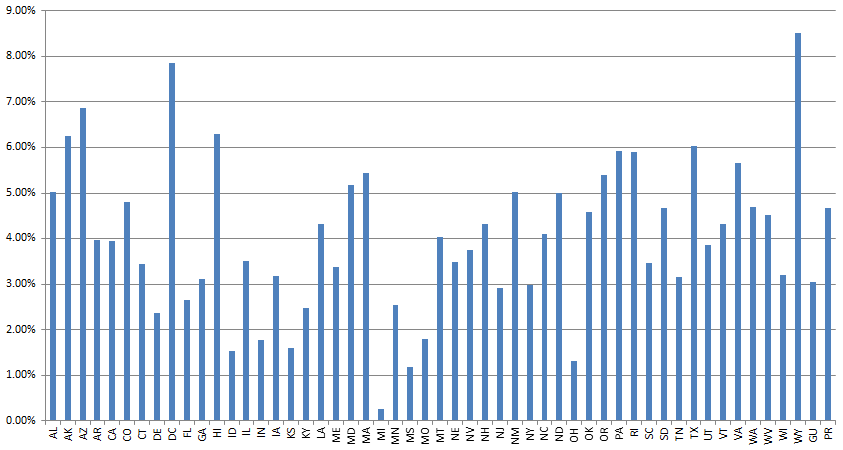
And it turns out that the opposite is true. Since the recession started hourly wages in Texas have increased at a 6th fastest pace in the nation.
As a side note, the only blue state that has faster growing wages is Hawaii. Just thought I’d get that jab in since so many people have been making snarky “Yeah, I could get a job in Texas is I wanted to flip burgers!” comments at me on Twitter.
“Texas is oil country and the recent energy boom is responsible for the incredible jobs increase.”
In identifying “energy jobs” I cast as wide a net as possible. If you want to replicate my findings, go to this link: http://www.bls.gov/sae/data.htm, click on “One-Screen Data Search”, then select “Texas”, then select “Statewide”, then in Supersectors select “Mining and Logging”, “Non-Durable Goods” and “Transportation and Utilities” and then in Industries select “Mining and Logging”, “Natural Gas Distribution”, “Electric Power Generation” and “Petroleum and Coal Products Manufacturing”.
Tedious, I know, but transparency is important and this is how you get the data.
When we finally get the data, we discover that energy isn’t really the biggest part of the Texas economy. Increases in jobs in the energy sector (or closely related to it) account for about 25% of the job increases in the last year. Since the energy sector only makes up 3% of all employment, there is some truth to this claim.
However, take the energy sector completely out of the equation and Texas is still growing faster than any other state. This indicates to us that the energy sector is not a single sector saving Texas from the same economic fate as the rest of the states. It’s not hurting, but Texas would still be growing like a weed without it.
“Texas has 100,000 unsustainable public sector jobs that inflate the growth numbers.”
I’m not sure where this one comes from, but the numbers are these (and can be found by selecting government employment from the data wizard at this link http://www.bls.gov/sae/data.htm):
Counting from the beginning of the recession (December 2007) the Texas public sector has grown 3.8%, or a little under 70,000 employees. This is faster than normal employment, but it’s not off the charts.
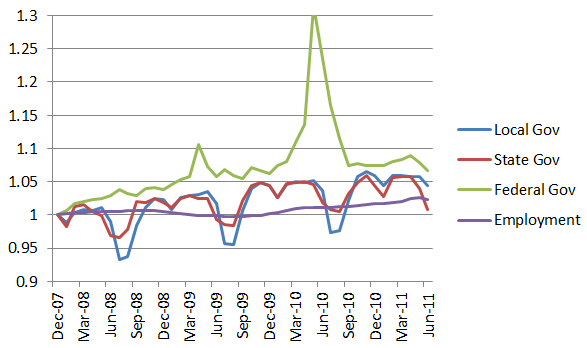
Given that the Texas economy has grown so much and private sector jobs have grown so much, that doesn’t strike me as an unsustainable growth in the public sector.
But, just in case you’re really worried about it, you can lay your fears to rest because in the last year the Texas public sector has shrunk by 26,000 jobs. In the last 12 months, Texas lost 31,300 federal employees, trimmed 3,800 state jobs, and increased local government jobs by 8,400 jobs.
(To be fair, this was partially driven by the role Texas employees played in the census, which inflated federal job numbers this time last year. Since the census numbers stabilized, federal employment has been at about break-even.)
As you can see, we’re nowhere near the “100,000 unsustainable jobs” number.
My Personal Favorite Chart
I’ll leave you with my personal favorite chart. I mentioned at the beginning that Texas is seeing high unemployment in a large part because they’re growing so damn fast. The problem with this from a charts and graphs perspective is that it leaves worse states off the hook, making them look better than they actually are. Looking at unemployment alone, we would conclude that Wisconsin has a better economy than Texas. But Wisconsin is still 120K short of it’s pre-recession numbers. The only reason they look better than Texas is because 32,000 people fled the state.
During that time, 739,000 people fled into Texas. Anyone who takes that data and pretends that this is somehow bad news for Texas is simply not being honest. At the worst, I’d call it a good problem to have.
So, to give something of a better feeling for the economic situation across states, this chart takes the population of the states I selected above and judges the current job situation against the population as it stood at the beginning of the recession.
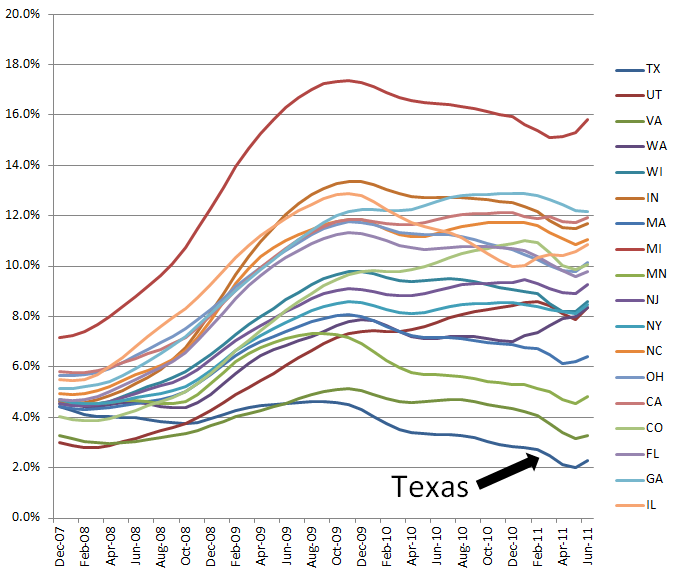
Using that metric, Texas would have a very low unemployment rate of 2.3%. But the fact that unemployment in the United States is fluid means that the unemployed flock to a place where there are jobs, which inflates its unemployment rate (at least in the short term). It’s not a bad thing for Texas… it just looks bad when dealing with the isolated “unemployment %” statistic.
UPDATE: @francisgagnon on Twitter felt that this chart was dishonest because it charts Texas as having 2.3% unemployment and (in his words so I don’t get him wrong): “It assumes immigrants create no jobs. But more people = more consumers = more jobs.”
He is absolutely right about this. I tried to be clear above that this chart doesn’t account for the fluid nature of an economy with immigration and departures of hundreds of thousands of people, but I don’t want to leave anyone with the wrong impression. So here it is: This chart doesn’t account for the fluid nature of an economy with immigrations and departures of hundreds of thousands of people. The point of this chart is not to say “Texas should have 2.3% unemployment if only things were fair.” Instead, it is an attempt to chart job growth in such a way that controls for people leaving one job market to enter another. To say “Wisconsin has a better job market than Texas because its unemployment rate is 0.6% lower” is a wholly untrue statement even though it cites accurate numbers. What this chart is meant to do is not posit a counter-factual, but to give a visual representation of the employment reality that is obscured by the way we calculate unemployment numbers.
END UPDATE
And… that’s it.
You may have noticed that I don’t mention Rick Perry very much here. That is because Rick Perry is, in my opinion, ancillary to this entire discussion. He was governor while these these numbers happened, so good for him. Maybe that means these jobs they are his “fault”. Maybe the job situation is the result of his policies. Or maybe Texas is simply the least bad option in a search for a favorable economic climate.
That is not an argument I’m having at this exact moment. My point is to show that most of the “excuses” you will hear about Texas’ job statistics are based in nothing more than a hope that Rick Perry had nothing to do with them and not on a sound understanding of the data.
My advice to anti-Perry advocates is this: Give up talking about Texas jobs. Texas is an incredible outlier among the states when it comes to jobs. Not only are they creating them, they’re creating ones with higher wages.
One can argue that Perry had very little to do with the job situation in Texas, but such a person should be probably prepare themselves for the consequences of that line of reasoning. If Rick Perry had nothing to do with creating jobs in Texas, than why does Obama have something to do with creating jobs anywhere? And why would someone advocate any sort of “job creating” policies if policies don’t seem to matter when it comes to the decade long governor of Texas? In short, it seems to me that this line of reasoning, in addition to sounding desperate and partisan, hogties its adherents into a position where they are simultaneously saying that government doesn’t create jobs while arguing for a set of policies where government will create jobs.
Or, to an uncharitable eye, it seem they are saying “Policies create jobs when they are policies I like. They don’t create jobs when they are policies I dislike.”
People will continue to argue about the data. But hopefully this will be helpful in sorting out reality from wishful and desperate thinking. I mentioned on Twitter that the Texas jobs situation was nothing short of miraculous. This is why I said that and why I’m standing by that statement.
Very good article! I’d imagine the hard left won’t like the results. But then again, they’re the ones who put so much stock into global warming “facts” that have been shown to be completely falsified.
Jim, I give up. Clearly none of us are going to convince you that unemployment numbers are not correlated to success in finding a job in the way you think it is.
Very nice analysis. Thanks for your effort.
BTW, I’m from the north-central part of PA and folks are indeed flocking here as gas drilling and pipeline work booms. Tough to find a rental and small, moderately priced homes are snatched up quickly. Lots of out of state plates in the local parking lots…some are even from Texas!
amy: No, you won’t. Especially in light of this:
http://www.newyorkfed.org/research/economists/sahin/duration.pdf
Scroll to page 26, figure 1. It would seem there’s a pretty high correlation between the unemployment rate and success in finding a job. The point of the paper is that the average time to find a job has increased, but changes in time are still very correlated with the unemployment rate.
It’s completely unfair of you to ask Jim (pthread) to substantiate any of his handwaving bullshit with actual facts and data.
I can’t believe you guys are being so mean to him. Why can’t you just take his word that all of his evidence-free claims and conjectures are true?
I love the assumption that lower unemployment increases your chance of getting a job. If the number of applications were the only factor, then I guess that could be correct. But if you are in a place with 5% unemployment and no job opening, I guess you just have to take comfort in the fact that there are fewer people competing for the 0 job openings then in other places.
However, if you are in Texas where job growth is actually happening, and there is 8% unemployment, then I guess you should be really upset that there are more candidates for the real actual jobs offered by employers that are actually hiring people to do work for pay.
Makes perfect sense.
Your facts and presentation are persuasive but the main street media will surely tell us many, many times that Perry is a poo-poo head and that the Blessed Obama knows The Way.
I’ll reserve judgment on Perry until I know who the democrats will run.
I consider the 100,000 public sector jobs unsustainable because they aren’t paid for. TX faces enormous budget cuts, including billions from education. I’m concerned that Perry is another Reagan, willing to spend us into oblivion. He hasn’t demonstrated any ability to make tough austerity cuts like the ones we need on a federal level. Interesting thought: billions cut from federal defense spending will hurt the TX economy, probably in time for the 2012 election.
Jim, you are clearly grasping at straws here, buddy. The simple facts are right there for you and you won’t let the views that you hold dear (that Texas has added a ton of jobs while Liberal bastions like California have lost a ton….by chance?) bend. As stated above, it’s amazing that Texas’ unemployment rate isn’t higher, honestly. Yet even with the incredible influx of in-migrants and immigrants, it is sitting well below the national average.
Do us all a favor and make a point, besides arguing over your incredibly unconvincing interpretation of unemployment % and what that means on a state-by-state basis. Are you arguing that Texas’ pro-business, hands-off governmental policies are ineffective? Do you argue that other states with practically opposite policies (CA, and my current state IL) are better off? Because unless you can somehow dig up some numbers to support that claim, I don’t think you’re really convincing anyone whatever it is you’re trying to prove.
Sorry, don’t have the charts as requested but one caution: Texas runs counter-cyclical over time. I’ve been here since ’78. There have been 2 downturns where Texas did well during the downturn but had its own downturn while the rest of the country experienced and upturn.
Joated, I’ll bet some of them are from New York. We have gas, but won’t drill for it for fear of pollution.
It would serve us right to be left freezing to death in the dark. When I’m retired or laid off, I’m gone.
@Jim – if the chances of finding work in Pennsylvania were better than Texas, they would not have moved to Texas in the first place. You suppose that emigration increases the chances of the people left behind, but you forget the main point that 90% of the people living there have jobs already, and the whole problem with the remaining 10% is that there’s no job for them NOW. If there was, then a). they wouldn’t leave because b). they would already be employed. There’s not magically going to be a job for the people living in that state that wasn’t there a month ago just because there are fewer unemployed people to divide up the (non) jobs.
And population growth is a valid confounding factor precisely BECAUSE the unemployment rate in Texas has followed a similar line to other states. States like Pennsylvania and Ohio have had a nearly flat line of population growth over the last 30 years, growing only about 2% and 1% respectively in the years since the economy peaked in 07. The population of Texas has grown by about 4% in that same time period, and has been been increasing consistently for the last 20 years.
So not only did unemployment in Texas level off at about 8% instead of the nearly 9% in PA and 10.6% in Ohio, but it did so while growing at 2-4x the rate of those other states. Pennsylvania lost jobs at a *faster* rate with *fewer* people entering the job market. That is the statistical opposite of having a better chance at a job after people leave.
No stats here, but two anecdotes that conform to those presented. 1. My daughter moved to Texas after college for a job on the fast track to management with a national company (raises every 6 months). Socially, a large number of her friends moved there from Calif (many in IT). 2. I have a client (native Texan) who had moved to Calif for business reasons, and moved back a few months later when he learned it was costing him 300K a year in state income tax to live in Calif.
The strongest argument against Perry is that Texas has the weakest governor of any of the states so he can’t claim the sole credit for Texas’ performance as he might in other states.
The Texas constitution spreads many of the powers most states give to the governors over the governor, the lieutenant governor, the speaker and the state comptroller. All state senior executives are elected in their own right. So, economically sound government in Texas is the result of a broad political culture of responsibility and not the result of a single good leader.
Texas is sound today because of the actual depression we struggle through alone during the period from 1984-1994 as a result of the oil bust. We jettisoned a century of populist quasi-socialism because other people’s money ran out and adopted a free-market approach. An entire generation got a hard lesson in the dangers of high government spending 20 years before the rest of the nation did. We learned to keep government small and business friendly because we had to in order to survive.
Perry deserves some credit for all this because he has been governor but frankly, if it hadn’t been Perry it would have been someone else just like him because that is what the political culture of Texas demanded.
In the end, it is not political leaderships but the wisdom and discipline of the people that counts in America. It won’t do any good to elect Perry President if most of the country still thinks they can get things for free.
I spent 5 minutes reading the post, and find it convincing.
But what is FAR MORE convincing is that 700K+ people decided to move to TX: they bet their lives that jobs in TX are easier to find, so probably spent much more time and efforts in looking for the realistic, not polemic, answer for “where it is easier to find a job”?
BTW, in my narrow specialty (theoretical math) the TX progress during several last years is simply amazing. I would not be surprised if they’ll jump to the first places in the rating in a few years.
“Jim, I give up. Clearly none of us are going to convince you …”
Aggravating for sure but not really too hard to predict. Read Thomas Sewell’s. “A Conflict of Visions” for the explanation as to why Jim won’t budge. Ideology is pretty much immune to change in the face of facts. Argument for the sake of argument till you get to the point of giving up as you have – that’s the game. Don’t give up the fight, just give up changing ideologues.
Wow, no mention of hurricanes, once. No post-Katrina evacuees moving to Texas or people coming to Texas after Ike in ’08 to rebuild Galveston? Louisiana lagged behind the rest of the nation in unemployment because of post-Katrina rebuilding.
Well, I’ve figured out the problem with Jim, he’s innumerate. I posted a hypothetical where 100 people move to Texas, and 90 of them get jobs (raising the TX unemployment rate since 10% of those who moved are unemployed). He referred to my hypothetical, but talked about *10* people getting a job.
Clearly, we see what happens when you can’t tell the difference between being employed and being unemployed.
Let’s try a different example, using two states we’ll call PA and TX. We’ll give PA a population of 5 million workers + job seekers, and TX a population of 10 million workers + job seekers. We’ll give PA a 5% unemployment rate, and TX an 8% unemployment rate.
There are therefore 250,000 job seekers in PA, and 800,000 job seekers in TX.
This month, PA will have 10,000 people lose jobs, 10,360 gain jobs, and 1,000 job seekers move out of the state. (4% chance of finding a job, jobless rate remains at 5% (4.98% if you want to get picky))
This month, we’ll add 20,000 job seekers to TX, have 20,000 people lose jobs (same % as PA), and have 38,400 people get jobs there. This keeps the jobless rate exactly the same, but you have a 4.57% chance of finding a job in TX that month.
Understand? Or are you simply so wedded to the idea that Rick Perry == Bad that nothing can ever convince you how wrong you are on this argument?
People, you all seem a bit confused. I concede all points made in this blog entry aside from the idea that absolute job growth is a proper metric for measuring whether an economy is booming. Further, I’m pretty sure I’ve also mentioned that I think Perry’s stance on immigration is dead on right (as was Bush’s). I also am not attempting to claim there’s particularly anything *wrong* with the economy of Texas, or that Perry has done anything wrong in handling it.
What I’m after is the truth on one particular point made in this blog post. Many of you seem more than happy to simply project on myself (or in several cases the author of this blog post) all sorts of nasty things regarding my (or his) intellect or motivations. You aren’t going to see me resort to ridiculous charges about Perry giving a Nazi salute or whatever crazy things are being said about his religious affiliation. I’m trying to be objective and fact-based here. I’m not sitting here slinging insults at any of you, nor the candidate you seemingly support. Please do me the same favor. So far The Schaef has been the only person able to disagree without being a condescending dick about it.
As to The Schaef’s point, my entire premise is that I don’t think we necessarily know about the effects of migration to Texas from other states. You seem to be of the opinion that their rate is what it is *in-spite* of the population shift. Is it also possible that it is what it is because of it? I don’t think we necessarily know enough to argue either way, but we do know certainly that their absolute numbers (both in jobs and the unemployed) are disproportionately large because of the influx of people.
GregQ: Apparently it’s reading, not math that’s my problem. I had read that as “90 don’t get jobs in the next month”. Regardless, I think it’s clear it was a mistake.
As to your example, you’ve created an example where the jobless rate stays the same. Of course if you add more people to Texas but don’t make the unemployment rate rise, the “success” rate will be higher.
You seem to have missed this paper I link to:
http://www.newyorkfed.org/research/economists/sahin/duration.pdf
which shows a pretty clear correlation between unemployment rates and how long it takes to find a job. Lower unemployment == easier to find a job. It’s simply not up for debate, the data is right there. I’m not claiming causation, just pointing out the high correlation.
Until I read this, I was leaning toward Obama because I thought Republicans were too extreme. Now that I have seen Jim get taken apart like the cowardly retarded draft dodger he is, I will support Rick Perry.
As a non-fan of Rick Perry, I accept the analysis here and agree that something good is happening in Texas.
Now I challenge all the conservatives here who are high-fiving the Perry analysis to read another piece by the same author and accept that the U.S. government needs to raise taxes in addition to cutting spending: http://www.politicalmathblog.com/?p=1509
“The strongest argument against Perry is that Texas has the weakest governor of any of the states so he can’t claim the sole credit for Texas’ performance as he might in other states.”
That would’ve worked ten years ago… but every person involved in Texas that I know (and a very good deal aside) have long said that Perry has made the governorship more powerful than it has been at any point in history, and even more powerful than govs. in most other states.
As a native Texan, I wish to hell our economy did suck and that we were losing jobs and that people were evacuating as fast as the interstate could carry them away.
That is not the case, we are growing rapidly, and many of the refugees from the other failed states are coming here and bringing their stupid ideas with them. I wish California and New York would fix their economies and take these people back before they can do any more damage down here. For god’s sake people, the joke is over, go back were you came from and fix you own damn state rather than destroying ours.
I to am not a fan of Rick Perry! To just talk about jobs is short sighted. What about quality of life? How does Texas rank with the other fifty states in education, health care, health insurance, pollution, cancer rates, racism, prison population, infrastructure, real and future debt, illegal immgrants, violent crime, social serves and criminal justice system. If one looks at the statistics they will find Texas is first or almost first in every thing bad and last or almost last in every thing good, except in growth of population and the resulting jobs! My family got here in 1848 and I am still wondering what Texans should be proud of! If anyone can show or tell me I would be grateful and very surprised. Rick Perrry is just another pawn of the filthy rich elite owners of the Corporate cartells. This less than one percent are bribing guys like Rick Perry to screw the other 99% of the population!
Marc. Did you miss the note:
Note: If you are going to comment and you want to introduce some new objection to the Texas job numbers, you MUST provide original data. I spent about 4 hours digging through raw data to write this post.
Put up, or shut up.
“accept that the U.S. government needs to raise taxes in addition to cutting spending”
Kevin Williamson (who coincidentally has posted an essay on just this Texas topic at NRO) is no friend of cuts only either. He is a bright man and makes it clear that just cuts can’t really ever pencil out. Whether one agrees or not the fact is Conservatives (that would be me) see tax increases to close the deficit the same as we see amnesty to solve the illigal immigrant problem from Mexico. If we could actually believe the intent of amnesty was to have one last go at legalizing those here and the boarders would be closed after that, few Conservatives would oppose it. But we know that is not the intent of those pushing amnesty so complete opposition is the only course open.
Similarly, if tax increases were certain to be spent to lower the debt to a controllable level, I suspect many Conservatives would buy that. But that is not what will happen. It will be spent on bridges to nowhere, new furniture for Barney Frank’s office and more goodies for the entitlement class and we all know it. The Government is beyond out of control and we will not be fooled again.
I’ve been living in Houston for 20-30 years.
I’m no economist, but the fact that the national housing bubble and subsequent collapse was not NEARLY as big here, is a huge factor in the Texas economy’s success.
Yes, True, We are a no state income tax, pro-business state. But the S&L/Banking crisis, we weathered in the 1980’s taught us (hopefully) to not be anti-all regulation. By State law, Texans were not allowed to borrow as aggressively against their own property here as much as Americans were elsewhere. Housing prices never boomed nor busted that much.
I think this insulated us.
Thanks for bringing data to this discussion. I had noticed the same thing while doing research in response to a misleading Paul Krugman column some time back. He has since doubled down on disinformation in a more recent post.
It constantly amazes me that a Nobel Laureate is either that lazy-minded or simply that transparently partisan. I do not know which is the case, but I find it hard to support the notion of people calling Krugman both honest and intelligent.
He can’t be both, so I tend to lean towards his being simply dishonest.
This data shreds him to pieces, which is not the first time that has happened. In fact it happens with great regularity.
As a native and old (53) Texan, I don’t give Gov. Perry very much credit (I don’t dislike him, though). It is just that the people of Texas haven’t wanted much in the way of government involvement – so people are free to start businesses. I believe that the same is true for most people in the United States. We just need to encourage small business people and discourage government regulations.
I think the fact that 1 in 4 Texans lack health insurance pretty much solidifies the fact that a lot of the jobs being created there are, indeed, crappy. (Unless of course, any of you want to work for me without getting medical coverage).
Ian, you know some people actually decide if they want to buy health care coverage or not, some times even taking a job that doesn’t offer it, because it better fits their individual circumstance. Your myopic mind set that ties your heath care coverage to your employment is a personal failing, not a public one.
Texas by the numbers:
47th in SAT scores
50th in percentage of population over 25 with a high school diploma
5th in percentage of children living in poverty
32nd in per capita income
49th in child immunization
1st in population without health insurance
3rd in poverty
3rd in malnourishment
5th in teenage birth rate
7th in obesity
18th in heart disease
1st in air pollution emissions
1st in carbon dioxide emissions
42nd in average hourly earnings
2nd in income equality between rich and poor
50th in homeowner’s insurance affordability
50th in electric bill affordability
6th in total crime rate
12th in violent crime rate
Those and much more at http://shapleigh.org/system/news_article/document/882/Texas_on_the_Brink_2007_Final.pdf
Check the footnotes for sources.
Where are you getting the figure that 739,000 people moved to Texas over that period (I assume that is the net figure, after those going the other way have been subtracted)? You seem to be assuming that Texas population growth is driven by migration from other states, but my recollection is that about 80% of Texas population growth since the 2000 census has been due to natural increase from a high birth rate, and immigration from other countries, mostly Mexico.
Last time I checked, Ian P, nobody is stopping the uninsured from purchasing health insurance! If you just stop and look, you will find serious personal priority problems with a great percentage of the “uninsured”. We are tired of the whiners that complain about not being able to afford $4.00/day while they smoke cigarettes, drink liquor, talk an smart phones and drive around with $4,000.00 chrome rims. I done with them…
I did check the foot notes, did you? Could you possibly find some sources that are not blatantly aligned with socialist ideology?
Center for Community Change
Center for Public Policy Priorities
Institute on Taxation and Economic Policy
The greatest strength of Gov. Perry’s philosophy is that he believes in state’s rights and that social, divisive issues are state-not national issues. (His comment on NY’s gay marriage law was that was the reason for having states’ rights, was people could then choose where they wanted to live based on the different values of that state.) That philosophy is the only way I can see to have a national government that functions, unlike what we are seeing in Washington. As Rasmussen polls have shown consistently, Americans do not want to be governed by the right or the left; they want to govern themselves. Traditional Texas values include tolerance for others’ viewpoints, as long as those aren’t forced on everyone.
“…but Texas would still be growing like a weed without it.” Is that unequivocally true? To make that claim you would have to demonstrate that the non-energy growth was not at all ancillary to the growth in the energy sector (construction, service, etc.). Your article completely glosses over this issue.
by the way Ryan:
Your link:
http://shapleigh.org/system/news_article/document/882/Texas_on_the_Brink_2007_Final.pdf
Lists that Texas is number 1 in executions, this is as big a lie as most of the “facts” in the link. Texas is number 2. (we used to be number 3, but we are making progress)
http://www.deathpenaltyinfo.org/state-execution-rates
What would be the impact on your analysis is you removed BOTH the economic impact of the O&G industry & oil prices AND the economic impact from being uniquely located to be the primary beneficiary for trade w/ Mexoico given the common border?
In other words, remove the effects of “God given” natural resources & happening to be in the right place border location from your analysis & what do you get??
I deal with these questions every day and have a degree in econometrics, yet I can’t quite make out the point of your final graph. The number of jobs in any state is closely related to the number of people who live in that state, because those people make up the bulk of the demand for goods and services produced in the state. This varies by the type of industries in the state, the size of the state, the nature of the state’s borders, yada yada but it is always true to a large extent.
If 30,000 people left Wisconsin since the recession started then, all things being equal, we’d expect the number of jobs in Wisconsin to have dropped. If 700,000 people entered Texas during that time then, all things being equal, we’d expect the number of jobs in Texas to have increased sharply.
If you’re analyzing how the jobs situation has changed over time in different states, it makes no sense to try to remove the effects of these changes in state populations over that time. Instead we should try to measure how each state performed in a way that incorporates the expected changes in jobs numbers that are due to changing populations. And this is just another way of saying we should look at how unemployment rates in each state (which, more or less, reflect the number of jobs relative to population) have changed over time. There are plenty of things to quibble over with this method too, but if you need to graph a single statistic for measuring the relative performances of the states with respect to jobs in a consistent way, unemployment rate is the best.
Diogenes, given that California would have the same benefits as well as Pacific trade, what is their excuse? I suppose you would have Utah. Possibly Montana, still would not have New York or Massachusetts.
“If this were true, all these new low-paying jobs should be dragging down the wages data, right?”
The business-friendly atmosphere of Texas has led to a lot of corporate headquarters to move there. With the growing salary gap between executives and “regular workers,” each added executive could offset an increasing number of low-wage workers when averaging everyone together.
I think a better way to confirm or refute the “most of the new jobs are crappy” argument would simply be to compare the number of minimum/below minumum-wage jobs added relative to the total number of jobs added since the recession began. I don’t know how to do this, so my comment therefore does not satisfy the “put up” criteria.
“If 30,000 people left Wisconsin since the recession started then, all things being equal, we’d expect the number of jobs in Wisconsin to have dropped. If 700,000 people entered Texas during that time then, all things being equal, we’d expect the number of jobs in Texas to have increased sharply.”
You really miss the whole cause and effect paradigm. Your statement is like saying that if you want smaller fires, send fewer fire trucks.
“each added executive could offset an increasing number of low-wage workers when averaging everyone together”
Very likely true since those executives would need their grass mowed, food served, coffee pored, shelves stocked, and a thousand other things that would employee low skilled people. I suppose it is better to wait for nonexistent “good job” (what ever that means) than to take a lower paying job offer.
Not sure why anyone thinks this discredits Krugman. We have a correlation/causation disconnect here. The facts merely say that the Texas has the largest increase in total population and also the largest increase in employed population.
An apt point that Krugman makes is that Texas has a very low COST OF LIVING (http://www.top50states.com/cost-of-living-by-state.html), especially so for a warm weather state. It’s not surprising that people forced out of homes in pricier markets would migrate to Texas.
Texas also has half the rate of underwater mortgages as the national average (http://www.npr.org/templates/story/story.php?storyId=129424619). This may have something to do with the fact that it has unusually strong predatory lending laws (http://www.dallasfed.org/research/swe/2008/swe0806b.cfm), which is something Krugman points out as well, and which has nothing to do with Perry or Republican policies.
In seventh grade, we learned how pie charts, bar graphs, and line graphs can be used to prove anything….even when the actual charts show no such thing.
Texas has no income tax so anytime the economy gets slammed, people move to areas where the slam isn’t happening as bad. Increase in population means an increase in needs of goods and services. TaDAA…..job growth.
Real simple…….Perry is nothing more than Bush Version 2.0. Have we learned nothing from our experience with the original Bush and Bush Version 1.5 ?
Let’s switch the order of two sentences in the post:
“Since the recession started hourly wages in Texas have increased at a 6th fastest pace in the nation.”
“Texas median hourly wage is $15.14… almost exactly in the middle of the pack (28th out of 51 regions).”
Large percentage increase, but still not quite middle of the pack. So how large are the salaries of the new jobs?