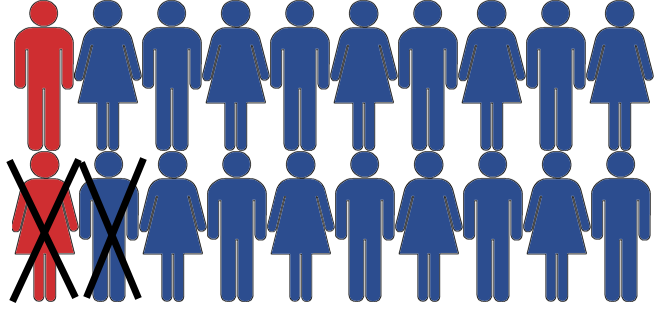
Balancing the Obama Budget With a Mandatory Gorilla

[youtube=http://www.youtube.com/watch?v=70lkobYY0Hc&hl=en&fs=1&]

After nearly two months of nothing, I figured I had to put something up. I’ve been tossing this idea around for a while looking for a metaphor that worked appropriately. I didn’t really push the metaphor of a household budget too far in the video because:

  • No one runs a household budget on $100 per month
  • Government does a lot of things that don’t correspond very well to household budgets
  • There is no good correspondence between mandatory spending and anything we budget for in real life.

But it is likely that you simply don’t care about the artistic matter of finding an appropriate metaphor and you only care about where the data came from.

Fair enough.

The data came from a couple of different places. First of all, the first data I’m using is a rough budget projection for 2017. This came from the CBO projection of President Obama’s budget extended to 2017. This is also where I got the federal reciept estimates I used to calculate how much we would have to decrease spending in order to balance the budget as well as the estimates for mandatory spending and interest.

For the purposes of the video, I combined what the CBO calls “mandatory spending” (which is mostly entitlement spending like Social Security, Medicare and Medicaid) and interest payments on the national debt into a single “mandatory spending” amount because both these parts of the budget are automatic and neither of them can be changed through the normal budget channels.

The next piece of data is the distribution of spending according to agency. In order to estimate how much we would spend on various departments and agencies, I took the latest projected data from President Obama’s budget, which is for 2014. I then calculated that, if we split up spending proportionally the same way in 2017 as we do in 2014 we would end up with the money distribution you see in the video (give or take a few cents).

Then, for the part where I take away the money until the budget is balanced, I simply looked at the amount of money we would have left over after we take care of all the mandatory spending with the receipts we expect to have.

That number was:

Federal Receipts – Mandatory Spending = Money Left To Spend

The “Money Left To Spend” number came out to $427 billion in 2017. The Defense spending in 2017 is anticipated to be about $662 billion, so I got rid of everything except defense spending. Then I started shaving off parts of the defense department until I got to a number small enough to roughly equal $427 billion.

Using this web site as a guide and calculating the proportional spending between the 2010 budget and the 2017 one, I subtracted the entire intelligence budget and the Navy. Then I reduced “Defense Wide” spending by half (I figure with the Navy gone, we don’t need quite as much military support bureaucracy) and I added up the Army, Air Force and the reduced bureaucracy.

That number came to $447 billion. Which means that we’re technically still running a deficit, but it’s a really small one.

One thing I did not do was calculate out how much more we would have to cut if we pass health care reform. This is because the legislation is so fluid and malleable at this point, it seemed pointless to put it into a number that would just change in a couple weeks.

But, I can say this one thing with an enormous level of certainty (and I’ll even put it into bold so you know I’m really serious):

President Obama, despite his best intentions, will not sign a “deficit neutral” bill.

This is because entitlement programs always start out with the best intentions and with rosy predictions. They almost always fail to meet those predictions, costing far more than was originally estimated. The problem is that the programs go on auto-pilot and neither the president nor Congress can do a damn thing to pull back on the costs.

What can be done about this? My suggestion is one that would satisfy no one.

I think President Obama should refuse to sign any legislation that doesn’t have an expiration date on it. If health care reform is really as wonderful as he says it will be, this shouldn’t be a problem. People will adore it, burn incense to it, throw ticker tape parades for it. Voting it back into law would be like raising Abraham Lincoln from the dead and having him run for another term.

But the fact of the matter is that it will never as wonderful as President Obama claims, which is why it can’t have an expiration date. Once people have a benefit, changing the status quo away from that benefit is often politically impossible. Just ask George W. Bush when he tried to change the clearly broken Social Security system. Everyone agreed that it was broken, but no one could muster the political wherewithal to fix it. So they just left it broken.

This is, I believe, exactly what will happen with health care reform. But that part is just my opinion.

College Students: Learn Things You Can’t Learn On Your Own

New York Times has a short group of blurbs on college advice from educators. Some of it is good, but some of it is shockingly bad.

Rabbit Trail: One professor tells students to read a good newspaper every day. He might as well tell students to check the typeset on their printing presses. If you want to make a point for someone to expand their horizons, tell them to actively seek out the opinions of those with whom they disagree and discover why they disagree or tell them to independently verify facts that they read in a news article once a week. Both these activities will expand your horizons far more than burying your face in a dead tree containing the collected daily writings of 400 people who voted for the same person in the last election.

Back to the point:

I thought the make-up of professors polled was fascinating. Out of 9 total professors, two of them were technical professors (biology and physics), and their advice is shoved down to the bottom of the page. If you considered “science” to be a single subject, it would have been as well represented as English, history or law. No engineering professors. No math professors either.

Here is the reason this kind of irks me: I got tons of terrible college advice from people who gave me some permutation of “expand your horizons”, “do what you like” or “follow your dream”. This led perfectly intelligent individuals to spend $60,000 on an education so they could get perfectly hideous careers taking customer complaints for American Express.

Most of my college classes were fairly technical (mathematics, chemistry, computer science, physics, statistics). But I always kind of bristled at the fact that so many universities basically discriminate against students with technical degrees. If you have a degree in something technical, the chances are you were forced to take a ton of humanities.

And I’m not talking English composition or public speaking classes, which every single person should take (or test out of) in order to be a functioning college degree holder. Every degree holder should be able to write in a manner appropriate for educated communication and everyone should be able to stand up in front of people and make some kind of speaking presentation. When I say “humanities”, I’m talking the often endless humanities, literature, history, and “society” classes that go far beyond basic proficiency.

Universities make technical students take all these humanities on the laughable premise that it will make them “rounded” individuals. On an informal survey of core curriculum at a half dozen major universities, a rounded individual takes twice as many classes in the humanities as he or she does in math and science.

What I am NOT saying is “humanities are worthless”. I’m an avid literature fanatic with enough books to take over one of the rooms in my house. What I AM saying is that a college education should be cost-effective. It is my opinion (and my advice to new college students) that students should make every effort to spend their time and money learning things that they can’t learn on their own.

If this survey is correct, students are paying $35,000 dollars for a private university (and ) on classes and fees this year. It is my understanding that out-of-state students to public universities are similarly priced. If a student takes a 15 hour workload (five 3-hour classes), they’re looking at about $3200 per class.

My guess is that most places have a core humanities curriculum that takes about 30-40 hours to complete. So, if you’re getting a science or engineering degree, you’re looking at about $30,000 – $40,000 to pay for classes that have nothing to do with your profession and (here’s the key part) are filled with things you could have figured out on your own.

Example: I took a survey of western literature and thought from the Reformation to the modern era. The key take away from that class on my side of things was the fact that the book we used had a wretched translation of “The Grand Inquisitor”, a portion of Fyodor Dostoevsky’s opus “The Brothers Karamazov“. I knew it was a wretched translation because I had read “The Brothers Karamazov” the previous summer (it remains to this day my favorite novel) and vital imagery was toned down because the translators had no respect for the intelligence of their readers. Of all of the authors assigned in that class, I’ve re-discovered all but one in my own leisure time.

In fact, most of the stuff we learned in order to secure the calligraphic document that got us jobs were things quickly forgotten after the final exam. I have since re-learned far more than I was taught because of:

As a contrast, how many people in the audience figured out fluid dynamics all by themselves because they were curious? Calculus? Organic chemistry? These are topics that are very difficult to get into simply by hitting up Wikipedia for some info.

Don’t even get me started on Social Science classes. I was lucky enough to take a gender class my final semester in undergrad. We had several biology students in the class who tried to patiently argue with the professor that men were more aggressive than women not because society taught them to be aggressive but because men have more testosterone. Our professor refused to believe them. One of them suggested that the professor should investigate societies of lab rats. He did not get a good grade.

Every gender class should be taught with an evolutionary biologist and a neuroscientist sitting in the back row trying not to laugh.

Maybe if I wasn’t still paying off tens of thousands of dollars in student loans, I wouldn’t feel this enormous resentment to the months I spent reading stuff I’d already read (or would read again when I wanted to) and talking about it in classes with 3 students who cared and 40 who didn’t. But the fact of the matter is that many students are going to college to get degrees to get jobs. For technical students, their progress is being slowed by humanities classes filled with readings they can do on their own time if they are so inclined.

College Students: Learn Things You Can't Learn On Your Own

New York Times has a short group of blurbs on college advice from educators. Some of it is good, but some of it is shockingly bad.

Rabbit Trail: One professor tells students to read a good newspaper every day. He might as well tell students to check the typeset on their printing presses. If you want to make a point for someone to expand their horizons, tell them to actively seek out the opinions of those with whom they disagree and discover why they disagree or tell them to independently verify facts that they read in a news article once a week. Both these activities will expand your horizons far more than burying your face in a dead tree containing the collected daily writings of 400 people who voted for the same person in the last election.

Back to the point:

I thought the make-up of professors polled was fascinating. Out of 9 total professors, two of them were technical professors (biology and physics), and their advice is shoved down to the bottom of the page. If you considered “science” to be a single subject, it would have been as well represented as English, history or law. No engineering professors. No math professors either.

Here is the reason this kind of irks me: I got tons of terrible college advice from people who gave me some permutation of “expand your horizons”, “do what you like” or “follow your dream”. This led perfectly intelligent individuals to spend $60,000 on an education so they could get perfectly hideous careers taking customer complaints for American Express.

Most of my college classes were fairly technical (mathematics, chemistry, computer science, physics, statistics). But I always kind of bristled at the fact that so many universities basically discriminate against students with technical degrees. If you have a degree in something technical, the chances are you were forced to take a ton of humanities.

And I’m not talking English composition or public speaking classes, which every single person should take (or test out of) in order to be a functioning college degree holder. Every degree holder should be able to write in a manner appropriate for educated communication and everyone should be able to stand up in front of people and make some kind of speaking presentation. When I say “humanities”, I’m talking the often endless humanities, literature, history, and “society” classes that go far beyond basic proficiency.

Universities make technical students take all these humanities on the laughable premise that it will make them “rounded” individuals. On an informal survey of core curriculum at a half dozen major universities, a rounded individual takes twice as many classes in the humanities as he or she does in math and science.

What I am NOT saying is “humanities are worthless”. I’m an avid literature fanatic with enough books to take over one of the rooms in my house. What I AM saying is that a college education should be cost-effective. It is my opinion (and my advice to new college students) that students should make every effort to spend their time and money learning things that they can’t learn on their own.

If this survey is correct, students are paying $35,000 dollars for a private university (and ) on classes and fees this year. It is my understanding that out-of-state students to public universities are similarly priced. If a student takes a 15 hour workload (five 3-hour classes), they’re looking at about $3200 per class.

My guess is that most places have a core humanities curriculum that takes about 30-40 hours to complete. So, if you’re getting a science or engineering degree, you’re looking at about $30,000 – $40,000 to pay for classes that have nothing to do with your profession and (here’s the key part) are filled with things you could have figured out on your own.

Example: I took a survey of western literature and thought from the Reformation to the modern era. The key take away from that class on my side of things was the fact that the book we used had a wretched translation of “The Grand Inquisitor”, a portion of Fyodor Dostoevsky’s opus “The Brothers Karamazov“. I knew it was a wretched translation because I had read “The Brothers Karamazov” the previous summer (it remains to this day my favorite novel) and vital imagery was toned down because the translators had no respect for the intelligence of their readers. Of all of the authors assigned in that class, I’ve re-discovered all but one in my own leisure time.

In fact, most of the stuff we learned in order to secure the calligraphic document that got us jobs were things quickly forgotten after the final exam. I have since re-learned far more than I was taught because of:

As a contrast, how many people in the audience figured out fluid dynamics all by themselves because they were curious? Calculus? Organic chemistry? These are topics that are very difficult to get into simply by hitting up Wikipedia for some info.

Don’t even get me started on Social Science classes. I was lucky enough to take a gender class my final semester in undergrad. We had several biology students in the class who tried to patiently argue with the professor that men were more aggressive than women not because society taught them to be aggressive but because men have more testosterone. Our professor refused to believe them. One of them suggested that the professor should investigate societies of lab rats. He did not get a good grade.

Every gender class should be taught with an evolutionary biologist and a neuroscientist sitting in the back row trying not to laugh.

Maybe if I wasn’t still paying off tens of thousands of dollars in student loans, I wouldn’t feel this enormous resentment to the months I spent reading stuff I’d already read (or would read again when I wanted to) and talking about it in classes with 3 students who cared and 40 who didn’t. But the fact of the matter is that many students are going to college to get degrees to get jobs. For technical students, their progress is being slowed by humanities classes filled with readings they can do on their own time if they are so inclined.

The Best Paying Undergrad College Degrees

Cool little piece on the best paying undergrad college degrees has this accompanying graph.

(Parts of the graph aren’t showing up very well on wordpress, so feel free to head over there to check it out.)

Degrees Degrees
Methodology
Annual pay for Bachelors graduates without higher degrees. Typical starting graduates have 2 years of experience; mid-career have 15 years. See full methodology for more.

If you’re thinking about choosing your major, my only advice has stayed the same over the years: Go as technical as you think you can handle.

Many employers assume that, if you have a technical degree they can teach you the other stuff. Very few of them assume that if you have a liberal arts degree they can teach you the technical side.

I’ve Got My Eye On You, Robert Stacy McCain

Robert Stacy McCain (who is totally hilarious, even if you vehemently disagree with him) has a post on an FHA bailout he believes is heading our way. I have no opinion on the matter one way or another because I haven’t really looked into it and I try to have some idea of what is going on before I open my big mouth.

(Although I occasionally fail at even that simple task.)

But one of McCain’s statements made me pretty skeptical (emphasized below):

The FHA is on the hook for lots of “underwater” loans, taken out by low-income homeowners who got special low down-payment deals and — in case you didn’t notice — unemployment hit a 26-year high in August, with no prospect the 9.7% jobless rate will go down any time this year.

Really? No prospect at all? Not  even an itsy-bitsy prospect?

I know it is something of a debate as to whether we’re currently seeing a real recovery or something more akin to an extended dead cat bounce. I personally kind of oscillate between the two views and I think there is a good deal of evidence supporting either side.

But I tend to think we’re definately seeing a slowdown in unemployment and I wouldn’t be at all surprised to see it go down by the end of the year.

So, Mr. McCain, I’m watching you. One of the greatest things about the internet is normal people can go back and see how right or wrong someone was in the past, using this information to judge their future claims.

If unemployment dips below 9.7% by the end of the year, I will make a point that your enormous confidence in the suckiness of the economy was misplaced.

If it does not, I will write a humble post begging your forgiveness. I’m curious to see how this goes.

I've Got My Eye On You, Robert Stacy McCain

Robert Stacy McCain (who is totally hilarious, even if you vehemently disagree with him) has a post on an FHA bailout he believes is heading our way. I have no opinion on the matter one way or another because I haven’t really looked into it and I try to have some idea of what is going on before I open my big mouth.

(Although I occasionally fail at even that simple task.)

But one of McCain’s statements made me pretty skeptical (emphasized below):

The FHA is on the hook for lots of “underwater” loans, taken out by low-income homeowners who got special low down-payment deals and — in case you didn’t notice — unemployment hit a 26-year high in August, with no prospect the 9.7% jobless rate will go down any time this year.

Really? No prospect at all? Not  even an itsy-bitsy prospect?

I know it is something of a debate as to whether we’re currently seeing a real recovery or something more akin to an extended dead cat bounce. I personally kind of oscillate between the two views and I think there is a good deal of evidence supporting either side.

But I tend to think we’re definately seeing a slowdown in unemployment and I wouldn’t be at all surprised to see it go down by the end of the year.

So, Mr. McCain, I’m watching you. One of the greatest things about the internet is normal people can go back and see how right or wrong someone was in the past, using this information to judge their future claims.

If unemployment dips below 9.7% by the end of the year, I will make a point that your enormous confidence in the suckiness of the economy was misplaced.

If it does not, I will write a humble post begging your forgiveness. I’m curious to see how this goes.

“Real Unemployment” at 16%? Color Me Skeptical

You may have seen the recent headline “Real US unemployment rate at 16 pct: Fed official. A snippet:

“If one considers the people who would like a job but have stopped looking — so-called discouraged workers — and those who are working fewer hours than they want, the unemployment rate would move from the official 9.4 percent to 16 percent, said Atlanta Fed chief Dennis Lockhart.

UPDATE: Commentor Tom M. takes note that Mr. Lockhart is probably refering to the U6 numbers and this fact was simply not reported appropriately. He says:

When economists, such as myself, talk about the “real” unemployment rate, we are usually referring to the U6 unemployment figure, which is the U3 rate (the published/official rate) plus people that are “part time for economic reasons” among other groups.

If that is the case, it makes most of the rest of what I have to say pretty much void, but I’ll leave it up anyway. Thanks Tom!

A little while back, I called “discouraged workers” the “despair numbers” (basically, they say they want a job, but they aren’t looking for one).

My conclusion was that we’ve always had despair or discouraged workers, so suddenly adding them in now seems like a dishonest tactic to artificially inflate unemployment to some scary level. In good times, we saw unemployment at about 4-5%, so we’re used to thinking about that range as being good. But if you add the “discouraged workers” in those good times, you’re looking at a “good” unemployment rate of about 7-8%.

As for the “wants to work more hours” crowd, I’m open to considering that group in some way, shape or form, but I don’t know how to add them in a way that is honest. Frankly, as a small business owner and contractor, I don’t work as many hours as I would like. But I don’t go around calling myself “unemployed” or even “underemployed”.

If you look at the Bureau of Labor’s stats on part time workers, you can see that the number has jumped about 3 million in the past year. If we add those workers plus the increase in the “discouraged workers” (about 1 million), we get a rate a little over 12%.

But the problem in my mind is that you can’t simply add part time workers to the “unemployed” list to get any kind of meaningful data. Maybe, for the sake of argumentation, you could could cast an involuntary part time worker as half a worker. Then the unemployment rate is a shade over 11%. This is, I think, a not-unreasonable number to use, given that it shaves off the standard number of “discouraged workers” and uses a dampening variable to account for the fact that part-time workers aren’t really “unemployed”, but “underemployed”.

But I could be easily convinced that crunching the numbers in a new and interesting way is basically statistical cheating and we should just use the standard definitions.

Overall, I’m really uncomfortable with the whole “let’s crunch the numbers so the situation look really terrible” methodology because all it does is try to cast the current situation in a bad light by changing the metric. But you can’t use one metric in the good times and another metric in the bad times.

As such, I think the 16% number is really more of a scare tactic than anything else.

"Real Unemployment" at 16%? Color Me Skeptical

You may have seen the recent headline “Real US unemployment rate at 16 pct: Fed official. A snippet:

“If one considers the people who would like a job but have stopped looking — so-called discouraged workers — and those who are working fewer hours than they want, the unemployment rate would move from the official 9.4 percent to 16 percent, said Atlanta Fed chief Dennis Lockhart.

UPDATE: Commentor Tom M. takes note that Mr. Lockhart is probably refering to the U6 numbers and this fact was simply not reported appropriately. He says:

When economists, such as myself, talk about the “real” unemployment rate, we are usually referring to the U6 unemployment figure, which is the U3 rate (the published/official rate) plus people that are “part time for economic reasons” among other groups.

If that is the case, it makes most of the rest of what I have to say pretty much void, but I’ll leave it up anyway. Thanks Tom!

A little while back, I called “discouraged workers” the “despair numbers” (basically, they say they want a job, but they aren’t looking for one).

My conclusion was that we’ve always had despair or discouraged workers, so suddenly adding them in now seems like a dishonest tactic to artificially inflate unemployment to some scary level. In good times, we saw unemployment at about 4-5%, so we’re used to thinking about that range as being good. But if you add the “discouraged workers” in those good times, you’re looking at a “good” unemployment rate of about 7-8%.

As for the “wants to work more hours” crowd, I’m open to considering that group in some way, shape or form, but I don’t know how to add them in a way that is honest. Frankly, as a small business owner and contractor, I don’t work as many hours as I would like. But I don’t go around calling myself “unemployed” or even “underemployed”.

If you look at the Bureau of Labor’s stats on part time workers, you can see that the number has jumped about 3 million in the past year. If we add those workers plus the increase in the “discouraged workers” (about 1 million), we get a rate a little over 12%.

But the problem in my mind is that you can’t simply add part time workers to the “unemployed” list to get any kind of meaningful data. Maybe, for the sake of argumentation, you could could cast an involuntary part time worker as half a worker. Then the unemployment rate is a shade over 11%. This is, I think, a not-unreasonable number to use, given that it shaves off the standard number of “discouraged workers” and uses a dampening variable to account for the fact that part-time workers aren’t really “unemployed”, but “underemployed”.

But I could be easily convinced that crunching the numbers in a new and interesting way is basically statistical cheating and we should just use the standard definitions.

Overall, I’m really uncomfortable with the whole “let’s crunch the numbers so the situation look really terrible” methodology because all it does is try to cast the current situation in a bad light by changing the metric. But you can’t use one metric in the good times and another metric in the bad times.

As such, I think the 16% number is really more of a scare tactic than anything else.

How Big is $9 Trillion? – Willful Omissions From Paul Krugman

You may have seen the Paul Krugman post “How Big is $9 Trillion” in which he attempts to defend the Obama administration’s recent announcement that they expect that their policies will increase the national debt by $9 trillion. His tack is to “explain” that $9 trillion isn’t really all that much when you understand it in context.

it’s being treated as an inconceivable sum, far beyond anything that could possibly be handled. And it isn’t.

What you have to bear in mind is that the economy — and hence the federal tax base — is enormous, too. Right now GDP is around $14 trillion. If economic growth averages 2.5% a year, which has been the norm, and inflation is 2% a year, which is the target (and which the bond market seems to believe), GDP will be around $22 trillion a decade from now. So we’re talking about adding debt that’s equal to around 40% of GDP.

Right now, federal debt is about 50% of GDP. So even if we do run these deficits, federal debt as a share of GDP will be substantially less than it was at the end of World War II.

I defer to Paul Krugman on a lot of things because he is transparently smarter than I am. But it is precisely because of this fact that I know he is conscious of the obvious reasons his analysis is hogwash.

First of all, the national debt in WWII was initiated by an existential threat to the very continuation of our country. Mr. Krugman does not make even attempt to make the case that we have a similar crisis that justifies this kind of debt.

Second, implicit in his observation is the concept that since we did fine after WWII, we’ll do fine now. But the years after WWII saw drastic reductions in the inflation-adjusted debt driven by drastic reductions in spending. Mr. Krugman points to no similar possibility in the post-Obama world.

Third, we have something now that we didn’t have in the 1940’s. Back in the 1945, at the height of the spending that saw our national debt rise so dramatically, entitlement spending and interest on the national debt made up a meager 5% of our total budget.

By the end of President Obama’s term (if he runs two terms) we’ll be looking at a federal budget that is 70% mandatory spending. (I assume for the purposes of consistency that mandatory spending includes interest on the national debt because we don’t really have a choice in not paying it.)

Here’s a quick visual of the difference in the budgets in 1945 and 2016. (Ugly, because I did it fast… I’m on vacation.)

1945 vs 2016

If you look at the 1945 budget with the single question “How are we going to reduce our debt?” you can identify the major problem. It’s the defense budget, which is almost 90% of the budget. Interestingly, reducing the defense budget is exactly what we did in order to reduce the debt, cutting it over 80% in 3 years (it helped that we won the war).

As a contrast, President Obama’s solution to reducing overall spending is… well, I don’t think he really has a plan. His projected budget in 2016 has reduced the defense budget as a percentage of the overall budget from 20% to 14%, but military spending isn’t what is killing us. The president has no plans to reduce mandatory spending whatsoever. In fact, his only change to entitlement spending is to increase it.

My problem with Mr. Krugman’s “How big is $9 trillion?” is that he is aware of all the problems I pointed out. He didn’t explain how much $9 trillion is; he obfuscated it. By comparing the debt load in the heart of a world-shaking war to a debt load that was accumulated in (relative) peacetime, he has misled his readers to the real significance of the data.

(By the way… if you would like to blame the debt load on the Iraq war, you should know that those costs have raised our debt by 5% of the GDP. Comparing this to WWII, which raised our debt by 70% of the GDP, is a pretty weak argument.)

Is Despair Deflating Unemployment Numbers?

Is despair deflating the unemployment numbers?

Spoiler Alert: The answer is not much.

In my previous post, I talked about how the unemployment for July decreased from 9.5% to 9.4% mainly on the merits of people leaving the labor force altogether. Basically, the number of people employed dropped, but the number of people who are unemployed dropped too (and dropped faster). So… if the unemployed people didn’t move into the “employed” column, where did they go?

Some people have suggested they are giving up in despair. Let me explain:

A person is “unemployed” for the purpose of labor statistics only if they have looked for work in the last four weeks. If they stop looking, they’re simply not in the labor force anymore. So, in theory, if people are at home sobbing uncontrollably because they can’t find a job, they’re not unemployed, they’re just not in the labor force.

Fortunately, I discovered that the Bureau or Labor Statistics has been gathering a very useful statistic for the last 15 years called “Persons Who Currently Want a Job”. This is basically a count of people who have given up looking, but would still like to have a job. I suppose you could call this either the “despair index” or the “laziness index” depending on how cynical you are.

Here’s  a graph of the “Want a Job” number over the last 5 years.

WantAJob5years

So the number of people who wish they had a job but have stopped looking has increased dramatically this year, which is somewhat reducing the unemployment rate.

The number of people who aren’t looking for a job but still want one has increased about 1,000,000 in the last year, representing by far the largest increase in since we started tracking the data.

HOWEVER!

If you look at the unemployment rate with and without the “Wants a Job” crowd, they look pretty much the same. In other words, there’s not really that much hiding in the numbers here. There’s maybe a .3-.4% increase in the unemployment rate that can be attributed to despair. Or at least, attributed to new found despair, since we normally have between 4.5 million and 5.0 million people in this category anyway.

What is really weird is that it looks like a lot of people are just up and leaving the work force, either through retirement or due to going back to school. Only a quarter of the decrease in the work force over the last couple months is attributable to an increase in the “Wants a Job” demographic. Even if you added them back into the labor force… the labor force is STILL decreasing.

So… while there is a case to be made for the “despair thesis” (as I’m now calling it), it looks like we’re also just seeing a good number of people who don’t much care for work anymore, thank you.

Political Information Visualization and Other Math-y Things